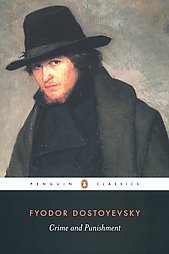
Crime and Punishment (pre-reform Russian: Преступленіе и наказаніе; post-reform Russian: Преступление и наказание, tr. Prestupléniye i nakazániye, IPA: [prʲɪstʊˈplʲenʲɪje ɪ nəkɐˈzanʲɪje]) is a novel by the Russian author Fyodor Dostoevsky. It was first published in the literary journal The Russian Messenger in twelve monthly installments during 1866. It was later published in a single volume. It is the second of Dostoevsky's full-length novels following his return from ten years of exile in Siberia. Crime and Punishment is considered the first great novel of his "mature" period of writing. The novel is often cited as one of the supreme achievements in literature.Crime and Punishment focuses on the mental anguish and moral dilemmas of Rodion Raskolnikov, an impoverished ex-student in Saint Petersburg who formulates a plan to kill an unscrupulous pawnbroker for her money. Before the killing, Raskolnikov believes that with the money he could liberate himself from poverty and go on …
Crime and Punishment (pre-reform Russian: Преступленіе и наказаніе; post-reform Russian: Преступление и наказание, tr. Prestupléniye i nakazániye, IPA: [prʲɪstʊˈplʲenʲɪje ɪ nəkɐˈzanʲɪje]) is a novel by the Russian author Fyodor Dostoevsky. It was first published in the literary journal The Russian Messenger in twelve monthly installments during 1866. It was later published in a single volume. It is the second of Dostoevsky's full-length novels following his return from ten years of exile in Siberia. Crime and Punishment is considered the first great novel of his "mature" period of writing. The novel is often cited as one of the supreme achievements in literature.Crime and Punishment focuses on the mental anguish and moral dilemmas of Rodion Raskolnikov, an impoverished ex-student in Saint Petersburg who formulates a plan to kill an unscrupulous pawnbroker for her money. Before the killing, Raskolnikov believes that with the money he could liberate himself from poverty and go on to perform great deeds. However, once it is done he finds himself racked with confusion, paranoia, and disgust for his actions. His justifications disintegrate completely as he struggles with guilt and horror and confronts the real-world consequences of his deed.
No need for a long review since IMO this book truly deserves its place as one of the greatest works of literature. A murder mystery which is not so much about the plot but meanders into themes of human nature, society, pride, poverty, vice and insanity. The characters are very interesting - delightfully, stereotypically Russian and yet relatable in a disturbing way - plagued with moral dilemmas, engaging in great philosophical dialogs and often overly melancholy.
Review of 'Dostoevsky Crime & Punishment' on 'Goodreads'
4 stars
Growing up in former Yugoslavia, I was exposed to Russian literature from the very early age. There's still some of the old awe remaining in me when I read the old Russian masters, like Dostoevsky. I don't think I'm qualified or brazen enough to review the "Crime and Punishment," but I can offer some impressions the book made on me.
Let me begin by mentioning the language. My first language is Serbo-Croatian: a language which is nowadays split at the hyphen into two separate languages. I never realized that hyphen stood for the ethnic line between the two groups of people, though I was forced to learn it when the line broke in the bloody conflict of the Balkans, and the language split, just as the country did, into two separate entities. But, I digress. The point is that both, Croatian and Serbian language, are of the Slavic origin, as …
Growing up in former Yugoslavia, I was exposed to Russian literature from the very early age. There's still some of the old awe remaining in me when I read the old Russian masters, like Dostoevsky. I don't think I'm qualified or brazen enough to review the "Crime and Punishment," but I can offer some impressions the book made on me.
Let me begin by mentioning the language. My first language is Serbo-Croatian: a language which is nowadays split at the hyphen into two separate languages. I never realized that hyphen stood for the ethnic line between the two groups of people, though I was forced to learn it when the line broke in the bloody conflict of the Balkans, and the language split, just as the country did, into two separate entities. But, I digress. The point is that both, Croatian and Serbian language, are of the Slavic origin, as is Russian. Therefore, the translations from Russian into Croatian are seamless and the flow is natural, unlike the awkward and rigid form English translation gave to the "Crime and Punishment." I recently read another Russian classic translated in English, Tolstoy's "Ana Karenina", which had the same inflexible awkwardness.
Once you get over the language, you're teleported into Russian Empire at it's eleventh hour, with it's social and ideological problems, you catch a glimpse of the seed of ideas which will evolve--or devolve--into Communism; you feel the heat of rainless St. Petersburg, the stench of poverty, the corruption of the higher middle class. You feel for the criminal, and although you can't justify his crime, you feel and cheer for him. And, at the end, you are rewarded with the gift of hope.