Review of 'The Immortal life of Henrietta Lacks' on 'Goodreads'
1 star
this book is apparently inaccurate
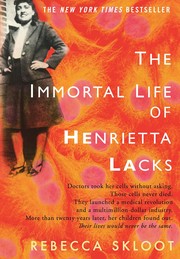
Hardcover, 369 pages
English language
Published Nov. 8, 2010 by Crown Publishers.
Her name was Henrietta Lacks, but scientists know her as HeLa. She was a poor black tobacco farmer whose cells—taken without her knowledge in 1951—became one of the most important tools in medicine, vital for developing the polio vaccine, cloning, gene mapping, in vitro fertilization, and more. Henrietta’s cells have been bought and sold by the billions, yet she remains virtually unknown, and her family can’t afford health insurance.
This New York Times bestseller takes readers on an extraordinary journey, from the “colored” ward of Johns Hopkins Hospital in the 1950s to stark white laboratories with freezers filled with HeLa cells, from Henrietta’s small, dying hometown of Clover, Virginia, to East Baltimore today, where her children and grandchildren live and struggle with the legacy of her cells. The Immortal Life of Henrietta Lacks tells a riveting story of the collision between ethics, race, and medicine; of scientific discovery and …
Her name was Henrietta Lacks, but scientists know her as HeLa. She was a poor black tobacco farmer whose cells—taken without her knowledge in 1951—became one of the most important tools in medicine, vital for developing the polio vaccine, cloning, gene mapping, in vitro fertilization, and more. Henrietta’s cells have been bought and sold by the billions, yet she remains virtually unknown, and her family can’t afford health insurance.
This New York Times bestseller takes readers on an extraordinary journey, from the “colored” ward of Johns Hopkins Hospital in the 1950s to stark white laboratories with freezers filled with HeLa cells, from Henrietta’s small, dying hometown of Clover, Virginia, to East Baltimore today, where her children and grandchildren live and struggle with the legacy of her cells. The Immortal Life of Henrietta Lacks tells a riveting story of the collision between ethics, race, and medicine; of scientific discovery and faith healing; and of a daughter consumed with questions about the mother she never knew. It’s a story inextricably connected to the dark history of experimentation on African Americans, the birth of bioethics, and the legal battles over whether we control the stuff we’re made of. ([source][1])
this book is apparently inaccurate
I picked up this book hoping it would tell me more about the HeLa cells and the background to them. It sort of does that, except it's really more a book about how the author gathered the information in the book - "I went here, met X, went somewhere else, met Y". As a result, it ends up feeling like the author has inserted herself into the story, and perhaps also got a bit too close to the participants.
For me, this is one of those books which isn't that fulfilling on its own, but a good jumping off point by following up the references etc.
I picked up this book hoping it would tell me more about the HeLa cells and the background to them. It sort of does that, except it's really more a book about how the author gathered the information in the book - "I went here, met X, went somewhere else, met Y". As a result, it ends up feeling like the author has inserted herself into the story, and perhaps also got a bit too close to the participants.
For me, this is one of those books which isn't that fulfilling on its own, but a good jumping off point by following up the references etc.
very, very well written. the transition between science and personal life of not only henrietta but her family members as well was very smooth. the only thing was i kinda got whiplash from the afterword because it went straight into super technical stuff. i guess it is only an afterword though. very good book, and i recommend it to everybody, but especially people who are involved in molecular biology.
This is an incredible book. One of the best biographies I've ever read. Enormous amount of research and great writing brings to life the amazing story of Henrietta Lacks and her cells.
This is an incredible book. One of the best biographies I've ever read. Enormous amount of research and great writing brings to life the amazing story of Henrietta Lacks and her cells.
Anyone who is interested in medical history or medicine has probably heard of the immortal HeLa cells.
Now here is your chance to find out the real story behind the woman who “donated” her cells.
For those of you who know what happened, you know that Henrietta didn’t donate her cells. She wasn’t even asked. The cells were just taken because that’s what was done to poor black patients back in the segregated days.
While I knew the basic story (and her real name), I wasn’t as familiar with her as person, the exact circumstances of her disease and the cells named after her. This was the author’s obsession: to find out as much as she could about Henrietta and the circumstances of her cells.
While this was a very well written book, I didn’t enjoy it as much as other medical history books, but I would put it on …
Anyone who is interested in medical history or medicine has probably heard of the immortal HeLa cells.
Now here is your chance to find out the real story behind the woman who “donated” her cells.
For those of you who know what happened, you know that Henrietta didn’t donate her cells. She wasn’t even asked. The cells were just taken because that’s what was done to poor black patients back in the segregated days.
While I knew the basic story (and her real name), I wasn’t as familiar with her as person, the exact circumstances of her disease and the cells named after her. This was the author’s obsession: to find out as much as she could about Henrietta and the circumstances of her cells.
While this was a very well written book, I didn’t enjoy it as much as other medical history books, but I would put it on my top ten must read medical history books.
Recommended with a 4.0 out of five.