Wow. Never before did I read radical literature that's so modestly phrased. As Skidelsky & Skidelsky seek out what makes for 'the good life', they trace the evolution of economic thought, and show how ethical considerations in ancient times morphed into a framework that is superficially scientific, but rich in 'moral fragments' nonetheless. Economic newspeak turned avarice into self-interest, happiness into utility and virtue into purposiveness, and thereby muddled all discussion on the good society.
How Much is Enough? shines when tracing the origins and evolution of ideas, but is only worthwhile for those who get excited about such things. Structurally, the authors drop the ball on several occasions -- it's not always clear why they take a sudden, detailed detour into Aristotelian thought, for example. Content-wise, they are too dismissive of the accusation that their view of the good society is 'dictatorial' or at least paternalistic. State power takes …
User Profile

Alterego of this guy on Mastodon.
This link opens in a pop-up window
Vincent Tijms's books
User Activity
RSS feed Back
Vincent Tijms rated We Are All Completely Fine: 2 stars
We Are All Completely Fine by Daryl Gregory
Harrison is the Monster Detective, a storybook hero. Now he’s in his mid-thirties and spends most of his time not …
Vincent Tijms rated Flight Behavior: 5 stars

Flight Behavior by Barbara Kingsolver
Set in the present day in the rural community of Feathertown, Tennessee, Flight Behavior tells the story of Dellarobia Turnbow, …
Delusions of Gender : How Our Minds, Society, and Neurosexism Create Difference by Cordelia Fine
How bogus sex- and gender-related concepts get propagated along the road from social-science labs to popular perception.
Review of 'How Much is Enough?: Money and the Good Life' on 'Goodreads'
5 stars
Wow. Never before did I read radical literature that's so modestly phrased. As Skidelsky & Skidelsky seek out what makes for 'the good life', they trace the evolution of economic thought, and show how ethical considerations in ancient times morphed into a framework that is superficially scientific, but rich in 'moral fragments' nonetheless. Economic newspeak turned avarice into self-interest, happiness into utility and virtue into purposiveness, and thereby muddled all discussion on the good society.
How Much is Enough? shines when tracing the origins and evolution of ideas, but is only worthwhile for those who get excited about such things. Structurally, the authors drop the ball on several occasions -- it's not always clear why they take a sudden, detailed detour into Aristotelian thought, for example. Content-wise, they are too dismissive of the accusation that their view of the good society is 'dictatorial' or at least paternalistic. State power takes a central role in their proposals for creating a just society, without any consideration on the possible, and historically recurring corruption of the State. Also, one might argue that a strong appeal to move towards pre-Smithean values would also lead to more imaginative proposals than basic income, progressive taxation and stronger regulation of advertising.
That being said, if you're interested in a persuasive, historically enlightening account of how and why there is more to economics than GDP, there's no book I could recommend more strongly.
Vincent Tijms reviewed Mogelijke memoires by Brusselmans Herman

"Mogelijke memoires' is een woeste trip, een vorte puinhoop, een opeenstapeling van zo veel woorden …
Review of 'Mogelijke memoires' on 'Goodreads'
2 stars
Zelden zat een beroerde roman zo goed in elkaar, of andersom.
Vincent Tijms reviewed The Democracy Project by David Graeber

A bold rethinking of the most powerful political idea in the world--democracy--and the story of …
Review of 'The Democracy Project' on 'Goodreads'
4 stars
While the arguments aren't presented as coherently as they should have been, Graeber makes some excellent points about the shape that contemporary politics is taking, as well as about the rich history from which democratic movements can draw their inspiration. Democracy, argues Graeber, is not a singular concept that was at one point invented -- or even rediscovered -- by French, British and American intellectuals. Instead, peoples across both world and time have experimented with collective decision-making by consensus and have found many different ways to do so. According to Graeber, the so-called democratic revolution mostly consisted of selecting those ways that were compatible with existing power structures, while disposing of those that challenged established hierarchies. To do so, both the New World and Old World projects were molded into a Roman, essentially aristocratic form. In fact, Graeber shows, up until the 1800s, admitting to being a 'democrat' was tantamount …
While the arguments aren't presented as coherently as they should have been, Graeber makes some excellent points about the shape that contemporary politics is taking, as well as about the rich history from which democratic movements can draw their inspiration. Democracy, argues Graeber, is not a singular concept that was at one point invented -- or even rediscovered -- by French, British and American intellectuals. Instead, peoples across both world and time have experimented with collective decision-making by consensus and have found many different ways to do so. According to Graeber, the so-called democratic revolution mostly consisted of selecting those ways that were compatible with existing power structures, while disposing of those that challenged established hierarchies. To do so, both the New World and Old World projects were molded into a Roman, essentially aristocratic form. In fact, Graeber shows, up until the 1800s, admitting to being a 'democrat' was tantamount to claiming to be a radical crackpot -- the democratic project was considered to be an aristocratic enterprise by its own architects.
This admittedly revisionist account is one that fits well with [a:Bakunin|5447290|Bakunin|https://s.gr-assets.com/assets/nophoto/user/u_50x66-a7c55399ea455530473b9f9e4da94c40.png]'s view of social structure being built around a managerial class or, in the words of [a:Michael Albert|112947|Michael Albert|https://d.gr-assets.com/authors/1346936675p2/112947.jpg], the coordinators. Graeber fully subscribes to this view and argues that our current political dynamics is, at least at its fringes, dominated by resistance against different kinds of coordinators. While left-wingers (e.g. Occupy) take aim at CEOs, hedge funds and other capitalists who constrain the lives of others, Graeber believes right-wingers (e.g. the Tea Party) take aim at technocrats, media personalities and academics for similar reasons.
Both the historical account and the analyses of current events are argued for convincingly. Graeber seems to share my personal belief that the direction of current politics is not immediately towards liberty, nor towards equality or brotherhood, but towards the autonomy that is a necessary condition for the former triad to flourish. As this is basically an anti-ideological stance, he isn't able to formulate what a free society looks like, or how it should be run.
But he tries anyway.
And that is where the greatest weakness of the book lies. It's impossible to be specific about tomorrow's society and Graber realizes this, so his view of the future is clouded with abstractions and slogans. He is right not to draw a blueprint, but should have also refrained from sketching a vague outline in flowery prose that even Barack Obama would find insubstantial.
Yet, even despite these and other misgivings, The Democracy Project is an inspiring read for anyone who is willing to entertain the possiblity of genuine democracy in a free, horizontalist society.
Vincent Tijms reviewed Second Machine Age by Erik Brynjolfsson

Erik Brynjolfsson, Andrew Mcafee: Second Machine Age (2014, Norton & Company, Incorporated, W. W.)
A revolution is under way. In recent years, Google's autonomous cars have logged thousands of …
Review of 'Second Machine Age' on 'Goodreads'
3 stars
I guess this book is interesting if you've never given our changing economy much thought or if you haven't been paying attention to technological progress since the eighties. If you have been, this book offers very little.
I guess this book is interesting if you've never given our changing economy much thought or if you haven't been paying attention to technological progress since the eighties. If you have been, this book offers very little.
Vincent Tijms reviewed Submergence by J. M. Ledgard

Review of 'Submergence' on 'Goodreads'
5 stars
An excellent novel that crosses the border with poetry, but never strays too far. While the frequent zapping across time, space and perspective is reminiscent of much contemporary fiction, Ledgard's writing stands out among a generation of writers who hurry to move their plots forward. Clever use of motifs encourage the reader to seek out parallels among the different storylines, but the parallels remain elusive, ambiguous beginnings of thoughts. As a consequence, reading Submergence is as demanding as it is rewarding. Despite some minor issues -- Ledgard is a journalist, and it shows on those few occasions when the prose turns encyclopedic -- this book promises to be as timeless as it is timely.
An excellent novel that crosses the border with poetry, but never strays too far. While the frequent zapping across time, space and perspective is reminiscent of much contemporary fiction, Ledgard's writing stands out among a generation of writers who hurry to move their plots forward. Clever use of motifs encourage the reader to seek out parallels among the different storylines, but the parallels remain elusive, ambiguous beginnings of thoughts. As a consequence, reading Submergence is as demanding as it is rewarding. Despite some minor issues -- Ledgard is a journalist, and it shows on those few occasions when the prose turns encyclopedic -- this book promises to be as timeless as it is timely.
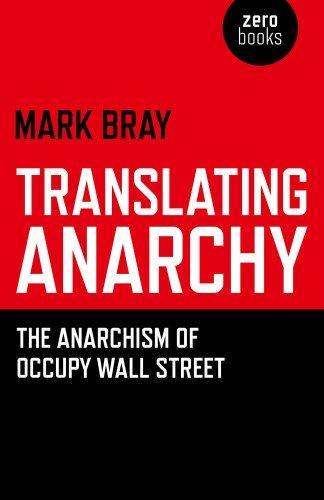
Review of 'Translating Anarchy: The Anarchism of Occupy Wall Street' on 'Goodreads'
3 stars
While this book offers interesting tidbits about anarchist history and the daily affairs of Occupy Wall Street, it tries too many different things at the same time to succeed. It tries to be a sociological exploration of OWS, but reduces all interviews to soundbites that illustrate the writer's thoughts. It tries to review the history and varying forms of anarchism, but leaves enormous gaps and dismisses the types of anarchism that Bray isn't comfortable with. It proposes that anarchism can offer an inclusive, pragmatic and liberating framework for the left, but at the same time it deals bitter jabs to liberals, communists and other leftists, whom Bray ultimately wants to have aboard.
This all detracts from the book's coherency and, more importantly, from its ultimate message. In the final segment of the book, Bray addresses the build-up of parallel institutions that should be attractive to a broad segment of society …
While this book offers interesting tidbits about anarchist history and the daily affairs of Occupy Wall Street, it tries too many different things at the same time to succeed. It tries to be a sociological exploration of OWS, but reduces all interviews to soundbites that illustrate the writer's thoughts. It tries to review the history and varying forms of anarchism, but leaves enormous gaps and dismisses the types of anarchism that Bray isn't comfortable with. It proposes that anarchism can offer an inclusive, pragmatic and liberating framework for the left, but at the same time it deals bitter jabs to liberals, communists and other leftists, whom Bray ultimately wants to have aboard.
This all detracts from the book's coherency and, more importantly, from its ultimate message. In the final segment of the book, Bray addresses the build-up of parallel institutions that should be attractive to a broad segment of society while staying true to anarchist praxis. He talks about the tension between alternative culture, revolutionary change and mass appeal. If Bray's goal was to address the translation of anarchist thought into practice and into society, these are the topics he should have elaborated on.
Vincent Tijms reviewed Afterparty by Daryl Gregory
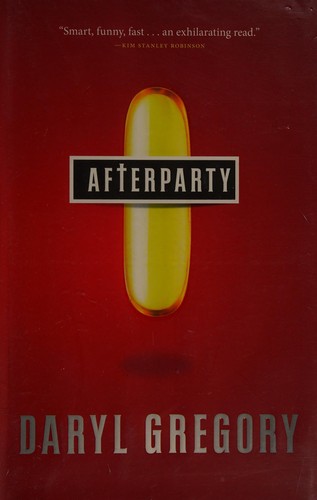
Following the suicide of a seventeen-year-old Toronto street girl who used a new brain-altering drug …
Review of 'Afterparty' on 'Goodreads'
4 stars
Very realistic depiction of an addicted neuroscientist who hallucinates an angelic mentor-deity while battling Afghan hairdresser-druglords and a theologically crazed pharmacologist. Science fiction at its finest.
Vincent Tijms reviewed Fox 8 by George Saunders
George Saunders: Fox 8 (2013)
Review of 'Fox 8' on 'Goodreads'
5 stars
The fox is right. From now on I will be nice to all animals.
Vincent Tijms reviewed Tenth of December by George Saunders
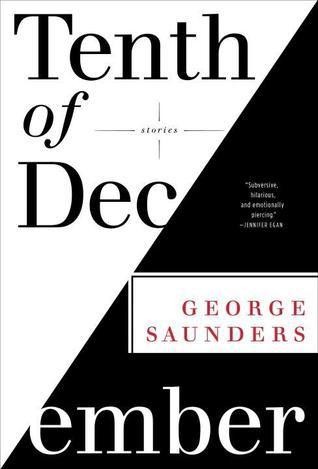
One of the most important and blazingly original writers of his generation, George Saunders is …
Review of 'Tenth of December' on 'Goodreads'
5 stars
Saunders lives up to hype. You can check out that hype if you want to know more about my rating.

A highly unlikely scenario, or a Neetsa Pizza employee's guide to saving the world by Rachel Cantor
In the not-too-distant future, the world is ruled not by governments but by fast-food delivery companies. Only one disgruntled employee …