
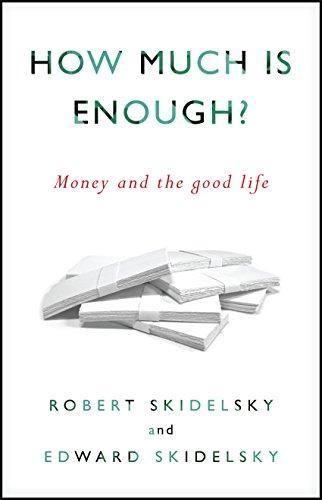
Review of 'How Much is Enough?: Money and the Good Life' on 'Goodreads'
5 stars
Wow. Never before did I read radical literature that's so modestly phrased. As Skidelsky & Skidelsky seek out what makes for 'the good life', they trace the evolution of economic thought, and show how ethical considerations in ancient times morphed into a framework that is superficially scientific, but rich in 'moral fragments' nonetheless. Economic newspeak turned avarice into self-interest, happiness into utility and virtue into purposiveness, and thereby muddled all discussion on the good society.
How Much is Enough? shines when tracing the origins and evolution of ideas, but is only worthwhile for those who get excited about such things. Structurally, the authors drop the ball on several occasions -- it's not always clear why they take a sudden, detailed detour into Aristotelian thought, for example. Content-wise, they are too dismissive of the accusation that their view of the good society is 'dictatorial' or at least paternalistic. State power takes a central role in their proposals for creating a just society, without any consideration on the possible, and historically recurring corruption of the State. Also, one might argue that a strong appeal to move towards pre-Smithean values would also lead to more imaginative proposals than basic income, progressive taxation and stronger regulation of advertising.
That being said, if you're interested in a persuasive, historically enlightening account of how and why there is more to economics than GDP, there's no book I could recommend more strongly.