mocoma reviewed The Three-Body Problem by Cixin Liu (Three-Body Trilogy, #1)
Review of 'The Three-Body Problem' on 'Goodreads'
4 stars
The start is kind of boring, but from page 100 onwards the book grabs you and wont let you escape.Really good
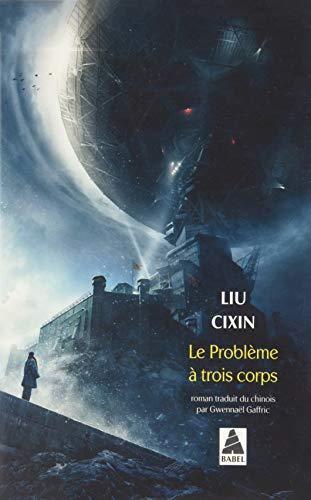
Paperback, 508 pages
French language
Published Dec. 18, 2018 by Actes Sud.
The Three-Body Problem (Chinese: 三体; lit. 'Three-Body'; pinyin: sān tǐ) is a science fiction novel by the Chinese writer Liu Cixin. The title refers to the three-body problem in orbital mechanics. It is the first novel of the Remembrance of Earth's Past (Chinese: 地球往事) trilogy, but the whole series is normally referred to as The Three-Body Problem. The trilogy's second and third novels are The Dark Forest and Death's End. The Three-Body Problem was serialized in Science Fiction World in 2006 and published as a book in 2008. It became one of the most popular science fiction novels in China. It received the Chinese Science Fiction Yinhe ("Galaxy") Award in 2006. A Chinese film adaptation of the same name was in production by 2015, but halted soon after. The English translation by Ken Liu was published by Tor Books in 2014. Thereafter, it became the first Asian novel ever to …
The Three-Body Problem (Chinese: 三体; lit. 'Three-Body'; pinyin: sān tǐ) is a science fiction novel by the Chinese writer Liu Cixin. The title refers to the three-body problem in orbital mechanics. It is the first novel of the Remembrance of Earth's Past (Chinese: 地球往事) trilogy, but the whole series is normally referred to as The Three-Body Problem. The trilogy's second and third novels are The Dark Forest and Death's End. The Three-Body Problem was serialized in Science Fiction World in 2006 and published as a book in 2008. It became one of the most popular science fiction novels in China. It received the Chinese Science Fiction Yinhe ("Galaxy") Award in 2006. A Chinese film adaptation of the same name was in production by 2015, but halted soon after. The English translation by Ken Liu was published by Tor Books in 2014. Thereafter, it became the first Asian novel ever to win a Hugo Award for Best Novel, and was nominated for the Nebula Award for Best Novel.The series portrays a future where, in the first book, the Earth is awaiting an invasion from the closest star system, which in this universe consists of three solar-type stars orbiting each other in an unstable three-body system, with a single Earth-like planet unhappily being passed among them and suffering extremes of heat and cold, as well as the repeated destruction of its intelligent civilizations.
The start is kind of boring, but from page 100 onwards the book grabs you and wont let you escape.Really good
I was surprised to read a Chinese sci-fi novel, but it's an interesting perspective on it. At first I thought this is going to be all about China, being for or against the CCP regime and a bit of sci-fi sprinkled on it, but it was the opposite!
The parts that were leaning on it being in China were great, it's a different view on how to write sci-fi, which is usually VERY centered on the US. I hope for more non-US authors in the sci-fi world, there's a lot to explore here.
The ending surprised me, because I read through it much faster than I thought. This should be a good thing, but I only noticed how far in I was, because I couldn't believe that this is how it's gonna end. It was a bit disappointing, but it's a trilogy, so and it felt very much …
I was surprised to read a Chinese sci-fi novel, but it's an interesting perspective on it. At first I thought this is going to be all about China, being for or against the CCP regime and a bit of sci-fi sprinkled on it, but it was the opposite!
The parts that were leaning on it being in China were great, it's a different view on how to write sci-fi, which is usually VERY centered on the US. I hope for more non-US authors in the sci-fi world, there's a lot to explore here.
The ending surprised me, because I read through it much faster than I thought. This should be a good thing, but I only noticed how far in I was, because I couldn't believe that this is how it's gonna end. It was a bit disappointing, but it's a trilogy, so and it felt very much written in such a way to build upon.
I'm not sure if I will read the rest, but I'd say it's okay. I'm not sure why people are into this story so much, it read a bit wooden at times, but that could be owing to it being a translation. Maybe people are just eager to read something non-US, which I totally get.
Intéressant début dans cette trilogie.
La préface de l'éditeur français divulgache violemment une bonne partie du bouquin, mais je connaissais déjà le thème du livre.
Le rythme est saccadé. L'exposition avec retour dans le passé un peu forcé. La fin un peu trop rapide.
On verra ce que donne la suite.
Intéressant début dans cette trilogie.
La préface de l'éditeur français divulgache violemment une bonne partie du bouquin, mais je connaissais déjà le thème du livre.
Le rythme est saccadé. L'exposition avec retour dans le passé un peu forcé. La fin un peu trop rapide.
On verra ce que donne la suite.
writing — 2/5, idea — 4/5. in the end i did enjoy listening to "the three-body problem".
writing — 2/5, idea — 4/5. in the end i did enjoy listening to "the three-body problem".
Ca n'est pas tous les jours que je suis à ce point éloigné de l'opinion consensuelle.
Donc, ce roman raconte une histoire assez confuse mettant en scène des scientifiques chinois, un jeu en réalité virtuel, le problème à trois corps qui donne son titre au roman et d'autres éléments.
Encore aujourd'hui, je ne comprend pas la mode qui encense ce roman.
En effet, je trouve que l'histoire s'y déploie avec une mollesse terrible : après cent premières pages d'exposition d'un personnage de femme scientifique malmenée par la révolution culturelle, on enchaîne avec un physicien qui se retrouve mêlé à une opération confidentielle, pour sauter à de sombres histoires de jeu ouvrant la porte à une société secrète, le tout pour conclure par des extra-terrestres "beaucoup trop forts". Franchement, la plupart des éléments m'ont paru mous.
Et ce ne sont pas les personnages en carton pâte qui ont aidé. Je n'ai …
Ca n'est pas tous les jours que je suis à ce point éloigné de l'opinion consensuelle.
Donc, ce roman raconte une histoire assez confuse mettant en scène des scientifiques chinois, un jeu en réalité virtuel, le problème à trois corps qui donne son titre au roman et d'autres éléments.
Encore aujourd'hui, je ne comprend pas la mode qui encense ce roman.
En effet, je trouve que l'histoire s'y déploie avec une mollesse terrible : après cent premières pages d'exposition d'un personnage de femme scientifique malmenée par la révolution culturelle, on enchaîne avec un physicien qui se retrouve mêlé à une opération confidentielle, pour sauter à de sombres histoires de jeu ouvrant la porte à une société secrète, le tout pour conclure par des extra-terrestres "beaucoup trop forts". Franchement, la plupart des éléments m'ont paru mous.
Et ce ne sont pas les personnages en carton pâte qui ont aidé. Je n'ai réussi à m'identifier à aucun d'eux, et la litanie de noms n'a pas aidé. La particularité, c'est que tous ces personnages sont d'un pessimisme incroyable. J'ai même cru qu'il s’agissait d'un roman français tellement ils étaient négatifs.
Avant de terminer, je voudrais juste rappeler un point : le coup des extra-terrestres super méchants, c'est un poncif de la SF.
Autrement dit, je n'ai pas aimé. Du tout.
Cixin Liu is a different voice in sci-fi - for someone brought up on western stories, Liu's story structure and background are odd, which makes it very refreshing to read. I had one minor problem with believability in the book, but otherwise I'm looking forward to reading the English translation of the next two books.
The tale is a sweeping one, filled with good sci-fi ideas and nothing less than the fate of humanity at stake. Like John Wright's Count to the Eschaton series, the fate of humanity rests in the hands of a few who know what's going on. Unlike anything else I've read, this book faces that challenge with the background of the Chinese Cultural Revolution driving the protagonists actions, and - here's where the refreshing part comes in - coloring the thoughts of alien minds as well.
If you've ever read the Night Watch books by Lukyanenko, …
Cixin Liu is a different voice in sci-fi - for someone brought up on western stories, Liu's story structure and background are odd, which makes it very refreshing to read. I had one minor problem with believability in the book, but otherwise I'm looking forward to reading the English translation of the next two books.
The tale is a sweeping one, filled with good sci-fi ideas and nothing less than the fate of humanity at stake. Like John Wright's Count to the Eschaton series, the fate of humanity rests in the hands of a few who know what's going on. Unlike anything else I've read, this book faces that challenge with the background of the Chinese Cultural Revolution driving the protagonists actions, and - here's where the refreshing part comes in - coloring the thoughts of alien minds as well.
If you've ever read the Night Watch books by Lukyanenko, or anything by Stanislaw Lem, after having been brought up on a steady diet of Asimov, Herbert, Clarke, and Niven, you'll understand the subtle and refreshing shift of perspective Liu's background brings. Really looking forward to the last book being translated, so I can take the rest of the series in at one go.
I enjoyed this read, from the outlook of Chinese culture to the scope of the story, it is enjoyable. The only portions that were slow and troublesome were at the end when the book focused on the Trisolarans and their activities...what benefit of explaining scientific failures of the 1st and 3rd dimension was there to the story? But the scientists, the game, and Da Shi might be one of my favorite characters I've read this year.
It was well thought out and very much enjoyable. Liu has the rest of the story complete, I hope the new translator did as good of a job as this one. It was very hard to know it was a foreign language book originally.
I enjoyed this read, from the outlook of Chinese culture to the scope of the story, it is enjoyable. The only portions that were slow and troublesome were at the end when the book focused on the Trisolarans and their activities...what benefit of explaining scientific failures of the 1st and 3rd dimension was there to the story? But the scientists, the game, and Da Shi might be one of my favorite characters I've read this year.
It was well thought out and very much enjoyable. Liu has the rest of the story complete, I hope the new translator did as good of a job as this one. It was very hard to know it was a foreign language book originally.