joelchrono commented on Abaddon's Gate by James S.A. Corey (The Expanse, #3)
For generations, the solar system — Mars, the Moon, the Asteroid Belt — was humanity's …
Not bad, not bad at all. Now at chapter 45!

I like reading Sci-fi, Mystery and stuff like that, still have to sink my teeth into the Fantasy genre but I would probably like it too. I also like Manga, but I use Anilist for that, until support for it improves here...
You can find me on mastodon at fosstodon.org/@joel
This link opens in a pop-up window
For generations, the solar system — Mars, the Moon, the Asteroid Belt — was humanity's …
Not bad, not bad at all. Now at chapter 45!
For generations, the solar system — Mars, the Moon, the Asteroid Belt — was humanity's …
Finished up to chapter 37, I didn't quite like this last chapter but I'm still reading
Finished up to chapter 37, I didn't quite like this last chapter but I'm still reading
For generations, the solar system — Mars, the Moon, the Asteroid Belt — was humanity's …
I went on a trip and had a chance to read a bunch of this book! More than halfway through now :P
Belgian detective Hercule Poirot is summoned to France after receiving a distressing letter with a …
chapter 5 is done
For generations, the solar system — Mars, the Moon, the Asteroid Belt — was humanity's …
Read the prologue and chapter 1. Already off to a good start!
For generations, the solar system — Mars, the Moon, the Asteroid Belt — was humanity's …
Continuing with the series once again
On board an obsolete ship, nine weeks out from home, the latest batch of colonists …
This one was pretty interesting, it is about a group of people—a total 24 convicts—that are sent on a one way trip to Mars. These people are usually criminals, undesirable for modern society, sentenced to live in the red planet for the rest of their lives, some were thieves, others caused sedition, others commited murder. They don’t know each other, and they don’t really like each other.
I found the writing and the setting to be very interesting, the novel is very much character driven, told from the perspective of multiple characters, who were sent for different reasons, and face different challenges and facets of life there. We follow a black man sorrounded by white people, a school teacher sentenced because she was teaching kids to think by themselves, a racist troublemaker who committed murder, and some other characters in the ship and on Mars.
Basically, it’s the …
This one was pretty interesting, it is about a group of people—a total 24 convicts—that are sent on a one way trip to Mars. These people are usually criminals, undesirable for modern society, sentenced to live in the red planet for the rest of their lives, some were thieves, others caused sedition, others commited murder. They don’t know each other, and they don’t really like each other.
I found the writing and the setting to be very interesting, the novel is very much character driven, told from the perspective of multiple characters, who were sent for different reasons, and face different challenges and facets of life there. We follow a black man sorrounded by white people, a school teacher sentenced because she was teaching kids to think by themselves, a racist troublemaker who committed murder, and some other characters in the ship and on Mars.
Basically, it’s the worst exhile possible. The sandstorms and the cold of night are bad enough by themselves, but of course, the society that has been formed in the Settlement is quite bleak and strict, but hey, at least it “works.”
Every person has to serve a purpose, the ships are turned into houses, everything they bring has a use, paper is a valuable resource. People who don’t abide by the rules are punished, either with hunger, or execution by the cold way out—being left outside at night. Such punishments are viewed as acceptable and even required given the situation everyone is in, nothing can be wasted.
As many books of the time, some of the language can be considered dated, in the way that it would not be used if it were written today. Despite this, misogyny and racism is shown in despicable characters and in ways where its use makes sense within the context of the story, it is a bitter thought to see how many authors in the 60s could not imagine a future where racism ceased to exist, but alas, after a quarter of a century of a new millenium, here we are, so, despite it all, it does work.
It is a bleak existence. I found the philosophical and thought provoking moments in the book to be quite insightful, comparison to society that still hold up today. Humanity’s struggle for survival, to fit among the rest and keep going by whatever means are necessary. Religion prevails in such an environment and among such people, oh right, and of course homosexuality is not allowed.
This crude reality, the flawed characters, and the prose were things I found rather gripping. Even if I didn’t enjoy some of the themes, I felt they were worth exploring, this takes a deep dive into so many topics, and features so many characters that feel real and somewhat understandable, I somehow read it in 3 days. I almost feel like I should re-read it. The ending was quite something as well, I really didn’t see it coming.
This is not a fun adventure story, there is no optimism to be found, stay away if you want to escape from reality, they don’t even plant potatoes. Still, if you are up for it, I think it’s worth a read.
By the way, I actually bought this book from the Kobo store but it had quite a bit of typos, some of the other sources out there are even worse though, I kind of want to find a physical copy of this one, it was a great read.
We are not alone.
On Ganymede, breadbasket of the outer planets, a Martian marine …
I don’t really think this will be a long review, this book is part of The Expanse series and by itself, it’s probably not as thought provoking or insightful as some of the other books I’ve read.
This is straight up awesome world building, characters, great action and cool science fiction, further developing the universe that I got introduced to since the first book Leviathan Wakes.
In this book we get introduced to three new characters that get involved in a plot where the events of the previous book have basically turned reality on its head, and Humanity is trying to make sense of things it still can’t comprehend.
We have Bobbie, essentially a Spartan from the Halo universe who goes through some rough stuff, Prax, a botanist whose daughter gets kidnapped for mysterious reasons, and Avasarala, a politician who is trying to keep the delicate balance …
I don’t really think this will be a long review, this book is part of The Expanse series and by itself, it’s probably not as thought provoking or insightful as some of the other books I’ve read.
This is straight up awesome world building, characters, great action and cool science fiction, further developing the universe that I got introduced to since the first book Leviathan Wakes.
In this book we get introduced to three new characters that get involved in a plot where the events of the previous book have basically turned reality on its head, and Humanity is trying to make sense of things it still can’t comprehend.
We have Bobbie, essentially a Spartan from the Halo universe who goes through some rough stuff, Prax, a botanist whose daughter gets kidnapped for mysterious reasons, and Avasarala, a politician who is trying to keep the delicate balance of relative peace between the different factions of Humanity. And of course, the original cast, which remains as awesome as ever.
I won’t say much more of the plot, which is great, develops characters and relationships further and kept me and my book club turning pages for a while.
Each character gets a moment to shine, in fact, like the first book where we have two concurrent plots from the point of view of two characters, here we do the same, but with four! And despite how confusing that may seem, it just works, and keeping the thread of the general plot is not difficult, at least not for me.
Basically, if you liked the first book, the second one is just as good.
I don’t think of this as ground-breaking, philosophical, thought-provoking stuff, even though as a whole it kind of is. What I mean to say is that this is much more action heavy, with cool moments, great sciencey stuff, tremendous world building, and fun characters, it is a journey I want to follow for as long as it keeps my interest, and so far it has managed to achieve with absolute success. It really is like watching the best action blockbuster ever in book form, and I am loving it.
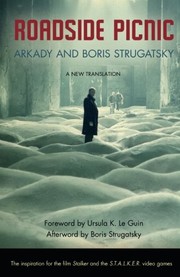
Roadside Picnic is set in the aftermath of an extraterrestrial event called the Visitation that …
Roadside Picnic is one of the most unique books of science fiction I have read. A first contact story where we don’t get whats going on, things happen too quickly, and the aliens leave without further to do, and the world keeps spinning.
The only trace of their Visit is some areas known as The Zones, where strange phenomena and dangerous traps can ben found at every corner, as well as strange objects and alien technology beyond human understanding, that lies there for whoever is willing to take it.
Those who venture inside the Zone to scavenge those goods are known as stalkers. The artifacts they find they then sell to whoever is willing to pay, making it a lucrative, if dangerous job. Of course, the government is trying to investigate and find a use for those objects as well, so being a stalker is very much illegal.
…Roadside Picnic is one of the most unique books of science fiction I have read. A first contact story where we don’t get whats going on, things happen too quickly, and the aliens leave without further to do, and the world keeps spinning.
The only trace of their Visit is some areas known as The Zones, where strange phenomena and dangerous traps can ben found at every corner, as well as strange objects and alien technology beyond human understanding, that lies there for whoever is willing to take it.
Those who venture inside the Zone to scavenge those goods are known as stalkers. The artifacts they find they then sell to whoever is willing to pay, making it a lucrative, if dangerous job. Of course, the government is trying to investigate and find a use for those objects as well, so being a stalker is very much illegal.
In this story we follow Red, a stalker who is trying to have a normal life, but he finds himself returning to the Zone time after time. He is just a random guy who is pretty good at his job, and every time he keeps telling himself it will be the last.
Most of the characters are pretty much regular people trying to adapt to this new world, there’s barely any geniuses or amazing discoveries done thanks to the new alien technology, and if there is, it’s clear it’s being used for very simple purposes, like using a rocket engine to start a fire.
At the time, and still today, science fiction is seen from the lenses of formidable heroes, brilliant scientists and engineers. In this book, most people are normal humans, and talk like a normal human (althought I think some of it is lost in translation), and most of the physics and technology in the novel has nicknames and slang that is not really scientific, simply based on what an artifact does or looks like, such as empties, bugtraps and shriekers.
What I liked the most about this story is its exploration on how humans would react to this, as a whole. Nobody is trying to contact the aliens or to figure everything out, we don’t even get to know how they looked, or find any kind of message. The principles behind the Zones are a complete mystery to humankind. The technology is far too advanced, and the dangers are far too high for any efforts to bring any significant results.
The implications of it all are big, the insight of some of the characters about our place in the universe. One of my favorite bits was a conversation that shares lots of thoughts and ideas about the reason for the visit, how it affects society as a whole, and despite it all, Humanity keeps moving forward and adapts to this new reality as the status quo.
A fantastic read that only takes a few hours to read and really brings a very interesting outlook to life and our place in this universe. I highly recommend this one!
Roadside Picnic is set in the aftermath of an extraterrestrial event called the Visitation that …
It is done, just got home to mark this as done, awesome book!
Roadside Picnic is set in the aftermath of an extraterrestrial event called the Visitation that …
Finished chapter 3, these are long but somehow fly by super quick, that was a very interesting one
Roadside Picnic is set in the aftermath of an extraterrestrial event called the Visitation that …
And there go two chapters done, might do another one before the day ends?
Roadside Picnic is set in the aftermath of an extraterrestrial event called the Visitation that …
I started this while on the road! But not having a picnic
Roadside Picnic is set in the aftermath of an extraterrestrial event called the Visitation that …
Your fault @jp@bookrastinating.com
On board an obsolete ship, nine weeks out from home, the latest batch of colonists …
Finished, that was a good book, quite the uncomfortable read, human nature in an alien planet. I have some thoughts to share on my review for it soon enough, but I haven't reviewed Caliban's War yet so, wait a little more.
Finished, that was a good book, quite the uncomfortable read, human nature in an alien planet. I have some thoughts to share on my review for it soon enough, but I haven't reviewed Caliban's War yet so, wait a little more.