
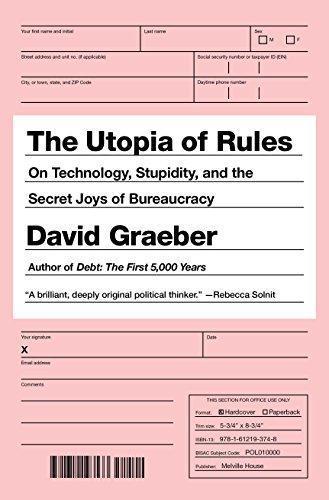
Review of 'The Utopia of Rules: On Technology, Stupidity, and the Secret Joys of Bureaucracy' on 'Goodreads'
2 stars
Sometime in 2000 I came across an ad in the newspaper telling of a panel that will take place in a club in Tel-Aviv on the topic of "can there be revolution in Israel?". Naive, young, libertarian me understood this to be a debate on whether Israel is in danger of a revolution. I was wrong. It was a panel of anarchists bemoaning the fact that revolution will never occur in Israel for various nonsensical reasons.
Many years have passed since. I drifted left and now consider myself a social-democrat, and I've enjoyed my fair share of arguments with naive, young libertarians. And yet, reading Graeber's "The Utopia of Rules" brought me back to that sensation from over 15 years ago. The reason was that I simply did not expect to fall head first into a rant about the capitalist, democratic (he doesn't call it that, of course) world.
And let's be clear: a rant is exactly what this book is. While his previous excellent [b:Debt: The First 5,000 Years|6617037|Debt The First 5,000 Years|David Graeber|https://d.gr-assets.com/books/1390408633s/6617037.jpg|6811142] was replete with evidence, this book feels more like idiosyncratic musings. No argument goes beyond anecdotal evidence, and interpretations that may be plausible but are certainly not conclusive suddenly become undisputed facts. Every once in a while there's an interesting insight. The idea of "interpretive labour", for example, is a useful tool to consider social relations. Some of the ideas about games vs. play are interesting, if not completely original, and unfortunately aren't taken in any interesting direction because the whole discussion is a bit of a digression. But they never become anything bigger than that. And for every somewhat interesting insight there is another that appears completely asinine. The entire argument that the reason the predictions of sci-fi from the 1950's have not come true is because the Powers-That-Be didn't want them to (rather than that they are impossible) is one such glaring example. (But Jules Verne's predictions came true! Graeber whines, as if contemporary authors such as H.G. Wells have not produced predictions that never came close to being realized -- primarily because that has never been an interest of most sci-fi literature).
Maybe it's my fault. I thought the use of the word "stupidity" in the title was merely an attempt to grab attention by being cheeky. But Graeber actually uses "stupidity" as a theoretical category, albeit one that is never really defined. We're just supposed to agree that bureaucracy is stupid because Graeber once accidentally signed where he was supposed to print his name and vice versa.
But it was the stellar Debt that got me to read Graeber's new book, and here is why The Utopia of Rules is not just a bad book, but an evil book - because it actually ruined Debt for me, retroactively. So here's a conclusion you don't often hear in a book review: if you enjoyed Graeber's Debt, do yourself a favour and steer clear of The Utopia of Rules.