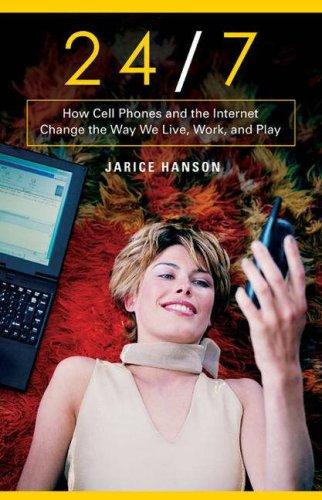
As far as subject matter goes, this book was spot-on in terms of both social and personal relevance. Cell phones and the Internet have had a distinctly observable effect on society and my own interactions with others. Points about online relationships were especially well taken.
However, much of the prose was oddly structured and difficult to read. As the commas proliferated, I began to get confused and forget the sentence's original subject. Sometimes I had to read paragraphs (and even entire pages) two or three times to actually grok the meaning couched in five layers of parenthetical phrases.
Often, commas (or other punctuation marks) seemed to be missing or misplaced, furthering the confusion. Parentheticals aren't nearly as confusing when their start and end points are clearly demarcated by properly matched punctuation.
I understand that the book was written by a communications researcher, not an English professor, but many of the …
As far as subject matter goes, this book was spot-on in terms of both social and personal relevance. Cell phones and the Internet have had a distinctly observable effect on society and my own interactions with others. Points about online relationships were especially well taken.
However, much of the prose was oddly structured and difficult to read. As the commas proliferated, I began to get confused and forget the sentence's original subject. Sometimes I had to read paragraphs (and even entire pages) two or three times to actually grok the meaning couched in five layers of parenthetical phrases.
Often, commas (or other punctuation marks) seemed to be missing or misplaced, furthering the confusion. Parentheticals aren't nearly as confusing when their start and end points are clearly demarcated by properly matched punctuation.
I understand that the book was written by a communications researcher, not an English professor, but many of the mistakes should have been caught by the editor. I assume there was an editor...
Aside from the mechanics, there were also distracting factual inaccuracies. I have never seen the electromagnetic spectrum defined as "the part of the atmosphere" we use to transmit broadcast signals. One of my friends, studying physics in college, was appalled when I mentioned that definition. That's because it's just plain wrong; the electromagnetic spectrum is the range of frequencies at which electromagnetic waves such as radio/television/wireless signals, X-rays, and light occur naturally or can be generated—not an atmospheric component.
As the child of a radio engineer, I cannot in good conscience let such a gross factual error slip by unchallenged. Libraries should paste corrections in their copies; such misinformation is simply appalling.
Anachronisms such as the triple-tap text input method (long replaced by T9 and similar predictive algorithms) and MySpace's dominant position among Internet social networks were obviously due to the book's already advancing age. Four years practically equal a century in the world of technology, after all, especially in the Internet sector. Facebook was recently launched and still restricted to college students at press time, and perhaps T9-style algorithms just weren't as common as I thought. Still, I had to stop and think about the sections referencing these outdated facts.
The text seemed repetitive at times. I felt like the same points were made several times over the course of the book. Whether the redundancy was real or merely perceived, pushing through to the end of the book was difficult. That difficulty might be jointly attributed to the style as well; the prose is staunchly academic, fit for a textbook (judging from my experiences therewith).
An enjoyable read at the start, but I got bogged down in esoteric grammatical mistakes and references to seemingly nonexistent images later in the book. The second half was kind of a slog; I considered not finishing it. Much of it seemed a bit repetitive.
The occasional turn of phrase struck me as odd (I'd never thought to myself that I should "suck back" a latté—my dislike for coffee aside), but the real intrigue was in the references to tables in the Appendix. Every reference I found in the text gave a page number that was wrong, the table in question located exactly 12 pages later than specified. (While I'm on the subject: Most of those "tables" aren't tables at all, but figures. But I quibble over semantics.)
My original hypothesis was that 12 pages of notes were added at the last minute and the references were never updated (something …
An enjoyable read at the start, but I got bogged down in esoteric grammatical mistakes and references to seemingly nonexistent images later in the book. The second half was kind of a slog; I considered not finishing it. Much of it seemed a bit repetitive.
The occasional turn of phrase struck me as odd (I'd never thought to myself that I should "suck back" a latté—my dislike for coffee aside), but the real intrigue was in the references to tables in the Appendix. Every reference I found in the text gave a page number that was wrong, the table in question located exactly 12 pages later than specified. (While I'm on the subject: Most of those "tables" aren't tables at all, but figures. But I quibble over semantics.)
My original hypothesis was that 12 pages of notes were added at the last minute and the references were never updated (something I've run across a few times when compiling documents in LaTeX, which often requires multiple passes to get all the references right). But when I looked at the Afterword and discovered that it was precisely 12 pages long, I realized what had happened. The page numbers were quite likely taken from the first edition, which having no Afterword put the Appendix 12 pages earlier, and updating them was probably overlooked in the preparation of this edition. Oops.
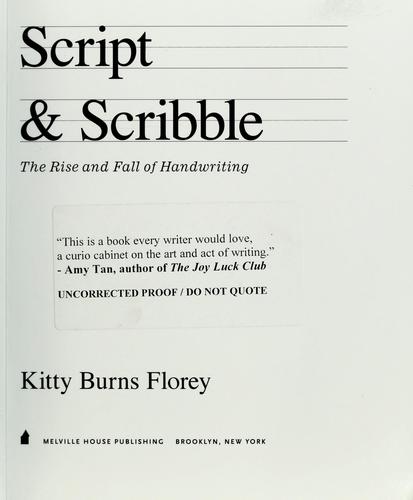
If only I could remember the path that led me to this book. To someone, somewhere, I owe a debt of gratitude for the initial mention that placed Script & Scribble on my radar. Perhaps it was mentioned in a Goodreads newsletter, or on a blog; I can't remember.
Having read Script & Scribble, I am now perhaps even more irked by my poor handwriting skills—the very cocography that drove me to learn how to type at a respectable 80–90 WPM. I also have a much better understanding of just why I learned to print before learning to write cursive, and just how handwriting has changed over the years.
(As a side-effect, I gained a revulsion for Blackletter: a script so unreadable it brings to mind the squiggles of Peanuts characters—only it's supposed to be "real" writing, not the pretending of comic strip characters.)
Calligraphy was a brief part …
If only I could remember the path that led me to this book. To someone, somewhere, I owe a debt of gratitude for the initial mention that placed Script & Scribble on my radar. Perhaps it was mentioned in a Goodreads newsletter, or on a blog; I can't remember.
Having read Script & Scribble, I am now perhaps even more irked by my poor handwriting skills—the very cocography that drove me to learn how to type at a respectable 80–90 WPM. I also have a much better understanding of just why I learned to print before learning to write cursive, and just how handwriting has changed over the years.
(As a side-effect, I gained a revulsion for Blackletter: a script so unreadable it brings to mind the squiggles of Peanuts characters—only it's supposed to be "real" writing, not the pretending of comic strip characters.)
Calligraphy was a brief part of my elementary schooling, and I've a sudden urge to dig out the fountain pen I have from those days. Not that my Uncial was ever that good—but maybe if I practice…
On top it all, Florey makes reference to many other books works that will most likely end up on my to-read shelf. When reading a book makes my to-read list longer, and not shorter, I consider it a tribute to the author—even if it means I edge that much closer to having a list that I will never finish.
The only thing I have to complain about is Chapter One, and not because of the content. I would like to have a talk with the publisher about the layout of that first chapter. Figures overlap the text, sidenote references in the text fail to match the number of the note beside them, and sometimes the text breaks in strange places to leave whitespace in odd arrangements. There's also a use of the word "happly" on page 53 that, well, just made me laugh after a double-take.
Aside from those few oddities, the book is flowingly written, beautifully laid-out, humorous, and witty. I look forward to reading Florey's best-selling [b:Sister Bernadette's Barking Dog|31049|Sister Bernadette's Barking Dog The Quirky History and Lost Art of Diagramming Sentences|Kitty Burns Florey|http://photo.goodreads.com/books/1168197838s/31049.jpg|2238416].
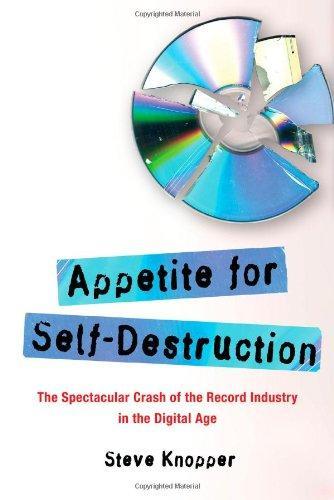
For the first time, Appetite for Self-Destruction recounts the epic story of the precipitous rise …
Review of 'Appetite for Self-Destruction' on 'Goodreads'
5 stars
Steve Knopper wrote a very well-researched book on the record industry. The list of sources in itself is impressive.
The analyses confirmed a lot of my preconceptions about the industry, and changed my views in a few subtle ways. I recommend this book for anyone who likes listening to music at all.
The Brief Wondrous Life of Oscar Wao is a 2007 novel written by Dominican American …
Review of 'The Brief Wondrous Life of Oscar Wao' on 'Goodreads'
1 star
A college sent this to me for freshman seminar. I felt obligated to read it, even though I didn't go to that school this year, but I almost didn't finish it.
How this book won such a prestigious award is beyond me. The reader knows what's generally going to happen from the title, and the outcome is pretty obvious from the start. The details (which are the only reason I kept reading) are mostly shrouded in Spanish slang. I don't read next to a computer, so looking the phrases up was impractical, and I couldn't understand a large chunk of the prose because of that fact.
Add to that the narrators who all speak in the same tone, and that's a recipe for confusion. I got to a "part" break and read a page and a half before I realized the narrator and subject had changed.
I honestly don't know …
A college sent this to me for freshman seminar. I felt obligated to read it, even though I didn't go to that school this year, but I almost didn't finish it.
How this book won such a prestigious award is beyond me. The reader knows what's generally going to happen from the title, and the outcome is pretty obvious from the start. The details (which are the only reason I kept reading) are mostly shrouded in Spanish slang. I don't read next to a computer, so looking the phrases up was impractical, and I couldn't understand a large chunk of the prose because of that fact.
Add to that the narrators who all speak in the same tone, and that's a recipe for confusion. I got to a "part" break and read a page and a half before I realized the narrator and subject had changed.
I honestly don't know how I managed to push myself through the book. I haven't hated a book this much since I had to read [b:Beloved|6149|Beloved|Toni Morrison|http://photo.goodreads.com/books/1165555299s/6149.jpg|736076] in high school.