
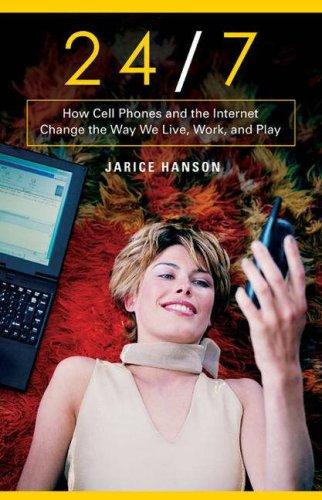
Review of '24/7' on 'Goodreads'
3 stars
As far as subject matter goes, this book was spot-on in terms of both social and personal relevance. Cell phones and the Internet have had a distinctly observable effect on society and my own interactions with others. Points about online relationships were especially well taken.
However, much of the prose was oddly structured and difficult to read. As the commas proliferated, I began to get confused and forget the sentence's original subject. Sometimes I had to read paragraphs (and even entire pages) two or three times to actually grok the meaning couched in five layers of parenthetical phrases.
Often, commas (or other punctuation marks) seemed to be missing or misplaced, furthering the confusion. Parentheticals aren't nearly as confusing when their start and end points are clearly demarcated by properly matched punctuation.
I understand that the book was written by a communications researcher, not an English professor, but many of the mistakes should have been caught by the editor. I assume there was an editor...
Aside from the mechanics, there were also distracting factual inaccuracies. I have never seen the electromagnetic spectrum defined as "the part of the atmosphere" we use to transmit broadcast signals. One of my friends, studying physics in college, was appalled when I mentioned that definition. That's because it's just plain wrong; the electromagnetic spectrum is the range of frequencies at which electromagnetic waves such as radio/television/wireless signals, X-rays, and light occur naturally or can be generated—not an atmospheric component.
As the child of a radio engineer, I cannot in good conscience let such a gross factual error slip by unchallenged. Libraries should paste corrections in their copies; such misinformation is simply appalling.
Anachronisms such as the triple-tap text input method (long replaced by T9 and similar predictive algorithms) and MySpace's dominant position among Internet social networks were obviously due to the book's already advancing age. Four years practically equal a century in the world of technology, after all, especially in the Internet sector. Facebook was recently launched and still restricted to college students at press time, and perhaps T9-style algorithms just weren't as common as I thought. Still, I had to stop and think about the sections referencing these outdated facts.
The text seemed repetitive at times. I felt like the same points were made several times over the course of the book. Whether the redundancy was real or merely perceived, pushing through to the end of the book was difficult. That difficulty might be jointly attributed to the style as well; the prose is staunchly academic, fit for a textbook (judging from my experiences therewith).