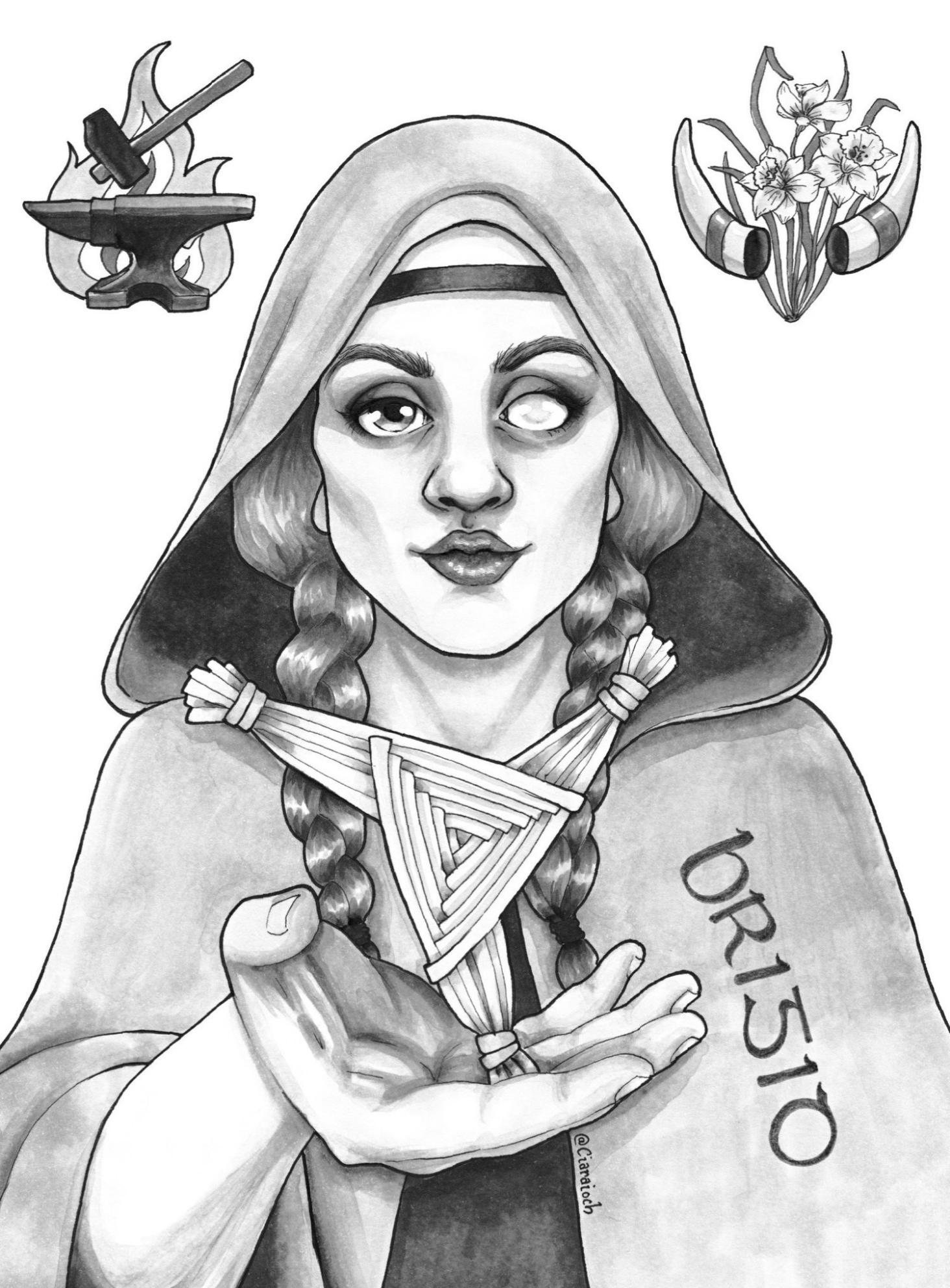
Made another card concept for #Tarotember. It's based on Arthurian legend. I was going to explain it, but now I'm curious to see if anyone gets the reference without explanation 😄
You know the folktales where fairy maidens are taking a bath, and the "hero" steals the dress of one of them to force her to be his wife? (Also in Selkie stories)
Well I just read a Hungarian folktale where the guy steals the dress - at which point the fairy walks up to him, slaps him across the face, and takes the dress back.
In Welsh folklore, the Cwn Annwn ("Hounds of the Otherworld") are white fairy dogs with red ears and red eyes that race across the sky as the Wild Hunt. Their baying can be mistaken for the honking of geese, though it actually gets quieter the closer the Cwn Annwn get to their prey. 🎨 Roger Garland
The medieval church porch at Corwen, #Denbighshire has been built round a little standing stone bearing the splendid name of Carreg y Big yn y Fach Rhewllyd (the pointy stone in the icy nook). #Folklore suggests this may have been true of earlier churches on this ancient site.
#StandingStoneSunday
A thought on #DnD - style #ttrpg where the player characters can be classified as "professional treasure hunters" either deliberately (they go into dungeons in order to seek treasure) or accidentally (they find treasure while they go into the dungeon for other reasons).
The absurd amount of valuables the player character find has ample precedent in European #folklore (click on the link for a few examples), and indeed, the whole concept of treasure hunting has precedent in the "Magical Treasure Hunting" craze of Early Modern Europe.
However, folk tales are almost always "one-shots" - the person who finds the treasure either gets rich and lives heavily ever after, or they feel regret for the rest of their lives because they missed their one big shot at riches.
In contrast, TTRPG usually feature ongoing campaigns, and thus the PCs will usually delve into "dungeons" and …
A thought on #DnD - style #ttrpg where the player characters can be classified as "professional treasure hunters" either deliberately (they go into dungeons in order to seek treasure) or accidentally (they find treasure while they go into the dungeon for other reasons).
The absurd amount of valuables the player character find has ample precedent in European #folklore (click on the link for a few examples), and indeed, the whole concept of treasure hunting has precedent in the "Magical Treasure Hunting" craze of Early Modern Europe.
However, folk tales are almost always "one-shots" - the person who finds the treasure either gets rich and lives heavily ever after, or they feel regret for the rest of their lives because they missed their one big shot at riches.
In contrast, TTRPG usually feature ongoing campaigns, and thus the PCs will usually delve into "dungeons" and similar treasure-laden sites again and again. So the question the GM - and indeed, anyone who does #worldbuilding for such settings - needs to answer is:
"Why would the player characters continue to risk life and limb even after finding riches?"
The Scholomance of European folklore was an infamous school of black magic located somewhere underground in Transylvania. Satan was the headmaster, and classes taught such sorcery as the speech of animals and weather control. In the original novel, Dracula was a student.
...this prompt was written for me, right? Because my entire writing work is all about folklore.
German folk tales, to be specific - folk tales written down and published in (mostly) the 19th century, which makes them in the public domain and thus fair game for translation into English and release to an international audience.
So far, I have released two books (with a third in preparation), and I have published 748 translated tales on my Patreon campaign.
What's more, all my translations have been released under a #CreativeCommons Zero license, so anyone is free to use them in whatever way they want for their own projects. And if anyone is interested in how to make more use of German folklore in their own works, I'd be happy to advise.
...this prompt was written for me, right? Because my entire writing work is all about folklore.
German folk tales, to be specific - folk tales written down and published in (mostly) the 19th century, which makes them in the public domain and thus fair game for translation into English and release to an international audience.
So far, I have released two books (with a third in preparation), and I have published 748 translated tales on my Patreon campaign.
What's more, all my translations have been released under a #CreativeCommons Zero license, so anyone is free to use them in whatever way they want for their own projects. And if anyone is interested in how to make more use of German folklore in their own works, I'd be happy to advise.
#WritersCoffeeClub 18/8: Have you ever hidden the fact that you're a writer?
Nope. While my status as an author hasn't gotten me any actual dates, so far (more's the pity - I suspect that aspect of the author's life is exaggerated), the response has been overwhelmingly positive and even impressed.
It helps that my #folklore books have some pretensions of scholarship, and it does help with preserving and spreading German cultural heritage and so forth - so they don't have the same stigma that #fantasy and #ScienceFiction have in certain circles. Even my aging father, who otherwise doesn't really "get" most of my hobbies, is impressed and occasionally asks me for my latest sales numbers.
#WritersCoffeeClub 18/8: Have you ever hidden the fact that you're a writer?
Nope. While my status as an author hasn't gotten me any actual dates, so far (more's the pity - I suspect that aspect of the author's life is exaggerated), the response has been overwhelmingly positive and even impressed.
It helps that my #folklore books have some pretensions of scholarship, and it does help with preserving and spreading German cultural heritage and so forth - so they don't have the same stigma that #fantasy and #ScienceFiction have in certain circles. Even my aging father, who otherwise doesn't really "get" most of my hobbies, is impressed and occasionally asks me for my latest sales numbers.
It occurs to me that it might be worth it at some point to write a book about all the weird local customs I've encountered in assorted German #folklore collections. While this wouldn't be a folk _tale_ collection, it might still be of interest to other people.
At the very least, #ttrpg game masters and worldbuilders could use them to enliven up their own fantastic worlds. If it worked for #WFRP , it can work for other settings as well.
It occurs to me that it might be worth it at some point to write a book about all the weird local customs I've encountered in assorted German #folklore collections. While this wouldn't be a folk _tale_ collection, it might still be of interest to other people.
At the very least, #ttrpg game masters and worldbuilders could use them to enliven up their own fantastic worlds. If it worked for #WFRP , it can work for other settings as well.
I find the "Alber" to be a very interesting creature indeed. It is a "bird of fire" whose approach is heralded by a disturbing whistle, and then everyone has to flee inside their houses and bar doors and windows so that they don't perceive it and suffer misfortune as a result. That description would make me inclined to identify it as a #WildHunt -type phenomena, perhaps similar to the Australian Wildg'fahr.
But what also makes me curious is its name. Is "Alber" derived from "albero", Italian for "tree" or "mast"? If so, perhaps this is no "bird" after all, but a flaming pole - which would make it kin to the "flaming pole"-type apparitions from German folklore as well.
I find the "Alber" to be a very interesting creature indeed. It is a "bird of fire" whose approach is heralded by a disturbing whistle, and then everyone has to flee inside their houses and bar doors and windows so that they don't perceive it and suffer misfortune as a result. That description would make me inclined to identify it as a #WildHunt -type phenomena, perhaps similar to the Australian Wildg'fahr.
But what also makes me curious is its name. Is "Alber" derived from "albero", Italian for "tree" or "mast"? If so, perhaps this is no "bird" after all, but a flaming pole - which would make it kin to the "flaming pole"-type apparitions from German folklore as well.
Una delle loro occupazioni principali è quella di succhiare da un orecchio il sangue ai neonati che rapiscono dalle culle per nasconderli nei tronchi delle querce.
And with the very first encyclopedia entry, we already have child-stilling "little people" - the "Abitatrici Dei Campi" ("Inhabitants of the Fields", if I've gotten this right). Although unlike their German counterparts, they do not replace the stolen children with changelings, and I am not sure if this is better or worse. #Italiano#folklore#kidnapping