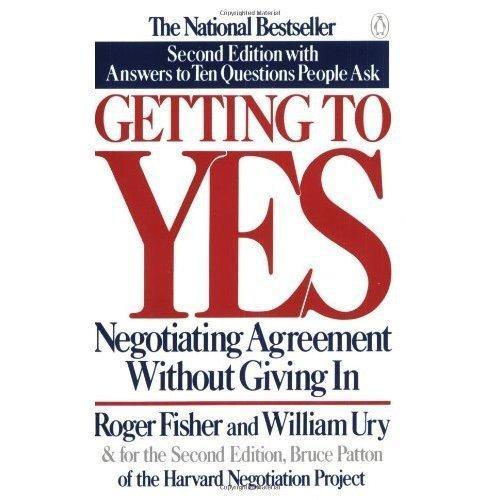
Describes a method of negotiation that isolates problems, focuses on interests, creates new options, and uses objective criteria to help two parties reach an agreement Amazon.com description: Product Description: Since its original publication nearly thirty years ago, Getting to Yes has helped millions of people learn a better way to negotiate. One of the primary business texts of the modern era, it is based on the work of the Harvard Negotiation Project, a group that deals with all levels of negotiation and conflict resolution. Getting to Yes offers a proven, step-by-step strategy for coming to mutually acceptable agreements in every sort of conflict. Thoroughly updated and revised, it offers readers a straight- forward, universally applicable method for negotiating personal and professional disputes without getting angry-or getting taken.This is by far the best thing I`ve ever read about negotiation. It is equally relevant for the individual who would like to keep …
Describes a method of negotiation that isolates problems, focuses on interests, creates new options, and uses objective criteria to help two parties reach an agreement Amazon.com description: Product Description: Since its original publication nearly thirty years ago, Getting to Yes has helped millions of people learn a better way to negotiate. One of the primary business texts of the modern era, it is based on the work of the Harvard Negotiation Project, a group that deals with all levels of negotiation and conflict resolution. Getting to Yes offers a proven, step-by-step strategy for coming to mutually acceptable agreements in every sort of conflict. Thoroughly updated and revised, it offers readers a straight- forward, universally applicable method for negotiating personal and professional disputes without getting angry-or getting taken.This is by far the best thing I`ve ever read about negotiation. It is equally relevant for the individual who would like to keep his friends, property, and income and the statesman who would like to keep the peace." --John Kenneth Galbraith"
I’ve often heard about the “Harvard Negotiation” method, but I hadn’t read Getting to Yes until recently. To my surprise, much of the content felt familiar - not because I had read it before, but because I had already been using many of its principles, unknowingly picked up from other sources. More here: gagor.pro/book/2025/getting-to-yes/
I’ve often heard about the “Harvard Negotiation” method, but I hadn’t read Getting to Yes until recently. To my surprise, much of the content felt familiar - not because I had read it before, but because I had already been using many of its principles, unknowingly picked up from other sources. More here: gagor.pro/book/2025/getting-to-yes/
Review of 'Getting to Yes: Negotiating Agreement Without Giving In' on 'Goodreads'
3 stars
The main problem with this book, which I can hardly hold against it, is that in the decades since it first came out, the wisdom of it has passed into common knowledge. If you're read anything about negotiating in the past few years, you're going to recognize many of the ideas presented here.
But like I said, that's not really a complaint. For what's it worth, this book puts all these bits and pieces that I've already been familiar with into a single, coherent and sensible framework. In that sense, it's absolutely worth reading. It gives a language to many ideas I've been vaguely aware of but couldn't necessarily explain as a single whole.
That said, it's not what I would call a fascinating read. The prose is often lacking, the examples are often quite lifeless, and the whole thing felt like quite a slog to get through. The worst …
The main problem with this book, which I can hardly hold against it, is that in the decades since it first came out, the wisdom of it has passed into common knowledge. If you're read anything about negotiating in the past few years, you're going to recognize many of the ideas presented here.
But like I said, that's not really a complaint. For what's it worth, this book puts all these bits and pieces that I've already been familiar with into a single, coherent and sensible framework. In that sense, it's absolutely worth reading. It gives a language to many ideas I've been vaguely aware of but couldn't necessarily explain as a single whole.
That said, it's not what I would call a fascinating read. The prose is often lacking, the examples are often quite lifeless, and the whole thing felt like quite a slog to get through. The worst culprit here is the section added in the latter editions - the "10 questions" segment. Rather than give new ideas, or recast old ideas in a new light, this section felt like a cliff's notes version of the book. I recommend skipping it all together.
The one question I was left in that wasn't answered in this book, or anywhere else, had to do with the initial example they give of a "positional negotiations" - the classic haggling. Try as I might, I couldn't see from this book how they resolve any problem for a clear-cut zero-sum game, such as haggling over an item in the market or, more consequentially, something like a house. They mention something about preserving relationships, but when I buy a house from another person, we don't have a relationship, and don't need to keep it - this is a single transaction, and we will likely never talk again after it. What can I do in a situation like this that will improve the final result over just positional bargaining? Maybe there isn't - and that's fair enough. But the example they start with is one of haggling. That strikes me as dishonest and set the wrong tone for the entire book for me.
But maybe I'm being overly nitpicky here. The bottom like is that this book teaches how to negotiate complicated deals, and it does it as well as can be expected from a book. I feel better equipped to face such situations in the future having read this book, and that's all that really matters, I guess.