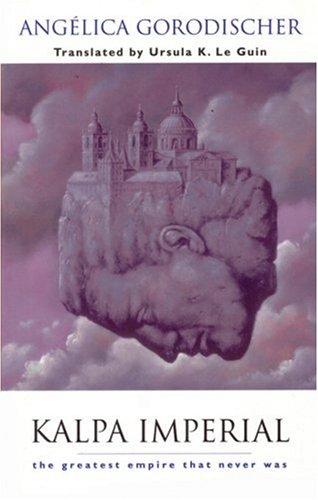
«Oh, sí, mis buenas gentes, sí, ya lo creo que sí. Se puede vivir en el sur. Y morir también. Y se puede nacer, y crecer y aprender y matar y sufrir en el sur. ¿Ustedes conocen el sur? ¿Han entrado a ese país vedado y tentador? ¿Han ido al paraíso de los monstruos, al antro de los asesinos, al reino de la barbarie? ¿Conocen a las gentes del sur? ¿Se han acostado con sus mujeres, han bebido con sus hombres, han escuchado a sus ancianos?». Obra ganadora de los premios Poblet y Gigamesh.
lo leí en el original, y no la traducción al inglés de Ursula Le Guin, pero aún así sentí algo de ella en el tono del prose, y también algo borgesiano en la fantasia fuera-del-tiempo
starts strong, ultimately meanders too much for me
No rating
I enjoyed reading most of this book, but as I went on from one story to the next I noticed I was taking longer and longer breaks between the stories. In the end I stopped a couple short of the end just because I was about to head out on a trip and I realised I wasn't finding it compelling enough to bring the physical book with me. I'll probably read them eventually, but I'm not in a hurry so I'm just considering this shelved for now.
The basic premise is that all the stories are pieces of the history of what appears to be one empire which has waxed and waned in size and power over a very long time, possibly millennia. But I'm not quite sure if I have that right, because the stories are generally not connected to each other - I think I caught one …
I enjoyed reading most of this book, but as I went on from one story to the next I noticed I was taking longer and longer breaks between the stories. In the end I stopped a couple short of the end just because I was about to head out on a trip and I realised I wasn't finding it compelling enough to bring the physical book with me. I'll probably read them eventually, but I'm not in a hurry so I'm just considering this shelved for now.
The basic premise is that all the stories are pieces of the history of what appears to be one empire which has waxed and waned in size and power over a very long time, possibly millennia. But I'm not quite sure if I have that right, because the stories are generally not connected to each other - I think I caught one ruling dynasty's name getting repeated but that's the only explicit link I've picked up so far. Which I don't necessarily mind in itself--after all I've enjoyed plenty of collections of totally unconnected short stories--but it seems to have constrained the author just enough for the stories to start to feel samey even though they're about clearly different eras and take a variety of narrative points of view.
I noticed somewhere that this book was originally published in Spanish as two separate volumes. I might have enjoyed it more if I'd read one volume and then set it aside for a while as I tend to do with successive instalments of a series. The repetitiveness didn't really start to bother me until some way into the second volume.
This book is the October/November #SFFBookClub book. It's a collection of stories about an empire that has fallen and been rebuilt multiple times, each focusing on a very different place and time, and each told with a narrated fable-like style. One stylistic choice that stands out immediately is that the sentence structure is quite long and there are often comically long lists of names or places or ideas or things or professions or or or... I found this to be overall a delight, personally.
This may be due to expectations that I had going into this, but the stories in this novel felt loose and disconnected. This is especially due to coming off collections of short stories like How High We Go in the Dark or even North Continent Ribbon, which interconnect the stories together with shared characters or worldbuilding. Kalpa Imperial had very few touchpoints between stories …
This book is the October/November #SFFBookClub book. It's a collection of stories about an empire that has fallen and been rebuilt multiple times, each focusing on a very different place and time, and each told with a narrated fable-like style. One stylistic choice that stands out immediately is that the sentence structure is quite long and there are often comically long lists of names or places or ideas or things or professions or or or... I found this to be overall a delight, personally.
This may be due to expectations that I had going into this, but the stories in this novel felt loose and disconnected. This is especially due to coming off collections of short stories like How High We Go in the Dark or even North Continent Ribbon, which interconnect the stories together with shared characters or worldbuilding. Kalpa Imperial had very few touchpoints between stories other than a loose thematic sense, and this created a storytale atmosphere where places and characters and words washed over me, unlistened.
Nothing was rooted in a time. Most stories were barely rooted in a place, and at best were set against "the south". Characters are referenced and never touched on again (or at best mentioned in passing elsewhere once). The storyteller narration references historical context that the in-universe listener would know to situate this story in, but to me the reader it felt like noise rather than worldbuilding, akin to opening the Silmarillion to a random page with no further context.
Theoretically, I can imagine placing any book on some hypothetical scale of narrative detail. (As a joke, let's say this is a scale with one end being the TV series Lost and the other end being a Brandon Sanderson wiki). I don't need all the details in a world spelled out, but there's a tipping point where there's enough detail where I believe that the author could fill in the blanks if needed. Well before that tipping point, it feels like authors are largely making everything up whimsically as they go. I think you can tell a set of disconnected stories where all the details are constructed out of whole cloth, but there needs to be some strong thematic through line to carry it, at least for me. This novel just doesn't quite have that.
To come back and treat this book for what it is rather than what I expected it to be, thematically I would try to pin this book down as about being about telling stories and taking the long view of history--that all places and empires and people change dramatically over time and can become something different. I think secondarily, it feels like it's a set of critiques and observations about empires and humanity; it's full of wry critiques of power, of nobles, and of human nature. I found the book amazingly quotable and quite funny in parts.
This is a hard book to recommend; even as I enjoyed it, its lack of coherence and whimsical storytale nature make it more a book that I enjoyed in passing than one that will stick with me.
Short stories of a fictional empire and the oral storyteller that connects them
5 stars
A collection of connected short stories set in a fictional [possibly post-apocolyptic] empire about its many rulers and cities and across many years. The stories are short and leave you wanting to know more about the people in them.
The writing is tight with just enough description to convince you they're being told by an oral storyteller, but it's not flowery and at times you wish you could hear a little bit more description.
However, one failing is how the stories connect. Other than the oral storyteller and the empire they pertain to, one is left wondering what connects them together. What are the relationships between all the emperors and empresses? Unfortunately, I suspect that would require a fictional history lesson and a long kings list, which would most certainly distract from the stories themselves.
A collection of connected short stories set in a fictional [possibly post-apocolyptic] empire about its many rulers and cities and across many years. The stories are short and leave you wanting to know more about the people in them.
The writing is tight with just enough description to convince you they're being told by an oral storyteller, but it's not flowery and at times you wish you could hear a little bit more description.
However, one failing is how the stories connect. Other than the oral storyteller and the empire they pertain to, one is left wondering what connects them together. What are the relationships between all the emperors and empresses? Unfortunately, I suspect that would require a fictional history lesson and a long kings list, which would most certainly distract from the stories themselves.