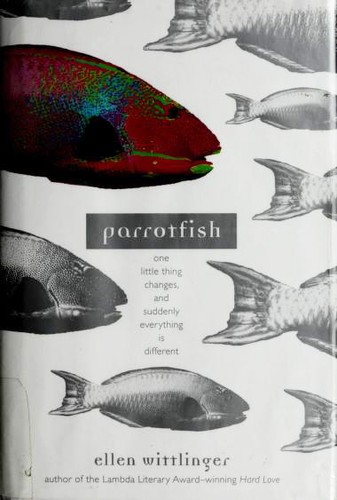
I just forced myself through this trash book this week.
I grew up during the time this was written, but somehow missed it on the shelves. I'm very glad I did miss it as a teen, because it is a cheap nonsense project by a cis author trying to cash in on the mid-2000s swell of LGBTQIA+ young adult fiction popularity. The main character is bitter and remains self-interested throughout the book, without growth; rather, the book is largely a study of how people grow around and to accommodate him.
I'll start with the story. The plot is very simple; a boy who has come out to his family as trans overcomes a bully, a crush, and his dad's love of Christmas. Grady changes his name and clothes and heads into school dressed as a boy. There he faces a one dimensional bully who tries to make him wear sexy clothes (instead a teacher wears the clothes as the great triumph). The bully is later told off at a school dance by Grady's crush, and cries in the bathroom, getting eyeshadow on her dress. The protagonist's best friend, Sebastian, suggests they go into the girl's restroom to film this. Grady meets a guy who is "normal" and instantly falls in love with his girlfriend, who kisses him and then decides to go back with her original boyfriend. That's the entirety of the love interest plotline.
The overarching story beyond these things is Grady's struggle with his dad's love of Christmas. His dad has a passion for decorating their house every year, culminating in a short play in their living room on Christmas Eve. The book repeatedly brings up how much this makes Grady's father happy, and the light in his eyes when they talk about Christmas. This joy in his father's life and his father's inability to recognize that his family, who have never raised complaint about it, are getting tired of the tradition is explained as toxic masculinity, or "testosterone poisoning". Grady overcomes the obstacle of his father's happiness by rewriting their Christmas Eve script and letting his father learn while reading the lines during the performance that this will be the last year they perform. Grady also gives his family and friends around the tree such classic Christmas gifts as a newspaper cutout advertising self defense lessons at the police station (this book at no point contains physical danger), an advertisement for his father to try out for a local production of Oliver!, and a poodle with which he surprises the family, and drove another state over to get for his brother without permission from his parents.
The reason for the name "Parrotfish" is that Grady's friend Sebastian is studying the parrotfish in class, and it's an animal that changes sex when the population requires it. The female parrotfish becomes supermale when there isn't enough population density of males, achieving domination over all other males. Grady feels drawn to this fish because he believes research on the parrotfish might translate to humans. This is mentioned in detail twice throughout the book; once when Sebastian suggests it, and once when Grady is reading Sebastian's report.
Now, my specific issues with it as a work of queer fiction:
Parrotfish uses harmful language that was outdated at the time of writing, included repeated use of the word "transgendereds" and the acronym GLBT, which had been largely abandoned before the time of publication (LGBT was in use). It discusses expecting all of the women in Grady's life to feel as if he has betrayed womanhood, a common theme among trans rejecting feminism and does not at any point resolve this. Grady mentions how extremely painful Ace bandages are to bind with MANY times throughout the book, which is indicative of misusing the bandage and potentially means causing permanent damage. Normalizing this as the way bandage "always" feels puts youths who are binding at medical risk. Extreme chest pain means improper binding or something else wrong, and should not be dismissed as one of the prices of being trans. Grady presents as a binary trans boy, he insists on being a binary trans boy, but there's a recurring discussion about the "football field of gender, with Sylvester Stallone on one end and Jennifer Lopez/Paris Hilton fighting over femininity on the other" and how Grady really just sits right in the middle of that field. That's fine, everyone has a different experience with gender, but presenting purportedly binary trans people as right in between man and woman can be pretty invalidating and confusing for teens who do identify as one or the other.
Now, onto my final issues, which are pretty big ones: this book is racist and antisemitic.
Let's hit the antisemitism issue first. You'll remember, the plot revolves around Grady crushing his fathers' Christmas dreams. Part of the reason his father loving Christmas is such a "toxic man" thing is because Grady's mother is Jewish. This is mentioned in two notable occasions. Once early on as a throwaway line, once when Grady is talking about how terrible his father enjoying Christmas is, saying that Judy (yes, the only Jewish character's name is Judy) has been taking part in this celebration with him for a decade to her mother's chagrin. Judy's Jewishness is blatant tokenism without research, as none of Judy's children are considered Jewish and that's not even brought up through the book. (Judaism is passed down matrilineally.) Her existence as a Jew serves entirely to explain her disdain for Christmas, which she timidly never mentions.
Then, there's Kita... "what a beautiful face it was, her double ethnicities weaving around each other in perfect harmony." Kita is half black, half Japanese, and is treated as visually exotic the entire book. Her skin is described as the colour of polished oak, which leads one to believe the author has never seen oak nor a half black/ half Japanese person in real life. Kita is the most sympathetic character, but really seems to hate men. Reading the book, I got the vibe from Kita of someone performing compulsory heterosexuality who will embrace her lesbianism later, and is just kind of experimenting with a trans dude on her way to that... which would invite quite a bit more discussion, but that's speculative.
All in all, one page of the entire book was memorably relatable, and it was a discussion about how some people don't seem to realize when others around them have needs that might be suffering at the expense of their actions. Which, upon reflection, is ironic, given that the main character at no point seems aware of how other people will be effected by his actions, nor does he (usually) seem to care.