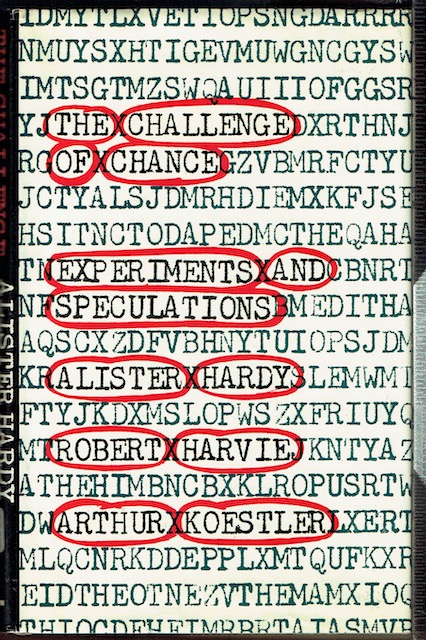

Fionnáin reviewed The Challenge of Chance by Alister Clavering Hardy
Experiments in telepathy, and a long-winded justification for them
1 star
This 1973 book is co-authored by three people. Alister Hardy, a renowned marine biologist who studied religious experience in his later life, drew me to this. He devised an experiment to test the possibility of telepathy through drawings and descriptions of scenes. Robert Harvie, an experimental mathematician, helps construct controls and explains the mathematics that rule out chance or coincidence. And Arthur Koestler is a researcher whose work on coincidence was widely published at the time.
Each author has a section, with a couple of sections co-authored by Hardy and Harvie. The first half is Hardy's experiment, which is very of its time, getting people to draw images and try to 'beam' them to others using only their minds. It's interesting and has some weird results that Harvie argues are more mathematically significant than chance.
The second half descends into farce – first Harvie spends a long time …
This 1973 book is co-authored by three people. Alister Hardy, a renowned marine biologist who studied religious experience in his later life, drew me to this. He devised an experiment to test the possibility of telepathy through drawings and descriptions of scenes. Robert Harvie, an experimental mathematician, helps construct controls and explains the mathematics that rule out chance or coincidence. And Arthur Koestler is a researcher whose work on coincidence was widely published at the time.
Each author has a section, with a couple of sections co-authored by Hardy and Harvie. The first half is Hardy's experiment, which is very of its time, getting people to draw images and try to 'beam' them to others using only their minds. It's interesting and has some weird results that Harvie argues are more mathematically significant than chance.
The second half descends into farce – first Harvie spends a long time discussing the science of chance. This is fine if a little dull, but it's then followed by Koestler spending three dull chapters trying to get one over on the scientific community by clutching at straws to show the scientific significance of parapsychological research into things like telepathy, paranormal activity or ESP. Koestler is not a compelling enough writer, and as a reader I don't really care for these justifications (particularly the odd chapter that essentially says 'quantum physics is weird so everything must be possible'). In the end the book is a disappointing mess.