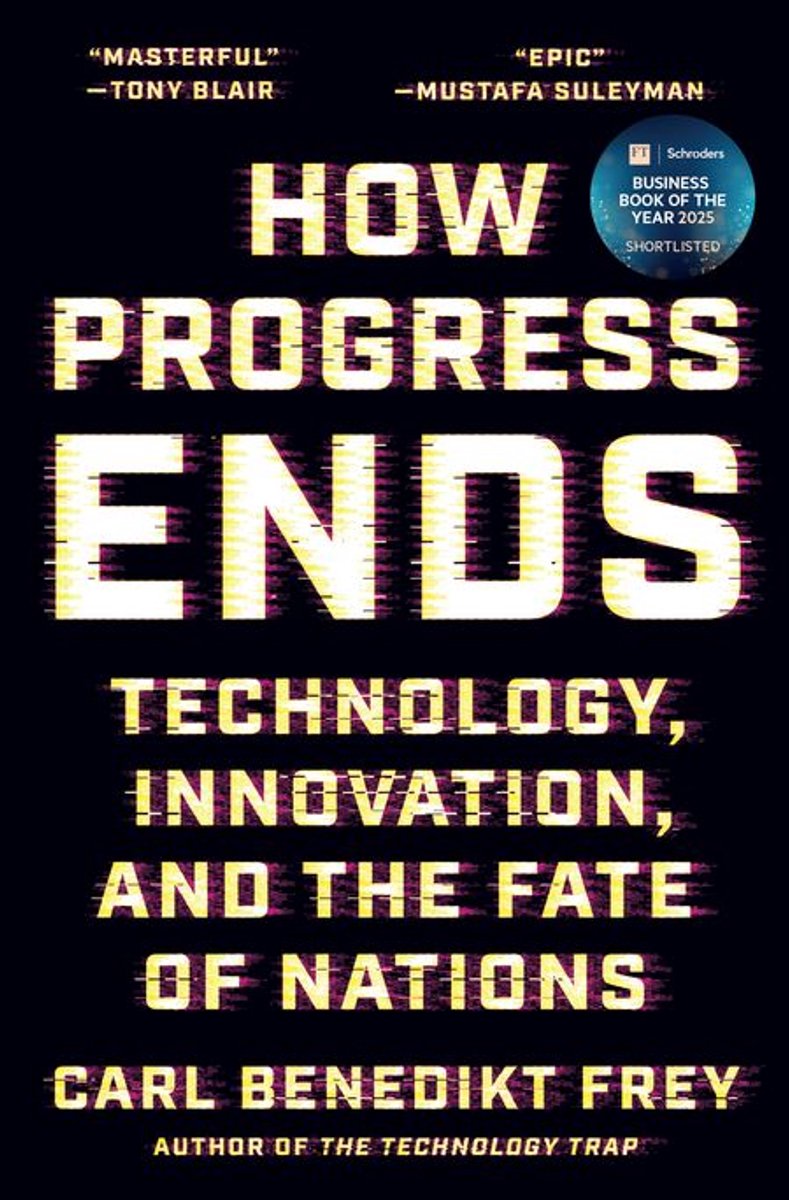

Ben Waber reviewed How Progress Ends by Carl Benedikt Frey
A Decent Book that Could Have Been Great
4 stars
This book is an impressive but mostly surface level comparative review of national economic and technological progress from the 1500s to the modern day. There's a lot of insight here, but it's often marred by contradictory analyses (e.g. cartels are why German industry grew quickly in the 1800s, cartels are why the US didn't grow fast until the 1900s), and some shockingly false economic assertions (e.g. claiming economic growth post WW2 never matched 19th century growth - by any measure, the period from 1945-1979 was the highest growth period in world history). There's also a disturbing anti-worker vein throughout the book, with Frey never passing up an opportunity to criticize workers for their advocacy and glossing over huge advances such as the weekend and the end of child labor. The sections on the Soviet economy, however, cover material that is rarely collected in a single source and is definitely the …
This book is an impressive but mostly surface level comparative review of national economic and technological progress from the 1500s to the modern day. There's a lot of insight here, but it's often marred by contradictory analyses (e.g. cartels are why German industry grew quickly in the 1800s, cartels are why the US didn't grow fast until the 1900s), and some shockingly false economic assertions (e.g. claiming economic growth post WW2 never matched 19th century growth - by any measure, the period from 1945-1979 was the highest growth period in world history). There's also a disturbing anti-worker vein throughout the book, with Frey never passing up an opportunity to criticize workers for their advocacy and glossing over huge advances such as the weekend and the end of child labor. The sections on the Soviet economy, however, cover material that is rarely collected in a single source and is definitely the highlight of the book.
Overall, however, the biggest weakness in the book is the unit of analysis. There are simply too few countries and too many variables for a constrained analysis to offer a convincing explanation of what drives innovation and economic growth. I don't mind economists or historians laying out hypotheses, but Frey frames these factors as clearly causal. As a chronology, there are some good nuggets here. As a work of analysis, however, this feels like a missed opportunity