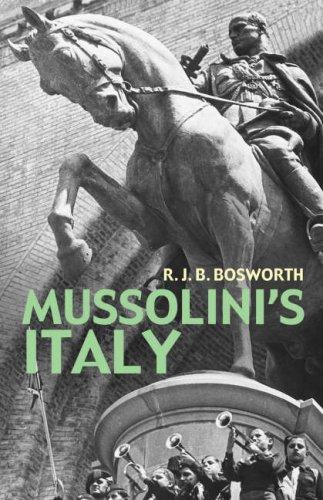

ilk reviewed Mussolini's Italy by R. J. B. Bosworth (Allen Lane History)
Mussolini's Italy
This is a sociopolitical survey of Italy during the first half of C20. Bosworth starts with the Resurgence of the mid-1800s that saw Italy become a unified kingdom, then progresses to the Liberal Democratic period of the 1900s and 1910s. The main players involved in early fascism were 'made' by the fallout of Italy's response to the First World War. We get the Aventine secession, a parliamentary protest at the daylight murder of one of their own by fascists, and the 1922 March on Rome, the event that saw Mussolini assume power in the Kingdom.
While the Duce isn't the primary focus of the book, you're given quite a good sense of the man and the statesman. But it's really a book about Fascism and how it presided over Italy for 20+ years, attempting like hell to remake society from the ground-up, and how much of a blustering, erratic …
This is a sociopolitical survey of Italy during the first half of C20. Bosworth starts with the Resurgence of the mid-1800s that saw Italy become a unified kingdom, then progresses to the Liberal Democratic period of the 1900s and 1910s. The main players involved in early fascism were 'made' by the fallout of Italy's response to the First World War. We get the Aventine secession, a parliamentary protest at the daylight murder of one of their own by fascists, and the 1922 March on Rome, the event that saw Mussolini assume power in the Kingdom.
While the Duce isn't the primary focus of the book, you're given quite a good sense of the man and the statesman. But it's really a book about Fascism and how it presided over Italy for 20+ years, attempting like hell to remake society from the ground-up, and how much of a blustering, erratic failure it was, lacking in confidence and clarity the whole time. Bosworth cites several factors behind this, such as Italian society's innate cynicism toward the state, the enduring presense of the church in people's lives, and the sanctity of family and local community. He contends that while Fascism was desparetely trying to manipulate Italians, Italians in fact found ways of manipulating Fascism to their own personal material and cultural ends.
Bosworth maintains a consistent narrative flow, but he doesn't shy away from complex sentences containing extended parentheses. None of it is hard to read at any time, it just demands focus. My understanding of the country is transformed, so in that sense it's a good book.
In the grander scheme, he interprets Italian Fascism as another belated attempt at nation building - to forge an 'Italy' from 'the Italies'. I got the sense too that Fascist foreign policy in particular was motivated by an inferiority complex. The regime couldn't abide a perception of Italy as a lesser power compared to Britain/France/Germany.