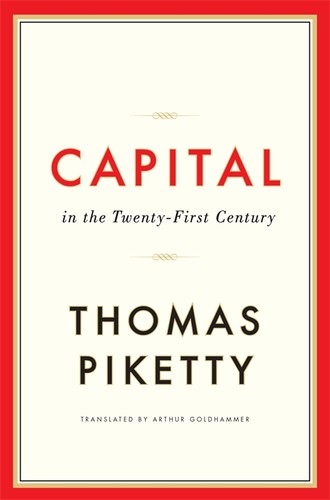

Capital in the Twenty-First Century

Hardcover

English language

Published Aug. 8, 2013 by Éditions du Seuil, Harvard University Press.

ISBN:
978-0-674-43000-6
Copied ISBN!

View on OpenLibrary

What are the grand dynamics that drive the accumulation and distribution of capital? Questions about the long-term evolution of inequality, the concentration of wealth, and the prospects for economic growth lie at the heart of political economy. But satisfactory answers have been hard to find for lack of adequate data and clear guiding theories. In Capital in the Twenty-First Century, Thomas Piketty analyzes a unique collection of data from twenty countries, ranging as far back as the eighteenth century, to uncover key economic and social patterns. His findings will transform debate and set the agenda for the next generation of thought about wealth and inequality.

Piketty shows that modern economic growth and the diffusion of knowledge have allowed us to avoid inequalities on the apocalyptic scale predicted by Karl Marx. But we have not modified the deep structures of capital and inequality as much as we thought in the …

6 editions

A Slightly Flawed but Still Classic Text

I finally got around to reading Pikkety's breakout book, and I can report that it's a classic for a reason. With his now trademark deep research and quantitative rigor, Piketty examines the nature of the global financial system and why inequality builds over time. There are some flaws in here, particularly around the economic history of the Americas, and a lot of space is spent on monetary policy with very little payoff. From this perspective this book can be viewed as an unfinished version of Piketty's more recent books which are superior in nearly every way. If you want to go back to the original, however, you'll still be in for a treat. Highly recommend


Review of 'Capital in the Twenty-First Century' on 'Goodreads'

In Capital in the 21th Century, Piketty investigates the changes that have occurred over the last two centuries in capital and in its distribution across the globe and across people. He also tries to figure out where it is all heading.

Concluding that there's nothing really keeping big money from growing faster than the capital of less fortunate people, he discusses possible solutions to make the distribution more even (most importantly wealth tax)

The book took me a very long time to read. While it may not look like it, it's pretty slow to read because Piketty tends to go into longwinded and detailed analysis of seemingly uninteresting facts. The reason he does, is to make sure that people understand to which depths he went to come to his conclusions.

All-in-all, I found this a very interesting read, although, I would have preferred a more condensed version, that's more focused …

Review of 'Capital in the Twenty-First Century' on 'Goodreads'

Piketty outlines the case for the inequality r>g (rate of return on capital > growth of overall economy) with extensive documentation. From this simple rule he describes the forces which lead to the rise of a rentier class that can live very well off inherited wealth which isn't necessarily socially useful. Ultimately I disagree with his solutions to this problem but it seems fairly hard to challenge the idea that wealth above a certain level tends to reproduce itself. Reinvestment of a portion of the returns on capital leads to a natural process of accumulation which Piketty argues will lead to a dangerous level of wealth concentration in the hands of a very few. Throughout the book he's very open about the strengths and weaknesses of his sources and openly declares his personal opinion about wealth accumulation. He did a tremendous amount of research and analysis and that's the main …

Review of 'Capital in the Twenty-First Century' on 'Goodreads'

I'm no economist, but to my ears Piketty makes a reasonable, readable, and engaging case for a new sort of tax to help close the growing disparity between the world's richest and poorest peoples.

Piketty recognizes that this sort of global tax is a utopia, but fails to acknowledge the sad truth that as long as the richest have a disproportionately loud voice in political decisions, nothing will ever change.

avatar for Moritz

rated it

avatar for bwaber@bookwyrm.social

rated it

avatar for PedalHoppy

rated it

avatar for nacho@lectura.social

rated it