Justin Younger reviewed Permutation City by Greg Egan
Review of 'Permutation City (Subjective Cosmology #2)' on 'Goodreads'
3 stars
Tough read but very prescient.
Permutation City is a 1994 science-fiction novel by Greg Egan that explores many concepts, including quantum ontology, through various philosophical aspects of artificial life and simulated reality. Sections of the story were adapted from Egan's 1992 short story "Dust", which dealt with many of the same philosophical themes. Permutation City won the John W. Campbell Award for the best science-fiction novel of the year in 1995 and was nominated for the Philip K. Dick Award the same year. The novel was also cited in a 2003 Scientific American article on multiverses by Max Tegmark.
Permutation City is a 1994 science-fiction novel by Greg Egan that explores many concepts, including quantum ontology, through various philosophical aspects of artificial life and simulated reality. Sections of the story were adapted from Egan's 1992 short story "Dust", which dealt with many of the same philosophical themes. Permutation City won the John W. Campbell Award for the best science-fiction novel of the year in 1995 and was nominated for the Philip K. Dick Award the same year. The novel was also cited in a 2003 Scientific American article on multiverses by Max Tegmark.
Tough read but very prescient.
What a wild ride. Prepare for your mind to be melted a bit
This book takes some time to absorb, and I'm probably doing it a great injustice by reviewing it so quickly after finishing it (and with such a rushed reading by such an uneducated reader). Greg Egan clearly knows what he's talking about when it comes to theoretical physics, and I certainly don’t, so the main bits of Permutation City intimidated me to a point that I may have taken the book too seriously. Some of the reviews I've read now that I've finished have lead me to believe some irony and perhaps even humor were completely lost on me in my reading.
But aside from the subtle and scientific points I missed (of which there was little to no overlap), there was plenty left to entertain and impress me. Egan handles ideas surrounding brain copies, digital consciousness, and immortality more realistically and satisfyingly than most sci-fi writers I've known to …
This book takes some time to absorb, and I'm probably doing it a great injustice by reviewing it so quickly after finishing it (and with such a rushed reading by such an uneducated reader). Greg Egan clearly knows what he's talking about when it comes to theoretical physics, and I certainly don’t, so the main bits of Permutation City intimidated me to a point that I may have taken the book too seriously. Some of the reviews I've read now that I've finished have lead me to believe some irony and perhaps even humor were completely lost on me in my reading.
But aside from the subtle and scientific points I missed (of which there was little to no overlap), there was plenty left to entertain and impress me. Egan handles ideas surrounding brain copies, digital consciousness, and immortality more realistically and satisfyingly than most sci-fi writers I've known to attempt it. However, I feel like some of the more enjoyable, interesting, brain copy aspects of the book were swallowed up by the more less-interesting-to-me theoretical parts, and find myself wishing this had instead been written as two complementary novellas (mostly so the concepts I enjoyed reading about could have been given more time and also a leading role in a story instead of a lead-in).
Regardless of how you felt after reading Permutation City, you should check out Eliezer Yudkowsky’s short unofficial sequel to Permutation City, The Finale of the Ultimate Meta Mega Crossover (www.fanfiction.net/s/5389450/1/The_Finale_of_the_Ultimate_Meta_Mega_Crossover). Yudkowsky loved Permutation City (as shown by his review here: www.amazon.com/review/R3RHGO7YH8GU9S), but suggests a replacement for one of the book’s central concepts. At the very least it left me with a better understanding of Permutation City (and also a drastically different color of ending).
Bon, je n'arriverai pas à tout faire en un coup : les nouvelles sont trop denses, et je sors trop chamboulé de chacune pour pouvoir me permettre d'attendre la fin de cette lecture. Voici donc mes avis sur chacune des nouvelles qui composent ce qui est pour moi un authentique chef d'oeuvre.
L'assassin infini
J'ai à peu près compris la base de cette histoire : dans un multivers connu, c'est-à-dire où on sait que c'est un multivers, il existe une drogue permettant de "voyager" dans les univers parallèles. Il existe logiquement une police empêchant ça d'une manière radicale, conçue fort logiquement autour de personnes stables dans les univers parallèles.
Ca part franchement très fort, avec des espèces de gradient de décalage et des observations triangulées. Mais la conclusion m'a laissé littéralement pantois par la dimension du piège tendu, et la présence tout à fait inattendue d'un ensemble de Cantor.
…
Bon, je n'arriverai pas à tout faire en un coup : les nouvelles sont trop denses, et je sors trop chamboulé de chacune pour pouvoir me permettre d'attendre la fin de cette lecture. Voici donc mes avis sur chacune des nouvelles qui composent ce qui est pour moi un authentique chef d'oeuvre.
L'assassin infini
J'ai à peu près compris la base de cette histoire : dans un multivers connu, c'est-à-dire où on sait que c'est un multivers, il existe une drogue permettant de "voyager" dans les univers parallèles. Il existe logiquement une police empêchant ça d'une manière radicale, conçue fort logiquement autour de personnes stables dans les univers parallèles.
Ca part franchement très fort, avec des espèces de gradient de décalage et des observations triangulées. Mais la conclusion m'a laissé littéralement pantois par la dimension du piège tendu, et la présence tout à fait inattendue d'un ensemble de Cantor.
Lumière des événements
Là, l'auteur explore tranquillement les conséquences de la symétrie de la flèche du temps dans les équations cosmologiques sur notre prédestination. J'ai cette fois été bluffé par la façon dont le personnage central abandonne un beau jour cette illusion de prédestination pour comprendre qu'il s'agit peut-être là d'une vaste conspiration. Un truc typique de la quatrième dimension.
Eugène
Oh bon sang ! Oh bon sang ! Elle a déja vingt ans cette nouvelle ? Je ne peux pas y croire ! Et cette scène incroyable de l'apparition d'Eugène dans la lucarne !
La caresse
Le mélange entre cette enquête pour meurtre, et cette recréation d'une toile du XIXème et proprement stupéfiant, je trouve. Après avoir lu cette nouvelle, je suis resté pendant 1/2 heure à me dire "c'est fou", obsédé que j'étais par l'étrangeté de la chose. Et ne sachant d'ailleurs même pas si la chose en question est plus l'enquête (et la description du mode de vie des policiers "amorcés") ou la tentative incroyable de recréation de cette toile.
je me demande d'ailleurs pour quelle raison cette nouvelle a été écrite. Est-ce parce que l'auteur est fan du tableau ? Est-ce une oeuvre de commande ?
Soeurs de sang
Des jumelles attrapent en même temps la même maladie rare. A partir de là, Egan nous dresse un portrait effrayant d'une médecine de l'urgence permanente provoquée par des virus de Monte-Carlo (pas de panique, il explique ça dans la nouvelle).
On est là plus dans l'anticipation économique et politique que dans la science-fiction visionnaire. Néanmoins, la conclusion de cette courte histoire est bien dans l'esprit de ce recueil : inattendue et terrifiante.
Le coffre-fort
Alors ça c'est de l'expérience de pensée absolument incroyable : un individu se réveille chaque matin dans le corps de quelqu'un d'autre. Toujours des gens du même âge, donc, finallement, souvent les mêmes personnes dans la même ville centrée autour du même endroit. Pourquoi ? Oh, ça, hélas, on le découvre ...
Le point de vue du plafond
Je l'ai trouvée un peu moins intéressante, celle-là. Je ne sais pas si c'est le thème des perceptions décalées choisi par l'auteur, ou le ton curieusement sympathique de l'histoire de ce magnat des loisirs, mais, j'ai eu l'impression d'un petit mou dans l'espèce de tension que ces nouvelles suscitent.
L'enlèvement
On fait croire à un homme que sa femme a été enlevée alors que non. Ou peut-être que si ... peut-être que son souvenir (à lui) d'elle a été kidnappé et lui sera rendu contre rançon. ce qui pose naturellement la question (déja abordée d'ailleurs dans [b:Par-delà les murs du monde|91056|Up the Walls of the World|James Tiptree Jr.|http://photo.goodreads.com/books/1212549311s/91056.jpg|1117250] de ce que nous connaissons des autres : est-ce bien eux, ou juste l'image qu'on a d'eux. Et cette image est-elle assez puissante pour exister d'elle-même ? Bref, voilà brossée en quelques pages une interrogation d'une profondeur abyssale.
En apprenant à être moi
Comment devient-on l'égal d'un des citoyens de Zalem de [b:Gunnm|844422|Battle Angel Alita, Volume 1 Rusty Angel (Battle Angel Alita (Graphic Novels))|Yukito Kishiro|http://photo.goodreads.com/books/1273181240s/844422.jpg|1715851] (oui, je cite un manga pour préciser le thème d'une des nouvelles de ce formidable recueil) ? Comment vit-on quand son cerveau est remplacé par une puce/un cristal ? Comment, surtout, vit-on la transformation ?
Là, l'horreur présent dans quelques-unes des autres nouvelles s'insinue plus doucement. Elle n'est pas pour autant absente de cette histoire, loin de là.
Les douves
Un récit très court qui hélas ne choisit pas la destination vers laquelle il part, puisqu'il hésite entre une vision d'un avenir écologiquement incertain, et une enquête sur un meurtrier aux gènes artificiels. Dommage qu'il ne choisisse pas, je pense que chacun de ces aspects aurait mérité un développement plus approfondi.
La marche
Une petite promenade dans les bois entre un tueur et sa victime, permettant juste à l'auteur d'exposer certaine théorie sur ce qui pourrait, très vaguement, être une réincarnation à la sauce Banks : une réincarnation d'instants, détachés de la fausse continuité de la personne.
Le p'tit mignon
Une histoire effrayant, mêlant désir d'enfant fou, manipulations génétiques et propriété industrielle d'une manière totallement inconcevable chez quiconque d'autre qu'Egan.
Vers les ténèbres
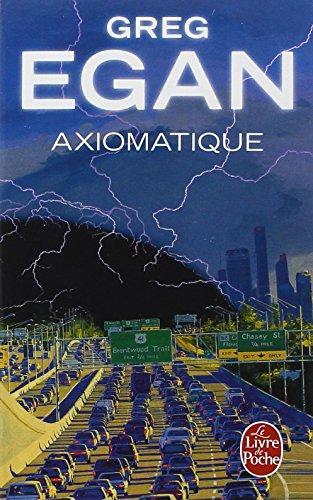
Cette nouvelle, qui donne sa superbe image de couverture à ce recueil, se résume à ces deux simples phrases : "On ne peut pas voir le futur. On ne peut pas changer le passé.". Le défi qu'Egan a relevé a été de donner une représentation visuelle à cette phrase.
Un amour approprié
Cette utilisation imaginative de l'utérus, bien que choquante à priori ne devrait pas forcément être considérée comme amorale, je trouve.
La Morale et le virologue
Le genre d'histoire dont les médias pourraient raffoler si elle devenait réalité.
Plus près de toi
Cette nouvelle a eu pour moi des résonnances très personnelles. En effet, comme l'auteur, je pense sincèrement qu'on ne peut pas connaître vraiment les gens : on ne voit d'eux qu'une facade, et leurs motivations profondes nous restent invisibles. Cependant, je pense que je préfère avoir choisi de conserver cette ignorance plutôt que d'essayer de lever le doute.
Orbite instable dans l'espace des illusions
Après une espèce de révolution spirituelle, des vagabonds errent aux franges de croyances matérialisées. Mais peut-être errent-ils au sein de leur propre espace d'attraction ...
Et maintenant mon avis
Ce n'est pas un recueil de nouvelles de hard-sciences, c'est LE recueil de nouvelles sur la hard-science. C'est même à mon avis l'une de mes meilleures lectures de SF. Tout simplement. Grâce à la profondeur de sa réflexion, Egan arrive à chaque fois à m'emmener dans des univers plus ou moins compréhensibles, mais toujours prenants. Je regrette juste quelques détails, comme la permanence des assassins : dans au moins neuf de ces nouvelles, l'auteur utilise les ressorts classiques de l'zenquête policière pour nous dévoiler son univers "par la bande". C'est dommage, je trouve. Surtout que dans d'autres (comme par exemple "Vers les ténèbresé qui est pour moi la meilleure du recueil) il se passe allègrement de ce genre d'artifices.
Cela dit, le point essentiel d'Egan, celui qui lui permet d'écrire tout ça, est assez clair : la technologie n'est rien, elle ne nous définit pas en tant qu'êtres humains. Ce qui nous définit plus, c'est notre humanité. Et cette humanité n'est affectée d'aucune manière dans ces nouvelles. C'est peut-être ce qui en fait pour moi un recueil aussi forrmidable - et aussi angoissant. Et ce qui doit en faire pour vous qui ne l'avez pas encore lu une lecture rigoureusement indispensable.