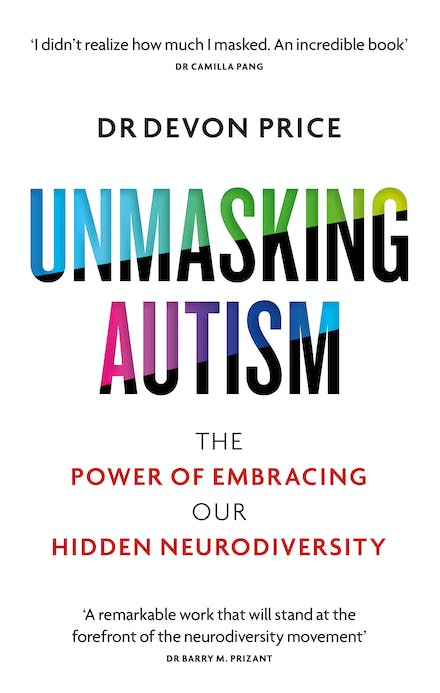
Have you, a friend or family member been living with undiagnosed autism?
For every visibly Autistic person you meet, there are countless ‘masked’ people who pass as neurotypical. They don’t fit the stereotypical mould of Autism and are often forced by necessity to mask who they are, spending their entire lives trying to hide their Autistic traits. In particular, there is evidence that Autism remains significantly undiagnosed in women, people of colour, trans and gender non-conforming people, many of whom are only now starting to recognise those traits later in life.
Blending cutting-edge research, personal insights and practical exercises for self-expression, Dr Devon Price examines the phenomenon of ‘masking’, making a passionate argument for radical authenticity and non-conformity. A powerful call for change, Unmasking Autism gifts its readers with the tools to uncover their true selves and build a new society – one where everyone can thrive on …
Have you, a friend or family member been living with undiagnosed autism?
For every visibly Autistic person you meet, there are countless ‘masked’ people who pass as neurotypical. They don’t fit the stereotypical mould of Autism and are often forced by necessity to mask who they are, spending their entire lives trying to hide their Autistic traits. In particular, there is evidence that Autism remains significantly undiagnosed in women, people of colour, trans and gender non-conforming people, many of whom are only now starting to recognise those traits later in life.
Blending cutting-edge research, personal insights and practical exercises for self-expression, Dr Devon Price examines the phenomenon of ‘masking’, making a passionate argument for radical authenticity and non-conformity. A powerful call for change, Unmasking Autism gifts its readers with the tools to uncover their true selves and build a new society – one where everyone can thrive on their own terms.
The book has some helpful info and is okay overall, though honestly it didn't do much for me personally - maybe because I spent a lot of time reading neurodivergent people's experiences and general info online before reading the book, so it felt a bit redundant. If you're new to the topic though, I think it might be a good starting point.
The book has some helpful info and is okay overall, though honestly it didn't do much for me personally - maybe because I spent a lot of time reading neurodivergent people's experiences and general info online before reading the book, so it felt a bit redundant. If you're new to the topic though, I think it might be a good starting point.
It was a very helpful read. To learn more about autism I started to read books and this one helped me immensely. It focuses on how autistic people mask and why they mask their autistic traits. Also, it explains why anyone who is not a "white, rich boy" has a hard time to get an official diagnosis even today. Also it comes with lots of helpful, handy exercises to put off the masks one has been wearing. Some parts of the book are a bit lot focused on the situation in the US - you may want to find data or statistics about your country-, yet, that's understandable given the author origin.
It was a very helpful read. To learn more about autism I started to read books and this one helped me immensely. It focuses on how autistic people mask and why they mask their autistic traits. Also, it explains why anyone who is not a "white, rich boy" has a hard time to get an official diagnosis even today. Also it comes with lots of helpful, handy exercises to put off the masks one has been wearing.
Some parts of the book are a bit lot focused on the situation in the US - you may want to find data or statistics about your country-, yet, that's understandable given the author origin.
A book I wish it would be translated into > 50 languages
5 stars
Radical and intriguing, this isn't the common book about Autism that you find in bookshelves, especially not written in languages other than English. This groundbreaking book, written by an Autistic and transgender author, is all about those hidden, 'masked' Autistics, especially from intersectionally marginalised populations, like Black, trans, women and other marginalised genders, and people with other disabilities on top.
Dr. Price takes a radical approach of harm reduction and social justice, identifying how much harm the ableist & capitalist society inflicts on Autistics (and on other neuro-divergent and disabled people, but really on everyone), forcing them into obscuring their disabilities, so that they can conform to 'normality' and function in an alienating, industrial society that punishes our quirks. The book helps neurodivergent people identifying their disability (seen from the social model of disability), and guides neuro-divergent people how they can actualise their own identity and identity their own …
Radical and intriguing, this isn't the common book about Autism that you find in bookshelves, especially not written in languages other than English. This groundbreaking book, written by an Autistic and transgender author, is all about those hidden, 'masked' Autistics, especially from intersectionally marginalised populations, like Black, trans, women and other marginalised genders, and people with other disabilities on top.
Dr. Price takes a radical approach of harm reduction and social justice, identifying how much harm the ableist & capitalist society inflicts on Autistics (and on other neuro-divergent and disabled people, but really on everyone), forcing them into obscuring their disabilities, so that they can conform to 'normality' and function in an alienating, industrial society that punishes our quirks. The book helps neurodivergent people identifying their disability (seen from the social model of disability), and guides neuro-divergent people how they can actualise their own identity and identity their own values and worthiness. Because society often does not permit this, the book also aims to change society itself.
Throughout the book, we are guided through Heather R. Morgan's Values-Based Integration Process, which I still want to go through, especially as I am about to start a new chapter in my own life.
The only thing I really do not like about the book is that it is only available in English. There are huge knowledge gaps and language barriers when it comes to #ActuallyAustic, as lot of great resources on Autism written by Autistic authors are only available in English. As a consequence, a lot of stereotypes about (especially masked) autism still persist. I think translations of this and similar books could really counter them.
Books written from the perspective of intersectionally are very valuable. Personally, I really enjoyed that the author is transgender himself, and there are a lot of things I could personally identify with in his story and in the stories of the diverse set of interviewed Autistics.
Another unsatisfying book on autism. Slightly helpful, but unsatisfying. I liked the first chapter about what autism is, though I would have liked to know what kind of studies found out the information and a bit more elaboration on the technical stuff. I kind of wanted just that chapter, but it being the book. Instead, the rest of the book was blog-style authors experiences, opinions and advice. Admittedly respectable all of it, but a bit informal for my liking. Besides maybe not jiving with the authors writing style, I think I also feel this way about the book because the science just isn't there yet. The author has to rely on "this educator is doing this thing" because there is no "this comprehensive study of what things were done and their impacts". Another hardship I have with this book is that it describes autism from the social model of disability …
Another unsatisfying book on autism. Slightly helpful, but unsatisfying. I liked the first chapter about what autism is, though I would have liked to know what kind of studies found out the information and a bit more elaboration on the technical stuff. I kind of wanted just that chapter, but it being the book. Instead, the rest of the book was blog-style authors experiences, opinions and advice. Admittedly respectable all of it, but a bit informal for my liking. Besides maybe not jiving with the authors writing style, I think I also feel this way about the book because the science just isn't there yet. The author has to rely on "this educator is doing this thing" because there is no "this comprehensive study of what things were done and their impacts". Another hardship I have with this book is that it describes autism from the social model of disability point of view, which I love. But that relies heavily on the society of the autistic person to be relatable, and my society is not the authors society. And lastly, I have the nitpicks like the author explaining what label avoidance is and immediately after using kind of shaming language towards the labels of misdiagnoses that autistics might get. Or writing about "how it is" without referencing the timeframe or locality of when and where it is like that. So yeah, kind of nice book, helped me a bit, still unsatisfying.