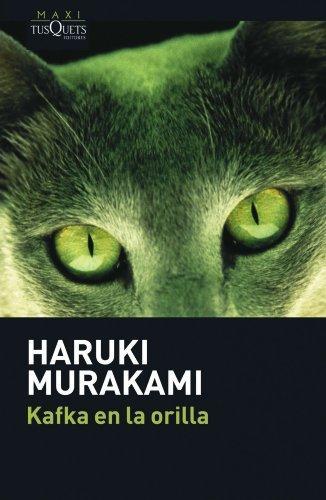
Kafka en la orilla

714 pages

Spanish language

Published Nov. 6, 2008

ISBN:
978-84-8383-524-1
Copied ISBN!
Goodreads:
4951360

View on Inventaire

Kafka Tamura se va de casa el día en que cumple quince años. Los motivos, si es que los hay, son las malas relaciones con su padre –un famoso escultor convencido de que su hijo repetirá el aciago sino del Edipo de la tragedia clásica– y la sensación de vacío producida por la ausencia de su madre y su hermana, que se marcharon también cuando él era muy pequeño. Sus pasos le llevarán al sur del país, a Takamatsu, donde encontrará refugio en una peculiar biblioteca y conocerá a la misteriosa señora Saeki. Si sobre la vida de Kafka se cierne la tragedia (en el sentido clásico), sobre la de Satoru Nakata ya se ha abatido: de niño, durante la segunda guerra mundial, sufrió un extraño accidente del que salió con secuelas, sumido en una especie de olvido de sí, con dificultades para comunicarse... salvo con los gatos. A los …

18 editions

Kafka on the Shore

I couldn't help but feel that this story was "Lynchian". The premise is mundane, Kafka Tamura is just another kid running away from his family. The deepening of the story involves chance encounters which later become inseparable from a dramatic notion of fate. Tamura is drawn into a vortex, his fate at odds with the rational, modern, mundane sense of reality brings out the surreal. This is something that the story stylistically clarifies: that surrealism is about subverting what we expect from reality. Dreams are based on our experiences but they are uncanny because they do not follow the rules of the waking world. on the Shore also interestingly seems to suggest kinship between surrealism and myth, Murakami places in our mind the idea that myth is dream and dream is myth. Oedipus and Orpheus live in the unconscious, ruling our fates whether or not we realize it. And this …

Kafka on the Shore

I couldn't help but feel that this story was "Lynchian". The premise is mundane, Kafka Tamura is just another kid running away from his family. The deepening of the story involves chance encounters which later become inseparable from a dramatic notion of fate. Tamura is drawn into a vortex, his fate at odds with the rational, modern, mundane sense of reality brings out the surreal. This is something that the story stylistically clarifies: that surrealism is about subverting what we expect from reality. Dreams are based on our experiences but they are uncanny because they do not follow the rules of the waking world. on the Shore also interestingly seems to suggest kinship between surrealism and myth, Murakami places in our mind the idea that myth is dream and dream is myth. Oedipus and Orpheus live in the unconscious, ruling our fates whether or not we realize it. And this …

Review of 'Kafka on the shore' on 'Storygraph'

A quite interesting mystery full of self-discovery at its core, with quite an unusual narrative that tells this story from multiple angles at once, this book seemed quite promising from the start. However, the overly casual dialogues that oscillate between intentionally inarticulate and pseudo-intellectual quickly got on my nerves, and the subsequent attempts to make light of pedophilia as well as incest were only the last straw. I'm fairly confident that this is the worst book that I've read in the past decade or so.

Review of 'Kafka on the Shore' on 'Goodreads'

This is my first Murakami book. And I really liked his style of writing. Murakami has a knack for capturing beauty, mood, and scenery perfectly. And that is what stood out for me among all the magical realism and philosophical ideas in the book. Just like how reality can be modeled by mathematics in a much better way if imaginary numbers are used, with skillful writers like Murakami, magical worlds can convey the truth and real feelings better than hyper-realism. I do not claim to have solved all the riddles the plot posed, but I doubt that is the point of the book. Unlike his mastery of building and conveying the mood and beauty, Murakami's attempt at conveying philosophical ideas is not as successful. Some of the philosophical ideas unintentionally felt like funny philosophical arguments written by Douglas Adams. But that is just a minor gripe I have in an …

Review of 'Kafka on the shore' on 'Goodreads'

"The whole world is a metaphor". No sentence could describe this book better. At the same time it is also a labyrinth and a collection of riddles which you are trying to puzzle together.
It describes several stories of characters running in parallel. Their interconnection is not clear until the very end and even after that, there is still a lot of place of interpretation.
That is one of the few books where the next event couldn’t be foreseen at all, the whole time you can look out for clues to find out what it means.
Even after reading, the book leaves you wondering what it does mean. You can think about theories but you will never know for certain.
That characteristics is major for this book. It is for certain excellent.

Review of 'Kafka on the Shore' on 'Goodreads'

Haruki Murakami adds his own brand of magical realism to ancient themes, seasons to taste, and shakes it all up. The result is--delightful. Just go with it!

And again, he's compelled me to listen to something I would never have discovered on my own--
https://www.youtube.com/watch?v=eika4rkMOGY

(Yes, that specific version)

avatar for bjerre

rated it

avatar for s_green

rated it

avatar for peter

rated it

avatar for hw

rated it

avatar for ASquareClaire

rated it

avatar for carms

rated it

avatar for stinkingpig

rated it

avatar for patrick

rated it

avatar for sudarkoff@ramblingreaders.org

rated it

avatar for fabriek@bookwyrm.social

rated it

avatar for Akasha

rated it

avatar for dr.skylaser

rated it

avatar for rolomon

rated it

avatar for nacho@lectura.social

rated it

avatar for phmongeau

rated it

avatar for patrick

rated it