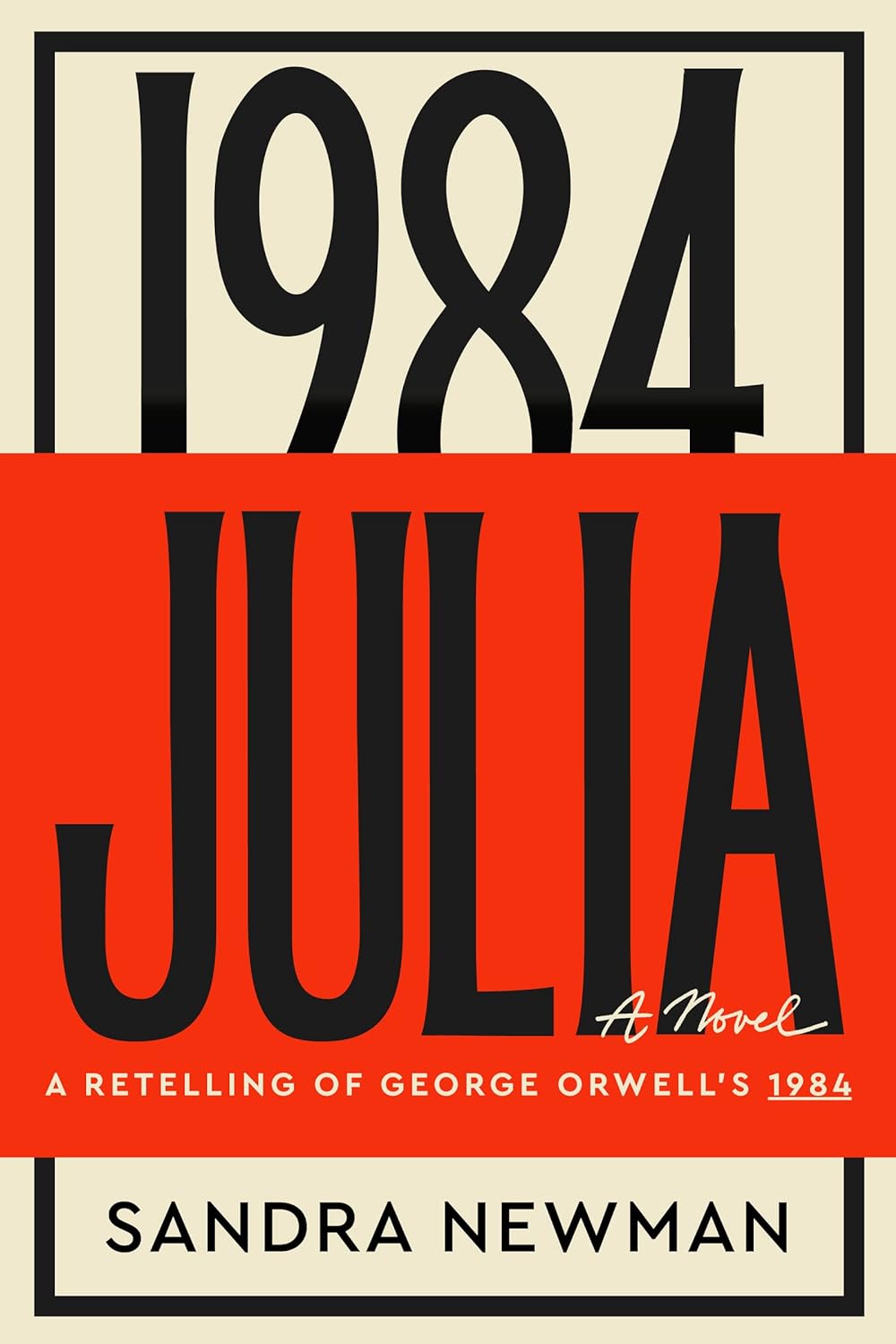
An imaginative, feminist, and brilliantly relevant-to-today retelling of Orwell’s 1984, from the point of view of Winston Smith’s lover, Julia, by critically acclaimed novelist Sandra Newman.
Julia Worthing is a mechanic, working in the Fiction Department at the Ministry of Truth. It’s 1984, and Britain (now called Airstrip One) has long been absorbed into the larger trans-Atlantic nation of Oceania. Oceania has been at war for as long as anyone can remember, and is ruled by an ultra-totalitarian Party, whose leader is a quasi-mythical figure called Big Brother. In short, everything about this world is as it is in Orwell’s 1984.
All her life, Julia has known only Oceania, and, until she meets Winston Smith, she has never imagined anything else. She is an ideal citizen: cheerfully cynical, always ready with a bribe, piously repeating every political slogan while believing in nothing. She routinely breaks the rules, but …
An imaginative, feminist, and brilliantly relevant-to-today retelling of Orwell’s 1984, from the point of view of Winston Smith’s lover, Julia, by critically acclaimed novelist Sandra Newman.
Julia Worthing is a mechanic, working in the Fiction Department at the Ministry of Truth. It’s 1984, and Britain (now called Airstrip One) has long been absorbed into the larger trans-Atlantic nation of Oceania. Oceania has been at war for as long as anyone can remember, and is ruled by an ultra-totalitarian Party, whose leader is a quasi-mythical figure called Big Brother. In short, everything about this world is as it is in Orwell’s 1984.
All her life, Julia has known only Oceania, and, until she meets Winston Smith, she has never imagined anything else. She is an ideal citizen: cheerfully cynical, always ready with a bribe, piously repeating every political slogan while believing in nothing. She routinely breaks the rules, but also collaborates with the regime when necessary. Everyone likes Julia.
Then one day she finds herself walking toward Winston Smith in a corridor and impulsively slips him a note, setting in motion the devastating, unforgettable events of the classic story. Julia takes us on a surprising journey through Orwell’s now-iconic dystopia, with twists that reveal unexpected sides not only to Julia, but to other familiar figures in the 1984 universe. This unique perspective lays bare our own world in haunting and provocative ways
The author really does capture the feeling and voice of 1984,
Well, at least it feels like that until you realize that The Brotherhood just hasn't lost the last of their humanity, when they read off the oath at the end.
Maybe a bullet would have been kinder.
The author really does capture the feeling and voice of 1984,
Well, at least it feels like that until you realize that The Brotherhood just hasn't lost the last of their humanity, when they read off the oath at the end.
Julia is cool. Winston Smith, not so much. Anyway, you don't need to have read 1984 to appreciate "Julia." It's excellent. Frightening, but not (entirely) hopeless. A bit queer, in the best sense. Both in that queer people are present, and in that Julia's interest in sex for pleasure renders her suspect in the eyes of the regime. Definitely worth reading in these times of repression and spreading fascism.
Julia is cool. Winston Smith, not so much. Anyway, you don't need to have read 1984 to appreciate "Julia." It's excellent. Frightening, but not (entirely) hopeless. A bit queer, in the best sense. Both in that queer people are present, and in that Julia's interest in sex for pleasure renders her suspect in the eyes of the regime. Definitely worth reading in these times of repression and spreading fascism.
This book tells the story of 1984 from the perspective of Julia instead of Winston Smith. An interesting idea, but I don't think it is worth a new book - especially as there is quite a bit of overlap between the two characters, given their relationship forms a key part of the story. The only way I could see this working is if chapters alternated between viewpoints - a bit like Game of Thrones where you read about the same scene from different perspectives.
I didn't feel that the situation was anything like as chilling as the original. Smith feels constantly watched and oppressed (which he is), whereas Julia seems to have more freedom and agency - or at least the impression of such. Smith is also an integral part of the rewriting of history - that's literally his job - even though he's uncomfortable about it, whereas Julia …
This book tells the story of 1984 from the perspective of Julia instead of Winston Smith. An interesting idea, but I don't think it is worth a new book - especially as there is quite a bit of overlap between the two characters, given their relationship forms a key part of the story. The only way I could see this working is if chapters alternated between viewpoints - a bit like Game of Thrones where you read about the same scene from different perspectives.
I didn't feel that the situation was anything like as chilling as the original. Smith feels constantly watched and oppressed (which he is), whereas Julia seems to have more freedom and agency - or at least the impression of such. Smith is also an integral part of the rewriting of history - that's literally his job - even though he's uncomfortable about it, whereas Julia is mainly responsible for fixing machines (when she's not bunking off) and seems happy, even enthusiastic, about collaborating.
Had this been told from the perspective of O'Brien, or Big Brother, that might have been more interesting - I would really like to see how things work from the perspective of someone who is operating the system, as opposed to a cog in the machine. As it stands, this feels like a book published for the purpose of celebrating the 75th anniversary of the original novel. I certainly don't agree with the LA Times: 'reads like the original — only better'. Doubleplusbad thoughtcrime.
Not just a retelling but a complete recasting of 1984. It's helpful to consider this as a separate work: a response to 1984, in a way, rather than a layering on top or a direct sequel. It's a criticism, an extension, a modernization, and a deep appreciation for the ideas all in one - and I was hooked. There's so much I want to write about here, but I don't want to spoil it. The ending, in particular, is perfect.
Not just a retelling but a complete recasting of 1984. It's helpful to consider this as a separate work: a response to 1984, in a way, rather than a layering on top or a direct sequel. It's a criticism, an extension, a modernization, and a deep appreciation for the ideas all in one - and I was hooked. There's so much I want to write about here, but I don't want to spoil it. The ending, in particular, is perfect.
Eagerly anticipating the release of "Julia: A Retelling of George Orwell's 1984," I was thrilled by the prospect of revisiting the dystopian world through the eyes of Julia, a character whose enigmatic presence in Orwell's masterpiece had always intrigued me. While the idea of expanding upon Orwell's universe was enticing, the realization that the book was commissioned by Orwell's estate dampened my enthusiasm. It was hard to ignore the potential for commercial motives to overshadow the creative integrity of the project.
Upon reading the novel, my initial apprehension proved to be well-founded. The narrative lacked the captivating prose and thought-provoking depth that characterized Orwell's original work. The author's attempt to flesh out Julia's character fell short, failing to capture the essence of her complexities and motivations. Additionally, the plot deviated from the established canon of 1984, introducing inconsistencies and undermining the cohesiveness of the story.
While I commend the author's …
Eagerly anticipating the release of "Julia: A Retelling of George Orwell's 1984," I was thrilled by the prospect of revisiting the dystopian world through the eyes of Julia, a character whose enigmatic presence in Orwell's masterpiece had always intrigued me. While the idea of expanding upon Orwell's universe was enticing, the realization that the book was commissioned by Orwell's estate dampened my enthusiasm. It was hard to ignore the potential for commercial motives to overshadow the creative integrity of the project.
Upon reading the novel, my initial apprehension proved to be well-founded. The narrative lacked the captivating prose and thought-provoking depth that characterized Orwell's original work. The author's attempt to flesh out Julia's character fell short, failing to capture the essence of her complexities and motivations. Additionally, the plot deviated from the established canon of 1984, introducing inconsistencies and undermining the cohesiveness of the story.
While I commend the author's endeavor to explore Julia's perspective, the execution ultimately failed to live up to the promise of the premise. For those seeking a profound and immersive exploration of the themes raised in 1984, Orwell's original masterpiece remains the definitive text.