Hardcover, 266 pages
English language
Published July 1, 1998 by Avon Books.
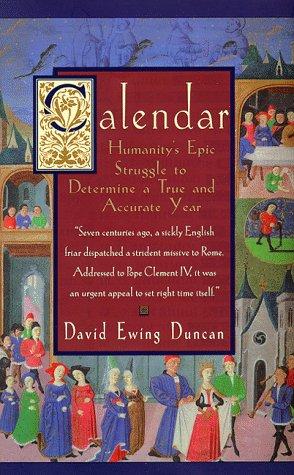
Hardcover, 266 pages
English language
Published July 1, 1998 by Avon Books.
From the earliest recorded date (4236 B.C.), people have tried to organize their lives according to the movements of the sun, moon and stars — and have, for the most part, consistently gotten it wrong. In this irresistible volume, David Ewing Duncan takes us on an extraordinary Journey through man’s reckoning of time, ranging from one of the earliest calendars (a series of markings gouged into an eagle bone 13,000 years ago) to the atomic clocks of today, which measure time too well for an ever slowing Earth.
The adventure spans the world from Stonehenge to astronomically aligned pyramids at Giza, from Mayan observatories at Chichen Itza to the atomic clock in Washington, the world’s official timekeeper since the 1960s. We visit cultures from Vedic India and Cleopatra’s Egypt to Byzantium and the Elizabethan court and meet an impressive cast of historic personages from Julius Caesar to Omar Khayyam, …
From the earliest recorded date (4236 B.C.), people have tried to organize their lives according to the movements of the sun, moon and stars — and have, for the most part, consistently gotten it wrong. In this irresistible volume, David Ewing Duncan takes us on an extraordinary Journey through man’s reckoning of time, ranging from one of the earliest calendars (a series of markings gouged into an eagle bone 13,000 years ago) to the atomic clocks of today, which measure time too well for an ever slowing Earth.
The adventure spans the world from Stonehenge to astronomically aligned pyramids at Giza, from Mayan observatories at Chichen Itza to the atomic clock in Washington, the world’s official timekeeper since the 1960s. We visit cultures from Vedic India and Cleopatra’s Egypt to Byzantium and the Elizabethan court and meet an impressive cast of historic personages from Julius Caesar to Omar Khayyam, and giants of science such as Galileo and Copernicus. Our present calendar system predates the invention of the telescope, the mechanical clock, and the concept of zero-and its development is one of the great untold stories of science and history.
How did Pope Gregory set right a calendar which was in error by at least ten full days? What did time mean to a farmer on the Rhine in 800 A.D.? What was daily life like in the Middle Ages, when the general population reckoned births and marriages by seasons, wars, kings’ reigns, and saints’ days? In short, how did the world ever come to agree on what day it was? As our personal clocks tick faster and time becomes more precious each day, as we move toward the mathematically awesome threshold of a new millennium, here is a fresh, stimulating volume that answers —and raises — a host of fascinating questions about the nature of human timekeeping and the majestic historical forces that have produced the miracle of the calendar.