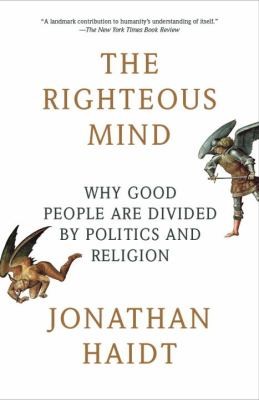
Why can’t our political leaders work together as threats loom and problems mount? Why do people so readily assume the worst about the motives of their fellow citizens? In The Righteous Mind, social psychologist Jonathan Haidt explores the origins of our divisions and points the way forward to mutual understanding.
His starting point is moral intuition—the nearly instantaneous perceptions we all have about other people and the things they do. These intuitions feel like self-evident truths, making us righteously certain that those who see things differently are wrong. Haidt shows us how these intuitions differ across cultures, including the cultures of the political left and right. He blends his own research findings with those of anthropologists, historians, and other psychologists to draw a map of the moral domain. He then examines the origins of morality, overturning the view that evolution made us fundamentally selfish creatures. But rather than arguing …
Why can’t our political leaders work together as threats loom and problems mount? Why do people so readily assume the worst about the motives of their fellow citizens? In The Righteous Mind, social psychologist Jonathan Haidt explores the origins of our divisions and points the way forward to mutual understanding.
His starting point is moral intuition—the nearly instantaneous perceptions we all have about other people and the things they do. These intuitions feel like self-evident truths, making us righteously certain that those who see things differently are wrong. Haidt shows us how these intuitions differ across cultures, including the cultures of the political left and right. He blends his own research findings with those of anthropologists, historians, and other psychologists to draw a map of the moral domain. He then examines the origins of morality, overturning the view that evolution made us fundamentally selfish creatures. But rather than arguing that we are innately altruistic, he makes a more subtle claim—that we are fundamentally groupish. It is our groupishness, he explains, that leads to our greatest joys, our religious divisions, and our political affiliations. In a stunning final chapter on ideology and civility, Haidt shows what each side is right about, and why we need the insights of liberals, conservatives, and libertarians to flourish as a nation.
Really thought provoking. Made me understand a little better how people think on the opposite sides of the spectrum, and how compelling moral arguments get made. (It's not just facts.)
Really thought provoking. Made me understand a little better how people think on the opposite sides of the spectrum, and how compelling moral arguments get made. (It's not just facts.)
This is such a worthwhile read. The author explores morality through psychology, and draws on a lot of personal experience and scientific experiments to back up his claims.
Here were the most intriguing ideas:
Most people believe themselves to be rational - that they use reason to make decisions. But the author says this is false. Through their intuition, people make judgments and decisions in an instant. Reason then is just a tool used to defend their original judgments. Have you ever seen people on Facebook continue to argue a point in the face of all logic against it? Or, when no more arguments can be thought up, just stop talking and disappear? (Or, in the worst case, go back and delete their conversation?) I know I've seen it before … and been guilty of it myself. It's because people will fight hard to protect the original judgment their brain …
This is such a worthwhile read. The author explores morality through psychology, and draws on a lot of personal experience and scientific experiments to back up his claims.
Here were the most intriguing ideas:
Most people believe themselves to be rational - that they use reason to make decisions. But the author says this is false. Through their intuition, people make judgments and decisions in an instant. Reason then is just a tool used to defend their original judgments. Have you ever seen people on Facebook continue to argue a point in the face of all logic against it? Or, when no more arguments can be thought up, just stop talking and disappear? (Or, in the worst case, go back and delete their conversation?) I know I've seen it before … and been guilty of it myself. It's because people will fight hard to protect the original judgment their brain devised. The author demonstrates it in action in a set of fun scientific experiments.
Therefore, to expect a perfect society ruled by emotionless Spocks or philosopher kings is a joke, because people don't function that way.
The author identifies six types of morality and describes how liberals and conservatives emphasize different types. As a result, you can have two people who are both good people but have fundamental disagreements about morality and are even baffled by each others' feelings. I'm sure you've seen this in action, when you see a crowd cheer during a speech by a politician not from your preferred political party.
The author identifies himself as liberal. However, a main theme of his book is being open minded and trying to understand people who think differently. As such, he kind of treats conservatives with kid gloves, but he includes some fascinating criticisms of liberals.
The most helpful discussion for me was that of disgust. He describes the emotion as originally used by humans to prevent them from eating the wrong thing or touching something diseased and becoming sick. But disgust has adapted to help enforce people's senses of morality. In the past I have seen people say they are disgusted by some political issue on Facebook, and it baffled me. Why is this person literally feeling sick about something that seems completely harmless to me? I always assumed that they were exaggerating and not choosing their words carefully. But now I understand that they truly were physically disgusted by something that violated the basis of their morality, and that I should take this very real reaction into account.
Anyway, great book. The author's style is pleasant and patient, and he still packs in a lot of insights, backed up by data. I recommend it.