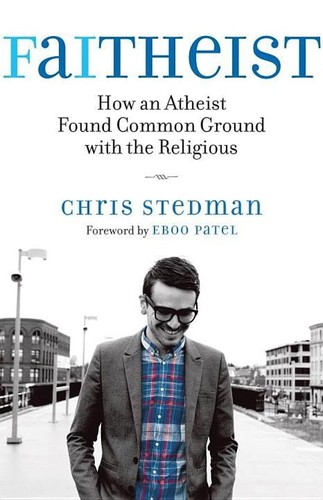

Doc Kinne reviewed Faitheist by Chris Stedman
Review of 'Faitheist' on 'Goodreads'
4 stars
I think that the beginning of Chris's book will strike an amazing cord in many of its readers. I expect that a good bit of its readers may be somewhere on Chris's spectrum. In my case I was heavily in Chris's spectrum as a Gay boy who moved from a social Catholic, to a committed Wiccan, ultimately ending up as a Humanist/Secular Buddhist who finds his expression within the Unitarian Universalist community. Reading the first part of Chris's book was, in a lot of ways, like reading my essay "Spiritual Atheism: A Search for a Reality-based Theology."
Chris uses the medium of story-telling to get his point across, and he does that very effectively. Having said that, I can't give his book the 5-stars I was looking forward to giving it because, in the end, the book just doesn't go far enough. In the end it doesn't answer the question …
I think that the beginning of Chris's book will strike an amazing cord in many of its readers. I expect that a good bit of its readers may be somewhere on Chris's spectrum. In my case I was heavily in Chris's spectrum as a Gay boy who moved from a social Catholic, to a committed Wiccan, ultimately ending up as a Humanist/Secular Buddhist who finds his expression within the Unitarian Universalist community. Reading the first part of Chris's book was, in a lot of ways, like reading my essay "Spiritual Atheism: A Search for a Reality-based Theology."
Chris uses the medium of story-telling to get his point across, and he does that very effectively. Having said that, I can't give his book the 5-stars I was looking forward to giving it because, in the end, the book just doesn't go far enough. In the end it doesn't answer the question that, in my mind, the whole book was set up to explore and answer.
We learn how and why Chris became an atheist. We learn clearly that he thinks that the "New Atheist" movement typified by Dawkins, among others, is shooting themselves in the foot with their characteristically antagonistic methodology. We know that Chris's answer is interfaith dialog, and I think he gives good reasons why he thinks it works. But the stories I was after in the second half of the book were stories of that interfaith dialog experience, HOW he makes it work, WHAT he's experienced doing it.
But those stories, really, aren't there and so you're left, in the end, somewhat hanging. At 26 even Chris himself wondered why he was writing a memoir. After reading Faitheist I think Chris still has a memoir still in him after he gains some more experience in what he's doing. I look forward to reading that book, now that he's whetted my apatite with this one.