Dan Keck reviewed Childhood's End. by Arthur C. Clarke
1950s sci fi, short and worth a look
3 stars
Short and more interested in ideas and characters. Seems to be the kind of work Douglas Adams was parodying.
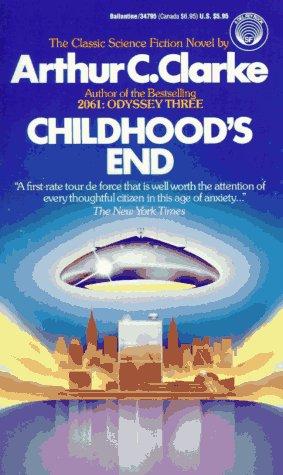
Mass Market Paperback, 224 pages
English language
Published May 12, 1987 by Del Rey.
Childhood's End is a 1953 science fiction novel by the British author Arthur C. Clarke. The story follows the peaceful alien invasion of Earth by the mysterious Overlords, whose arrival begins decades of apparent utopia under indirect alien rule, at the cost of human identity and culture. Clarke's idea for the book began with his short story "Guardian Angel" (published in New Worlds #8, winter 1950), which he expanded into a novel in 1952, incorporating it as the first part of the book, "Earth and the Overlords". Completed and published in 1953, Childhood's End sold out its first printing, received good reviews and became Clarke's first successful novel. The book is often regarded by both readers and critics as Clarke's best novel and is described as "a classic of alien literature". Along with The Songs of Distant Earth (1986), Clarke considered Childhood's End to be one of his favourites of …
Childhood's End is a 1953 science fiction novel by the British author Arthur C. Clarke. The story follows the peaceful alien invasion of Earth by the mysterious Overlords, whose arrival begins decades of apparent utopia under indirect alien rule, at the cost of human identity and culture. Clarke's idea for the book began with his short story "Guardian Angel" (published in New Worlds #8, winter 1950), which he expanded into a novel in 1952, incorporating it as the first part of the book, "Earth and the Overlords". Completed and published in 1953, Childhood's End sold out its first printing, received good reviews and became Clarke's first successful novel. The book is often regarded by both readers and critics as Clarke's best novel and is described as "a classic of alien literature". Along with The Songs of Distant Earth (1986), Clarke considered Childhood's End to be one of his favourites of his own novels. The novel was nominated for the Retro Hugo Award for Best Novel in 2004. Several attempts to adapt the novel into a film or miniseries have been made with varying levels of success. Director Stanley Kubrick expressed interest in the 1960s, but collaborated with Clarke on 2001: A Space Odyssey (1968) instead. The novel's theme of transcendent evolution also appears in Clarke's Space Odyssey series. In 1997, the BBC produced a two-hour radio dramatization of Childhood's End that was adapted by Tony Mulholland. The Syfy Channel produced a three-part, four-hour television miniseries of Childhood's End, which was broadcast on December 14–16, 2015.
Short and more interested in ideas and characters. Seems to be the kind of work Douglas Adams was parodying.
Childhood’s End, by Arthur C. Clarke, is a book about the fate of humanity after they make contact with a benevolent alien race, that helps them reach a Golden Age of progress and peace. So, what if aliens invaded the planet, but they actually helped us build a utopia? And why?
Compared to the previous two books I read, that also deal with Humanity making contact with alien life. Childhood’s End takes place in Earth itself, in a time where humans are barely getting started in the space race, and right when they’re about to take their first steps, they realize they already lost—they are not alone.
These aliens, known as the Overlords, do not come to cause havoc, but they seem to want to help us. They end war, they end animal cruelty, they end racism, divisions and countries. They intend to help humanity achieve a united …
Childhood’s End, by Arthur C. Clarke, is a book about the fate of humanity after they make contact with a benevolent alien race, that helps them reach a Golden Age of progress and peace. So, what if aliens invaded the planet, but they actually helped us build a utopia? And why?
Compared to the previous two books I read, that also deal with Humanity making contact with alien life. Childhood’s End takes place in Earth itself, in a time where humans are barely getting started in the space race, and right when they’re about to take their first steps, they realize they already lost—they are not alone.
These aliens, known as the Overlords, do not come to cause havoc, but they seem to want to help us. They end war, they end animal cruelty, they end racism, divisions and countries. They intend to help humanity achieve a united planet, a World State, a seemingly perfect society, a Utopia.
How this is done, and the events that develop in the novel, are something that I think you should simply read, it flies by, really quickly. The ideas displayed here are really, really interesting. For a book published in 1953, maybe the most aged thing—that is quite charming still—is how TV and radio are the main way information is delivered to people.
The commentary on humanity, consummerism, religion, racism, art, transportation, education, work, politics, and many other topics regarding Earth and how it lives its life under the guidance of the Overlords, is simply super interesting. I had never read a novel by Clarke, but I can see why he remains relevant to this day.
The ideas on display, about humanity, about alien life, about space—and beyond. They are just incredible. The novel was full of moments where I could not believe what I was reading, every time I turned my page there was something happening that only raised the mystery behind the Overlord’s true form, their true motives, the consequences of humanity living in a constant state of peace. The novel is not the longest I’ve read by any means, but its content is really thought-provoking and it just makes you question the things we take for granted even today.
I would dare say it is the most quotable book I’ve read in ages, the statements, the events, those last few chapters. I wasn’t worried about the stakes at hand, I could not even comprehend, I could not even grasp what happened, I could not even get mad. I could only read.
I am so glad I went into this blind. Simply a great book.
It is a bitter thought, but you must face it. The planets you may one day possess. But the stars are not for Man.

—Arthur C. Clarke, Childhood’s End.
This is an absolutely outstanding, albeit disturbing, tale of the future. It is simply amazing that it was written in the 1950s. I place it in a category of must read science fiction.
Written in 1953 and covering Clarke's ideas of modernity and social philosophy, it was interesting to compare reality with the fictional predictions of how to create utopia. Two moments stood out: the invention of birth control and paternity testing leading to the end of "Puritan aberration"; and while he claims, " Evil men could be destroyed, but nothing could be done with good men who were deluded," he doesn't seem to apply this to systems-thinking. So, there's a lot of racism and patriarchy in a book that is trying to write those things out of fictional existence. I imagine Escher's flawed hand drawing the flawed human. He also had a character outraged at the THREE whole hours of radio/TV consuming people's minds, and how this was a blight on humanity's creativity and thinking. That one he seems to have nailed pretty spot-on. His solution for it was odd, and left …
Written in 1953 and covering Clarke's ideas of modernity and social philosophy, it was interesting to compare reality with the fictional predictions of how to create utopia. Two moments stood out: the invention of birth control and paternity testing leading to the end of "Puritan aberration"; and while he claims, " Evil men could be destroyed, but nothing could be done with good men who were deluded," he doesn't seem to apply this to systems-thinking. So, there's a lot of racism and patriarchy in a book that is trying to write those things out of fictional existence. I imagine Escher's flawed hand drawing the flawed human. He also had a character outraged at the THREE whole hours of radio/TV consuming people's minds, and how this was a blight on humanity's creativity and thinking. That one he seems to have nailed pretty spot-on. His solution for it was odd, and left out women completely. He kind of glosses over UBI or work-related issues. I suppose that was necessary to keep the focus on the plot, but it's a pretty huge handwavium for a utopia. I would have preferred to hear more about those things, and less about the flying transportation. There was a lot in the travel parts that I found silly. Did they not have international travel in 1953? [they did: 1945] It certainly hasn't cured any societal ills. As far as the actual plot of the book goes - meh. The aliens were a fun surprise, but beyond that I found it kinda dull.