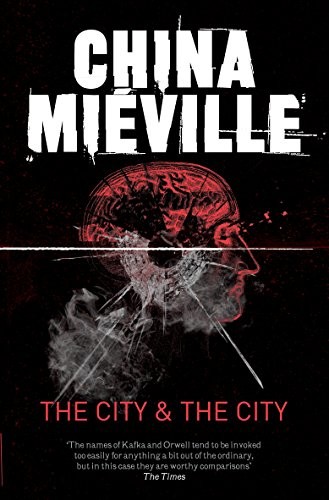
When a murdered woman is found in the city of Beszel, somewhere at the edge of Europe, it looks to be a routine case for Inspector Tyador Borlú of the Extreme Crime Squad. But as he investigates, the evidence points to conspiracies far stranger and more deadly than anything he could have imagined.
Borlú must travel from the decaying Beszel to the only metropolis on Earth as strange as his own. This is a border crossing like no other, a journey as psychic as it is physical, a shift in perception, a seeing of the unseen. His destination is Beszel’s equal, rival, and intimate neighbor, the rich and vibrant city of Ul Qoma. With Ul Qoman detective Qussim Dhatt, and struggling with his own transition, Borlú is enmeshed in a sordid underworld of rabid nationalists intent on destroying their neighboring city, and unificationists who dream of dissolving the two …
When a murdered woman is found in the city of Beszel, somewhere at the edge of Europe, it looks to be a routine case for Inspector Tyador Borlú of the Extreme Crime Squad. But as he investigates, the evidence points to conspiracies far stranger and more deadly than anything he could have imagined.
Borlú must travel from the decaying Beszel to the only metropolis on Earth as strange as his own. This is a border crossing like no other, a journey as psychic as it is physical, a shift in perception, a seeing of the unseen. His destination is Beszel’s equal, rival, and intimate neighbor, the rich and vibrant city of Ul Qoma. With Ul Qoman detective Qussim Dhatt, and struggling with his own transition, Borlú is enmeshed in a sordid underworld of rabid nationalists intent on destroying their neighboring city, and unificationists who dream of dissolving the two into one. As the detectives uncover the dead woman’s secrets, they begin to suspect a truth that could cost them and those they care about more than their lives.
What stands against them are murderous powers in Beszel and in Ul Qoma: and, most terrifying of all, that which lies between these two cities.
Casting shades of Kafka and Philip K. Dick, Raymond Chandler and 1984, The City & the City is a murder mystery taken to dazzling metaphysical and artistic heights.
Dans ce roman qui commence comme une enquête de police classique, on s'attache aux pas d'un policier qui va nous faire découvrir la complexité de sa ville. En effet, ici, il ne s'agit pas de science-fiction classique, mais plutôt comme l'a dit Alice Abdaloff de géographie-fiction (sa ville n'existant évidement pas). Et à partir de cette ligne, méfiez-vous des spoilers au moins aussi gros que ceux de la quatrième de couverture. En effet, celle-ci révèle immédiatement ce que l'auteur prend une centaine de pages à nous expliquer par des moyens assez fins : Beszèl et Ul Qoma sont deux villes dont les territoires s’entremêlent d'une façon bien plus fine et plus complexe que tout ce que vous pouvez imaginer, puisqu'elles sont quasiment superposées. Et pour expliquer ça finement, l'auteur nous expose d'une façon que j'ai trouvée réellement subtile l'ensemble des éléments de culture locale permettant de ne pas voir, de …
Dans ce roman qui commence comme une enquête de police classique, on s'attache aux pas d'un policier qui va nous faire découvrir la complexité de sa ville. En effet, ici, il ne s'agit pas de science-fiction classique, mais plutôt comme l'a dit Alice Abdaloff de géographie-fiction (sa ville n'existant évidement pas). Et à partir de cette ligne, méfiez-vous des spoilers au moins aussi gros que ceux de la quatrième de couverture. En effet, celle-ci révèle immédiatement ce que l'auteur prend une centaine de pages à nous expliquer par des moyens assez fins : Beszèl et Ul Qoma sont deux villes dont les territoires s’entremêlent d'une façon bien plus fine et plus complexe que tout ce que vous pouvez imaginer, puisqu'elles sont quasiment superposées. Et pour expliquer ça finement, l'auteur nous expose d'une façon que j'ai trouvée réellement subtile l'ensemble des éléments de culture locale permettant de ne pas voir, de ne pas percevoir, et surtout de ne pas interagir autrement que par l'évitement avec les habitants de l'autre ville. Il y a donc des personnes qui sont évisées (c'est-à-dire évitées de la vision) ou non-entendues, les villes ont également des langues, des géographies, des cultures, des styles vestimentaires et des langues différentes et, finalement, passer de l'une à l'autre revient non seulement à faire un voyage à l'étranger, mais aussi (et surtout) à corriger son appropriation de l'espace public pour être perçu par les autres habitants (des deux villes) comme étant en voyage dans l'autre. Tout cela est très habilement fait, comme est habilement construit l'enquête servant de guide de voyage, qui va méthodiquement explorer les deux villes, ainsi que la structure appliquant les règles obscures les séparant. Bon, bien sûr, il y a dans cette enquête quelques poncifs : si deux villes se superposent, pourquoi pas une troisième ? Et si quelqu'un connaît suffisamment les lieux et leurs cultures, peut-il passer de l'une à l'autre sans passer la frontière officielle ? Tout cela est donc très habile, très bien construit, et un porteur d'une forme d'hommage aux villes cloisonnées que sont/furent Jérusalem, évidement, mais aussi Berlin. Et le fait que l'existence de la troisième ville jointe ne soit jamais confirmée ou infirmée est une preuve de plus du talent de l'auteur, qui ne cherche pas à résoudre ce qui est l'un des authentiques mystères de ce roman (avec la fondation de ces cités siamoises). En un sens, ce genre d'exploration ne me surprend pas de la part de l'auteur, mais reste une excellente surprise, qui mérite donc une lecture attentive.
It starts as a typical noirish murder mystery: Inspector Tyador Borlu of the Extreme Crime Division in the Ruritanian city of Beszel is investigating a murder: a young woman has been found murdered in one of the even more derelict places in Beszel. After a few false leads his investigation soon brings him into contact with nationalists and other nutters who had in in for the victim, and it becomes apparent that the crime has roots and connections to Beszel's sister city Ul Quoma. He has to cross the border and work with his counterparts there to make sense of this crime, which turns out to touch, but not quite breach, the sublime borders the two cities have between each other.
And this is where the problems arise: Beszel and Ul Quoma are geographically the same place.
In a weird kink of history two different cities have developed in the …
It starts as a typical noirish murder mystery: Inspector Tyador Borlu of the Extreme Crime Division in the Ruritanian city of Beszel is investigating a murder: a young woman has been found murdered in one of the even more derelict places in Beszel. After a few false leads his investigation soon brings him into contact with nationalists and other nutters who had in in for the victim, and it becomes apparent that the crime has roots and connections to Beszel's sister city Ul Quoma. He has to cross the border and work with his counterparts there to make sense of this crime, which turns out to touch, but not quite breach, the sublime borders the two cities have between each other.
And this is where the problems arise: Beszel and Ul Quoma are geographically the same place.
In a weird kink of history two different cities have developed in the same place, sharing many of the same streets but not interacting at all, except as foreign, neighbouring countries. When seeing something of the other city a citizen is supposed to "unsee" it and work around.
There is a border crossing point in the middle of the city which lets people out on the same streets they were just in, but now in another country. Both cultures are different, and use different languages, culture styles, and even traffic laws.
Beszel is a derelict Eastern European nation with a more or less democratic government and some embarassing nationalists in charge, Ul Quoma is a more modern city with Turkish overtones, a prospering economy, and a military dictatorship in charge. There is some resentment on both sides. They even had some wars that were, unsurprisingly, disastrous for both sides.
Miéville manages to introduce all these things quite masterfully in a noir mode, written as if the main character was writing himself in competent but not flawless English. For the first few chapters our narrator does not even acknowledge the other city too much, and even when he does the reader can't really be sure if this might just have been another sign of his level of skill in English. It is noticeable that after the whole nature of the cities is revealed his English improves drastically. After a while it became clear to me that the mystery plot just is an excuse to explore the thought-experiment of two cities overlapping even further, testing out the boundaries and sounding out how far this story could be driven. The story is well-crafted, and is used masterfully to explore the different quirks a setup like this would have, some glaring problems in the book's internal logic notwithstanding. And it still works as a crime story/thriller.