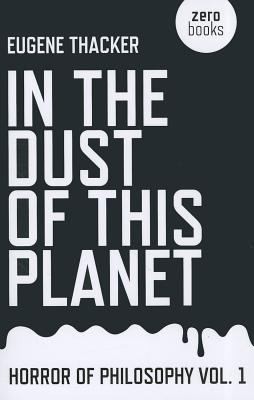

Jan Kjellin reviewed In The Dust Of This Planet by Eugene Thacker
Review of 'In The Dust Of This Planet' on 'Goodreads'
2 stars
It's not that [a:Thomas Ligotti|128466|Thomas Ligotti|https://images.gr-assets.com/authors/1371462738p2/128466.jpg] is wrong in his description of Thacker's book when describing it as "an encyclopedic grimoire instructing us in the varieties of esoteric thought and infernal diversions". Nor is it this "encyclopedic grimoire" in itself.
Instead, I feel a bit mislead. Like a gnawing feeling in the back of my head that this book is about as thin as the paper it's printed on, even though the words that actually are printed on it do their very best to provide profound - even mystical - depth.
As inspiration for aspiring writers of wierd fiction is should work like a charm; somewhere between these pages lurk formulas that could cast those who dare into the abyss of sub-sub-subgenres of horror and/or science fiction. Into those occult recesses where few readers venture willingly (and from where even fewer emerge with their sanity somewhat intact).
But I get …
It's not that [a:Thomas Ligotti|128466|Thomas Ligotti|https://images.gr-assets.com/authors/1371462738p2/128466.jpg] is wrong in his description of Thacker's book when describing it as "an encyclopedic grimoire instructing us in the varieties of esoteric thought and infernal diversions". Nor is it this "encyclopedic grimoire" in itself.
Instead, I feel a bit mislead. Like a gnawing feeling in the back of my head that this book is about as thin as the paper it's printed on, even though the words that actually are printed on it do their very best to provide profound - even mystical - depth.
As inspiration for aspiring writers of wierd fiction is should work like a charm; somewhere between these pages lurk formulas that could cast those who dare into the abyss of sub-sub-subgenres of horror and/or science fiction. Into those occult recesses where few readers venture willingly (and from where even fewer emerge with their sanity somewhat intact).
But I get the sense that Thacker wants to do more. His recurring excursions towards the unthinkable tend, however, to lose themselves in labyrinthic prose, making the unthinkable unreadable. (There might be some form of universal, poetic justice in there, somehow.) That in itself does feel insufficient, but on the other hand, "sufficient" is not something that goes hand in hand with trying to think the unthinkable, fathom the unfathomable, speak the unspeakable and - yes - read the unreadable.
Maybe this is as good as it actually can get? In that case, my meagre two stars ("it was ok") do seem a bit unjustified. Maybe so, but I did expect a little more "horror of philosophy" than I feel I got. And that has to count (or subtract, rather) for something.
Something to dwell on, maybe, as Thacker's book now rests in the dust of my bookshelf.