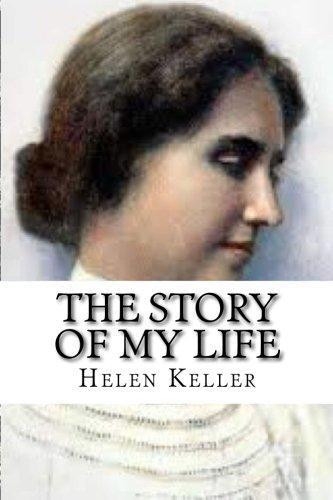
The Story of My Life, first published in book form in 1903, is Helen Keller's autobiography detailing her early life, particularly her experiences with Anne Sullivan. Portions of it were adapted by William Gibson for a 1957 Playhouse 90 production, a 1959 Broadway play, a 1962 Hollywood feature film, and the Indian film Black. The book is dedicated to inventor Alexander Graham Bell, who was one of her teachers and an advocate for the deaf.
The Story of My Life, first published in book form in 1903, is Helen Keller's autobiography detailing her early life, particularly her experiences with Anne Sullivan. Portions of it were adapted by William Gibson for a 1957 Playhouse 90 production, a 1959 Broadway play, a 1962 Hollywood feature film, and the Indian film Black. The book is dedicated to inventor Alexander Graham Bell, who was one of her teachers and an advocate for the deaf.
I had to read this for school in 10th and was the first (and last) biography I ever read. Brat I was, I thoroughly enjoyed it possibly because her word was unlike my own and was naturally curious. The simple and easy-to-read writing style helped a lot.
I had to read this for school in 10th and was the first (and last) biography I ever read. Brat I was, I thoroughly enjoyed it possibly because her word was unlike my own and was naturally curious. The simple and easy-to-read writing style helped a lot.
For a woman to go to college at all in the early 1900s was achievement enough that a memoir of her struggle to get there would be of interest to me. When I think that Helen Keller was also deaf and blind, her determination becomes all the more incredible. I cannot remember a time when I didn't know of Keller's existence and I am sure my mother gave me a child's edition of her story (a Ladybird book?) as soon as I was old enough to read it! However I hadn't given this example of perseverance much thought since until I needed a 1900s-published book to complete the Goodreads-BookCrossing Decade Challenge and decided to revisit Keller's story.
I like that this memoir is written in a straightforward style without the reliance on overly emotional scenes or appeals to readers for pity. Even in her early twenties, as she was …
For a woman to go to college at all in the early 1900s was achievement enough that a memoir of her struggle to get there would be of interest to me. When I think that Helen Keller was also deaf and blind, her determination becomes all the more incredible. I cannot remember a time when I didn't know of Keller's existence and I am sure my mother gave me a child's edition of her story (a Ladybird book?) as soon as I was old enough to read it! However I hadn't given this example of perseverance much thought since until I needed a 1900s-published book to complete the Goodreads-BookCrossing Decade Challenge and decided to revisit Keller's story.
I like that this memoir is written in a straightforward style without the reliance on overly emotional scenes or appeals to readers for pity. Even in her early twenties, as she was on wroting this memoir, Keller is already well-read and erudite beyond her years. At one point she notes blind poet Homer's immortality through his writing and I thought that the same is now true of her. Helen Keller is a name I think many people would recognise. She frequently makes sure to give credit where it is due so I understood that her success was equally as a much a result of her family's support and Anne Sullivan's tireless dedication as it was to Helen own efforts. It was also interesting to see the facilities available to deaf and/or blind American children at this period - at least to those whose parents could afford it - and to see how those resources dwindled as Helen strode past the needs of a child's education, pioneering the right of disabled people to expect college educations and independent lives. An inspirational woman.