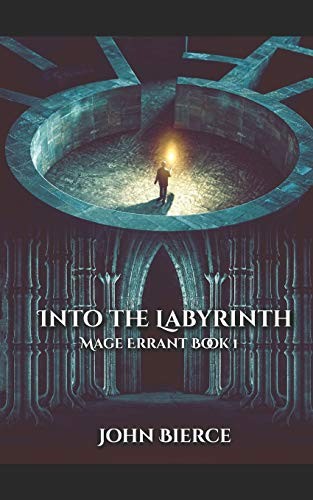
Bierce sets the stage with this series opener by introducing Hugh of Emblin and his friends. It's an interesting take on magical power, using the various "attunement" tropes along with some leveling mechanics and a dash of mysticism.
Hugh's low self-image, battered into him by the school bully and re-inforced regularly, serves the plot well. His companions - each with their own burdens to bear - work with him to overcome the most intractable obstacles.
I really liked the characters and their interactions. The setting, mostly just sketched in, provides just enough of a stage for the story to unfold on while hinting of deeper mysteries to come.
A fun set up to what promises to be a rollicking tale of magic and mayhem.
Highly recommended.
Bierce sets the stage with this series opener by introducing Hugh of Emblin and his friends. It's an interesting take on magical power, using the various "attunement" tropes along with some leveling mechanics and a dash of mysticism.
Hugh's low self-image, battered into him by the school bully and re-inforced regularly, serves the plot well. His companions - each with their own burdens to bear - work with him to overcome the most intractable obstacles.
I really liked the characters and their interactions. The setting, mostly just sketched in, provides just enough of a stage for the story to unfold on while hinting of deeper mysteries to come.
A fun set up to what promises to be a rollicking tale of magic and mayhem.
Disappointingly riddled with errors, but most unforgivingly there's a point early on in when the protagonist and his fellow apprentices go from frosty to monologuing their lifes' stories in the span of a second. That sort of emotional negation -- and the tendency to long-winded infodump in the face of characters whose motivations don't align with sitting still for an unanticipated story hour -- is the sort of jarring thing that yanks me right out. DNF.
Disappointingly riddled with errors, but most unforgivingly there's a point early on in when the protagonist and his fellow apprentices go from frosty to monologuing their lifes' stories in the span of a second. That sort of emotional negation -- and the tendency to long-winded infodump in the face of characters whose motivations don't align with sitting still for an unanticipated story hour -- is the sort of jarring thing that yanks me right out. DNF.
John Bierce has given us a very quick and fun read with Into the Labyrinth. This is YA fantasy that maintains many of the tropes of the genre; mage school, dungeon tests, and a fascinating magic system. I normally find YA books a little hard to rate, and this one is no exception. But in the end it’s just a lot of fun.
There is quite a bit to like in this debut from Bierce. For starters, it has an interesting magic system. Mages gain affinities to various types of mana and this allows them to cast particular sorts of spells—or at least more powerful sorts of elemental spells. The specifics are unclear here in the first book, but there is a lot of potential. At its core though, Into the Labyrinth is really a coming of age tale about Hugh of Emblin. One of the things I loved …
John Bierce has given us a very quick and fun read with Into the Labyrinth. This is YA fantasy that maintains many of the tropes of the genre; mage school, dungeon tests, and a fascinating magic system. I normally find YA books a little hard to rate, and this one is no exception. But in the end it’s just a lot of fun.
There is quite a bit to like in this debut from Bierce. For starters, it has an interesting magic system. Mages gain affinities to various types of mana and this allows them to cast particular sorts of spells—or at least more powerful sorts of elemental spells. The specifics are unclear here in the first book, but there is a lot of potential. At its core though, Into the Labyrinth is really a coming of age tale about Hugh of Emblin. One of the things I loved was the entire lack of confidence and fear of failure that Hugh has. To me this felt very authentic to what I struggled with myself as a teenager. One of the things I love about coming of age stories in fantasy is the way that characters are often forced to struggle with the same sorts of things many of us did as young people—they just do so with the added frustration of magic, or prophecy, or whatever else. Hugh’s friends, while not nearly as well drawn as Hugh, are still worthwhile secondary characters for a YA novel. The plot is serviceable, though nothing to write home about.
There are several weaknesses to the novel, unfortunately. To begin, there were a number of typos throughout the manuscript. More importantly, while I thought Hugh was a well drawn character, the antagonist is the most vanilla of vanilla characters. He’s basically a jerk for the sake of being a jerk with no motivation that I could distinguish. Frankly, Hugh’s own fears work better as the antagonist of the story than the actual antagonist does. In addition, while I liked the magic system and felt like it had a lot of potential, I also felt like the magic system didn’t entirely cohere based on the information we have here in the first novel in what will be a series. There are a lot of moving pieces to the system, but they aren’t always clearly explained. Some of those pieces work differently, warding versus enchanting versus spell glyphs. Eventually it all gets a little (overly) complex and I felt like the differences—and more importantly the reasons for those differences—were not adequately explained.
There is a lot to like here, and as a whole I did like this novel. Although the score rounds down to three stars I feel like I enjoyed it more than I normally do a three star. However, some of the problems described above keep me from bumping it up to a four. If you’re looking for a fun YA fantasy, definitely give this one a try. I hope to see more from John Bierce in the future. 3.4/5 stars.
5 – I loved this, couldn’t put it down, move it to the top of your TBR pile 4 – I really enjoyed this, add it to the TBR pile 3 – It was ok, depending on your preferences it may be worth your time 2 – I didn’t like this book, it has significant flaws and I can’t recommend it 1 – I loathe this book with a most loathsome loathing