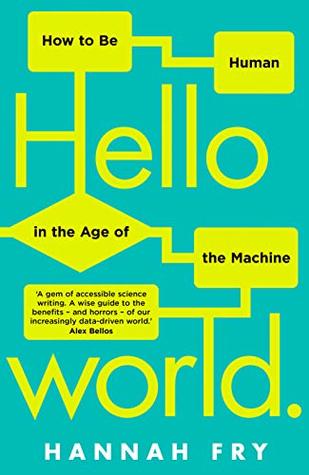
Would you let an algorithm determine your fate? Hannah Fry lifts the lid on the world of algorithms, examining how they impact our future and whether they really are an improvement on the humans they replace.
You are accused of a crime? Who would you rather decides your future – an algorithm or a human?
Before making your decision, bear in mind that the algorithm will always be more consistent, and far less prone to an error of judgement. Then again, at least the human will be able to look you in the eye before determining your fate. How much fairness would you be willing to sacrifice for that human touch?
This is just one of the dilemmas we face in the age of the algorithm, where the machine rules supreme, telling us what to watch, where to go, even who to send to prison. As increasingly …
Would you let an algorithm determine your fate? Hannah Fry lifts the lid on the world of algorithms, examining how they impact our future and whether they really are an improvement on the humans they replace.
You are accused of a crime? Who would you rather decides your future – an algorithm or a human?
Before making your decision, bear in mind that the algorithm will always be more consistent, and far less prone to an error of judgement. Then again, at least the human will be able to look you in the eye before determining your fate. How much fairness would you be willing to sacrifice for that human touch?
This is just one of the dilemmas we face in the age of the algorithm, where the machine rules supreme, telling us what to watch, where to go, even who to send to prison. As increasingly we rely on them to automate big, important decisions – in crime, healthcare, transport, money - they raise questions that cut to the heart of what we want our society to look like, forcing us to decide what matters most. Is helping doctors to diagnose patients more or less important than preserving our anonymity? Should we prevent people from becoming victims of crime, or protect innocent people from being falsely accused?
Hannah Fry takes us on a tour through the good, the bad, and the downright ugly of the algorithms that surround us. In Hello World she lifts the lid on their inner workings, demonstrates their power, exposes their limitations, and examines whether they really are an improvement on the human systems they replace.
An amazing book to help understand how algorithms are used in today's world.
4 stars
I enjoyed reading this book. It helped me get a grasp of some of the ways that algorithms are used in the world and some of the downsides to them. It helped me understand algorithms better.
A very clear exploration of what algorithms can and cannot do. And the answer is "it's complicated" however, despite the issues with algorithms, we shouldn't kid ourselves that human decision-making is flawless. Algorithms are biased but so are human beings. The goal should therefore be to make algorithms more transparent and assistant to human decisions rather than abdicate decision-making to algorithms uncritically. I especially liked this bit: "Whenever you see a story about an algorithm, see if you can swap out any of the buzzwords, like ‘machine learning’, ‘artificial intelligence’ and ‘neural network’, and swap in the word ‘magic’. Does everything still make grammatical sense? Is any of the meaning lost? If not, I’d be worried that it’s all nonsense.". This is a book that gives a lot to think about that is also pleasant to read and full of insightful examples.
A very clear exploration of what algorithms can and cannot do. And the answer is "it's complicated" however, despite the issues with algorithms, we shouldn't kid ourselves that human decision-making is flawless. Algorithms are biased but so are human beings. The goal should therefore be to make algorithms more transparent and assistant to human decisions rather than abdicate decision-making to algorithms uncritically. I especially liked this bit: "Whenever you see a story about an algorithm, see if you can swap out any of the buzzwords, like ‘machine learning’, ‘artificial intelligence’ and ‘neural network’, and swap in the word ‘magic’. Does everything still make grammatical sense? Is any of the meaning lost? If not, I’d be worried that it’s all nonsense.". This is a book that gives a lot to think about that is also pleasant to read and full of insightful examples.