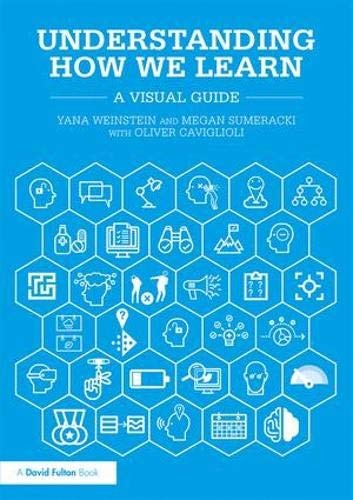

SocProf reviewed Understanding How We Learn by Oliver Caviglioli
Review of 'Understanding How We Learn' on 'Goodreads'
5 stars
If you haven’t really acquainted yourself yet with the scholarship of teaching and learning, and the latest research developments on the subject, this book is a good introduction to that. A big chunk of the book is a review of the research on the subject of perception, attention, and memory, as a way to push back on the myths and misunderstandings that still circulate about learning, especially among our students.
Based on that review, the book then goes into specific strategies for effective learning. If you are familiar with other books such as Making It Stick or Small Teaching, nothing presented in this book is entirely new but there are still details and examples worthy of interest.
So, what are the strategies for effective learning?
1. Planning
1.1. Spaced practice: spreading study activities over time as opposed to cramming (which is bad)
1.2. interleaving: switching between topics while studying as …
If you haven’t really acquainted yourself yet with the scholarship of teaching and learning, and the latest research developments on the subject, this book is a good introduction to that. A big chunk of the book is a review of the research on the subject of perception, attention, and memory, as a way to push back on the myths and misunderstandings that still circulate about learning, especially among our students.
Based on that review, the book then goes into specific strategies for effective learning. If you are familiar with other books such as Making It Stick or Small Teaching, nothing presented in this book is entirely new but there are still details and examples worthy of interest.
So, what are the strategies for effective learning?
1. Planning
1.1. Spaced practice: spreading study activities over time as opposed to cramming (which is bad)
1.2. interleaving: switching between topics while studying as opposed to mass practice.
2. Development of understanding
2.1. Elaboration: asking how and why questions about the topic under review
2.2. Concrete examples, especially to illustrate abstract concepts
2.3. Dual coding, combining visual and textual or spoken elements, while avoiding cognitive overload
3. Reinforcement
3.1 Retrieval practice that brings learned information to mind from long-term memory.
There is obviously no single good ways to implement those strategies. What we do depends on our respective fields, the level of the class (1000-level v. 2000-level), and the amount of time we have. These strategies can be implemented in class or set up so the students can use them on their own time.
While the set of chapters on strategies deals with the research and its results, the last section of the book includes three chapters: tips for teachers, tips for students, and tips for parents (the book is not specifically about higher education but is entirely relevant to it). If, after reading about the strategies, you are not sure where to start, the tips might be useful.
So, again, if you are kinda new to this, this is a good introduction, and the visual aspect (props to the authors for taking their own advice and using dual coding) makes the reading less dry. However, I don’t know who picked the color palette, but holy lack of contrast, that was a bad choice. Some of the font is super small and very light blue, and if you are like me and your eyesight ain’t what it used to be, there will be a few unhappy reading moments.