Alain de Botton proposes applying what has worked for religions to a more appealing atheism, in his book Religion for Atheists. He admits that a coherent theory will not be done in a single, short volume such as he has written. But while de Botton offers intriguing individual proposals, there remains some serious shortcomings for the overall project.
A recent issue of New Scientist ("The God Issue") examined the science of religion. De Botton himself provides an interview. What I found more convincing was the article, "Born believers", which explained the role of "agency reasoning", i.e. what we observe that we do not directly control -- the difference between us kicking a ball and watching a bird fly overhead.
That argument is that from a young age we are receptive to explanations that invoke design or purpose, as author Justin Barrett says.
Giving de Botton …
Reviews and Comments

Peacebuilding a shared Northern Irish society ✌️ Editor 🔍 Writer ✏️ Photographer 📸
This link opens in a pop-up window
Allan LEONARD rated Scroogenomics: 2 stars

Scroogenomics by Joel Waldfogel
Scroogenomics is a non-fiction book written by the economist Joel Waldfogel.
Allan LEONARD rated An optimist's tour of the future: 3 stars
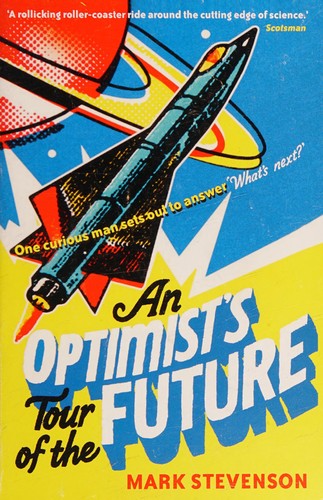
An optimist's tour of the future by Mark Stevenson
Ever heard of transhumans? Humans saved from aging through artificial spare parts. They're coming soon. So too are intelligent robots, …
Allan LEONARD rated Back to Work: 2 stars
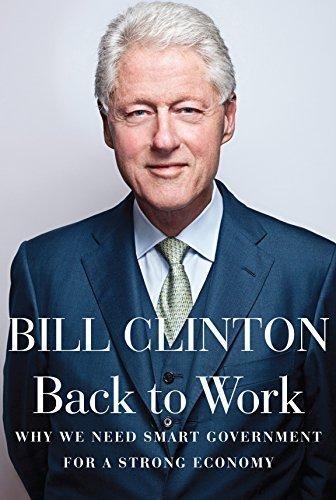
Back to Work by Bill Clinton
Back to Work: Why We Need Smart Government for a Strong Economy is a 2011 non-fiction book by former United …
Allan LEONARD rated Must-see in Kyoto: 4 stars
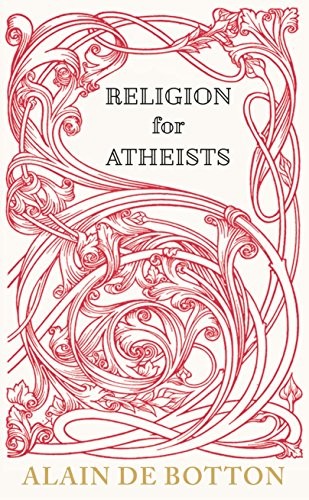
Review of 'Religion for Atheists' on 'Goodreads'
3 stars
Alain de Botton proposes applying what has worked for religions to a more appealing atheism, in his book Religion for Atheists. He admits that a coherent theory will not be done in a single, short volume such as he has written. But while de Botton offers intriguing individual proposals, there remains some serious shortcomings for the overall project.
A recent issue of New Scientist ("The God Issue") examined the science of religion. De Botton himself provides an interview. What I found more convincing was the article, "Born believers", which explained the role of "agency reasoning", i.e. what we observe that we do not directly control -- the difference between us kicking a ball and watching a bird fly overhead.
That argument is that from a young age we are receptive to explanations that invoke design or purpose, as author Justin Barrett says.
Giving de Botton the benefit of the doubt, he does apply this towards a selection of themes: community, kindness, education, tenderness, pessimism, perspective, art, architecture and institutions.
While interesting to learn de Botton's various suggestions, such as a communal orgy named "a yearly moment of release", for much of the first half of the book I didn't feel a common thread running through his secular offerings. As Barrett might put it, would these satisfy a sufficient number of atheists who were honest with themselves about our societal hard-wiring for a sense of greater purpose? (For me, for the longer run I'll take a companionship of love than an annual one-night stand.)
De Botton's chapter on institutions was the best, and really gets to the point. Religions have long known that they fulfill inherent needs in many people's lives, and they have organised themselves accordingly. (I loved the graphic comparing the annual revenue of the Catholic Church ($97 billion) with consumer goods company Procter and Gamble ($78 billion).)
I would like to see an even more detailed version of de Botton's proposal to create a global brand of psychotherapy ("Talkingcure..."), i.e. a supporting system of institutions to foster and protect our emotions (p. 298).
De Botton provides us with a review of the life and work of Auguste Comte, culminating with Comte's proposal for a Religion of Humanity, with its own priests and secular saints. This is an intriguing take on the theory of the perfection of man, but alas one with some big shortcomings.
That is, as de Botton points out in the previous chapter, an institution provides an authority and status higher than you can achieve on your own, or at least the potential to be more enduring than your solitary efforts. At a wider, societal level, this evokes sociology (a word not mentioned once in the book). Even my limited knowledge of sociology includes the role of ecclesiastical guardians, those entrusted with the spiritual and sacred traditions of that society.
That trust is established over many generations. And if you're going to rip it up and replace it with a form of Marxist-Leninist atheism, then you better be good at putting in place those structures, physical and emotional, that can endure for the long hall. Soviet communism wasn't good at this; Chinese communism is being more clever, with its retention of its religious traditions.
And so the challenge of Comte's scheme for religion. How hard it will be to establish a set of secular traditions that satisfy our innate expectation of a purpose for life, supported by people and institutions that you want to know will last beyond the end of your own journey.
It's a big ask. Religion will remain. And as de Botton puts it, atheists might as well get used to it and appropriate it however they can for their own survival.
Allan LEONARD rated Making peace: 5 stars
Allan LEONARD rated Pack up your troubles: 4 stars
Allan LEONARD rated Silver Linings: 4 stars

Allan LEONARD rated Northern Ireland: 4 stars

Northern Ireland by Marc Mulholland (Very short introductions)
Allan LEONARD reviewed Paperboy by Tony Macaulay
Review of 'Paperboy' on 'Goodreads'
4 stars
Tony Macaulay is a respected professional community relations and youth worker based in Belfast. For example, he has written independently, "A discussion paper proposing a five phase process for the removal of 'peace walls' in Northern Ireland".
This book is his story of being a 12-year-old paperboy, living in the Shankill area of West Belfast. I, too, was a 12-year-old paperboy, but that's where my shared experience starts and ends.
Tony so well tells his story. It is actually difficult for adults to write in the prose of childhood. The retrospective voice is usually readily apparent. But here in Paperboy, you really do see the world from this boy's experiences.
It's a world of not quite comprehending the sectarianism and violence around you, and doing your best to get on with what really matters to most 12-year-old boys -- your mates, your music, and earning some pocket money to spend …
Tony Macaulay is a respected professional community relations and youth worker based in Belfast. For example, he has written independently, "A discussion paper proposing a five phase process for the removal of 'peace walls' in Northern Ireland".
This book is his story of being a 12-year-old paperboy, living in the Shankill area of West Belfast. I, too, was a 12-year-old paperboy, but that's where my shared experience starts and ends.
Tony so well tells his story. It is actually difficult for adults to write in the prose of childhood. The retrospective voice is usually readily apparent. But here in Paperboy, you really do see the world from this boy's experiences.
It's a world of not quite comprehending the sectarianism and violence around you, and doing your best to get on with what really matters to most 12-year-old boys -- your mates, your music, and earning some pocket money to spend on your girlfriend.
And just like a youngster, there are key words that regularly reappear in the dialogue -- Sharon Burgess, "the only pacifist paperboy in Belfast", Bay City Rollers, "so I was".
Indeed, Tony writes in the local vernacular so well that the only criticism could be that he didn't include a glossary! This Yank has lived here long enough to not need one for Paperboy (!), and some phrases like, "God love the wee dote" probably pass without translation, but me thinks Tony should provide one for the American edition ("Och, ballicks!"). And/or subtitles when the film comes out!
Amidst all the humour, though, there is the reality of the environment that Paperboy grows up in. He notices more and more "peace walls" -- "... we were brilliant at walls in Belfast -- they were going up everywhere, higher and higher, all around me".
It's actually his dad who says to a neighbour who is demanding an even more walls, "Did you never think that it might be our side that's bein' walled in?"
And 35 years on, we have made little progress on dismantling our walls in Northern Ireland, whether physically or metaphorically. May Paperboy encourage more of us to put more effort into this.
Allan LEONARD reviewed Kosovo by Tim Judah
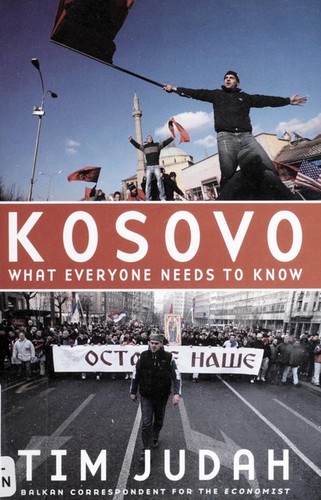
Review of 'Kosovo' on 'Goodreads'
4 stars
I was once asked if I thought the Northern Ireland conflict was difficult to comprehend. Not really, I replied. What confounded me was that as so many people within Northern Ireland understood the various factors involved, why work towards any resolution took so long.
Put another way, I found comprehending the geo-political situation of former Yugoslavia more difficult. For most of its former republics, resolutions were via the bloody wars of the 1990s.
And then there's Kosovo, with its independence declared in 2008, but how much resolved?
For the sake of my day job, I had to get a good grasp of the situation of Kosovo. A good friend endorsed my short-listed choice of Kosovo: What Everyone Needs to Know, by Tim Judah, Balkan Correspondent for The Economist.
In the Author's Note, Judah says that his book is to give general readers a straightforward introduction. He well achieves this. But …
I was once asked if I thought the Northern Ireland conflict was difficult to comprehend. Not really, I replied. What confounded me was that as so many people within Northern Ireland understood the various factors involved, why work towards any resolution took so long.
Put another way, I found comprehending the geo-political situation of former Yugoslavia more difficult. For most of its former republics, resolutions were via the bloody wars of the 1990s.
And then there's Kosovo, with its independence declared in 2008, but how much resolved?
For the sake of my day job, I had to get a good grasp of the situation of Kosovo. A good friend endorsed my short-listed choice of Kosovo: What Everyone Needs to Know, by Tim Judah, Balkan Correspondent for The Economist.
In the Author's Note, Judah says that his book is to give general readers a straightforward introduction. He well achieves this. But a "general reader" who has some education in international relations, or at least is an avid reader of The Economist, will find the introduction that much easier to absorb. This is not because Kosovo is not easily accessible; it is. But there is a good amount of history and culture to take in the book's concise 160 pages.
Judah does well in the first two chapters to provide cultural and historical overviews of Albanians and Serbs. Of course, this has to be a little superficial in such a generalist book. But an important highlight is that for Albanians, and particularly for those residing in Kosovo, it was language more than the role of the church that influences their nationalism. This contributed to a delayed nation-building -- surrounding peoples and places having several hundred years' head start -- with its own consequences.
We are told how the Serbs see Kosovo as their Jerusalem (p. 18), with the full poem provided, "The Downfall of the Serbian Empire". What interests me is that this is not the only contested place in the world with a Jerusalem-status, the sense of birthright and/or redemption.
The chapters are the right length, covering the essentials while moving you along to the next episode.
As in other contested places, the education system plays an important, often crucial role. For some decades, Albanians enjoyed an Albanian-language education (but while still needing to learn Serbian). However, when Serbian authorities clamped down on this in 1991, an underground, parallel system was created (p. 73). The consequence was that hereafter young Kosovo Albanians would be instilled with more nationalist thinking than under the "brotherhood and unity" era of Yugoslavia. For me, the significance is whether ethnic-based education is part of a wider whole or a particular sect.
Likewise, Judah describes the re-establishment of the Kosovo police service, one of the notable achievements (p. 95), moving from no service at all in 1999 to one comprising over 7,000 officers (6,082 Albanian; 746 Serbs; 414 others) in 2007. However, with Kosovo independence, retaining an integrated, singular police service has become more of a challenge. Here, I hope there are applicable lessons from the recent years of the reform of policing in Northern Ireland.
Judah explains one particularly curiosity -- multiple international calling codes (p. 99). Essentially, in the break up of Yugoslavia, Serbia retained code +381. For cell/mobile phones, new Kosovo wasn't going to use that nor the Serbian +063, so it acquired underused Monaco +377. I can attest that in areas such as Mitrovica, individuals who need to contact both Albanians and Serbs will carry two mobile phones/SIM cards.
There is a good description of the Ahtisaari Plan (setting out Kosovo's future, sans independence but with "supervised independence") (Chapter 10). While this plan was blocked by the UN Security Council, all EU members backed it and proceeded to establish an International Civilian Office (ICO), to deal with matters of law and headed by an International Civilian Representative (ICR).
Then, after Kosovo's declaration of independence, the EU replied by providing a Special Representative (EUSR), responsibilities which include "promoting overall EU coordination and coherence in Kosovo".
The thing is, the ICR and EUSR are the same person: Pieter Feith. On one hand, Feith's remit is to the EU's unanimous consent to the Ahtisaari Plan, while on the other hand he serves as EUSR even though not all EU members recognise Kosovo's independence. This conundrum is not lost on the local population.
Judah also succinctly puts the Kosovo situation in a global context of international relations (Chapter 12). Barring the wars that took place in the region in the 1990s, the disintegration of Yugoslavia, for the most part, reflected the disintegration of the Soviet Union, in that there was a reverting to previously existing republics (the "R" in USSR). Except Kosovo, which was not a pre-existing republic. Its declaration of independence, or at least EU semi-protectorate de facto status, is an unprecedented situation for the EU, which must proceed intelligently as other nations/subregions express their self-determination.
There's clearly more to say on this matter, and Judah's book is not the place for it. Indeed, while those with deeper knowledge of any particular dimension of the Kosovo scene won't find sustenance by Judah's overview, I found it an ideal primer and very useful in my subsequent visit. I sincerely recommend Kosovo: What Everyone Needs to Know as the first book to read in the path of unravelling the threads of politics and history in Kosovo.
Allan LEONARD reviewed Dreams from My Father by Barack Obama
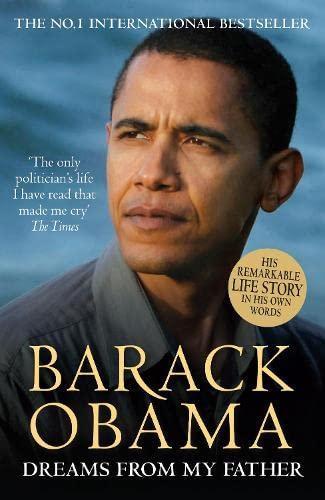
Dreams from My Father: A Story of Race and Inheritance (1995) is a memoir by …
Review of 'Dreams from My Father' on 'Goodreads'
5 stars
Difficult to add any enlightened review of a book read by so many. I enjoyed reading this pre-candidate autobiography, perhaps because of my personal hobby of genealogy. Obama provides insights to his personality, through the story of his own family history, which spans several continents and cultures.
To pick just one episode, as a school-age boy, he met his father for the first time (after some years of separation). Obama was embarrassed by bravado of the Old Man, and just wanted to get along, not stand out, among his childhood peers. Only later did his father's demeanour and behaviour intrigue him to discover more.
Brought forward, Obama recalls a trip that he and his sister Auma made, while in Kenya, to visit their father's youngest child, George:
"From the car, we watched George return to his friends, quickly indistinguishable from the others with round heads and knobby knees who were …
Difficult to add any enlightened review of a book read by so many. I enjoyed reading this pre-candidate autobiography, perhaps because of my personal hobby of genealogy. Obama provides insights to his personality, through the story of his own family history, which spans several continents and cultures.
To pick just one episode, as a school-age boy, he met his father for the first time (after some years of separation). Obama was embarrassed by bravado of the Old Man, and just wanted to get along, not stand out, among his childhood peers. Only later did his father's demeanour and behaviour intrigue him to discover more.
Brought forward, Obama recalls a trip that he and his sister Auma made, while in Kenya, to visit their father's youngest child, George:
"From the car, we watched George return to his friends, quickly indistinguishable from the others with round heads and knobby knees who were chasing a scuffed football through the grass. I found myself suddenly remembering then my first meeting with the Old Man, the fear and discomfort that his presence had caused me, forcing me for the first time to consider the mystery of my own life. And I took comfort in the fact that perhaps one day, when he was older, George, too, might want to know who his father had been, and who his brothers and sisters were, and that if he ever came to me I would be there for him, to tell him the story I knew."
Obama could have as easily been talking about his own children. Thus, he comes full circle with his father-son relationship, and is ready for the next generation. Otherwise known as signs of adulthood and maturity.
And that is why I enjoyed Dreams from my Father. Coming-of-age books are good reads, all the better when written with such sincerity. Let us see more of them.
Allan LEONARD rated To Kill a Mockingbird: 4 stars
To Kill a Mockingbird by Harper Lee
One of the best-loved stories of all time, To Kill a Mockingbird has earned many distinctions since its oritinal publication …
Allan LEONARD reviewed The storm by Vincent Cable
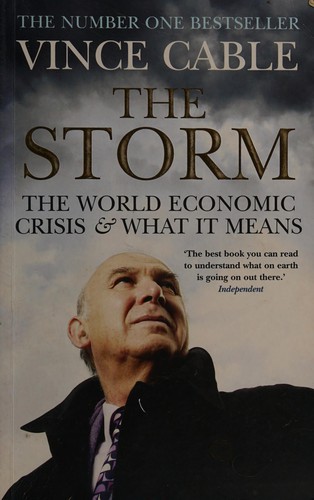
Review of 'The storm' on 'Goodreads'
4 stars
Vince Cable is the chief economic spokesperson for the Liberal Democrats, and his lucid explanations of the credit crunch and overall current parlous global economic situation has seen him well sought after by mainstream news media outlets. For good reason -- his analysis has been proven spot on.
In his book, The Storm: The World Economic Crisis & What It Means, Cable reviews both distant and more recent economic history to put the current situation in context. This includes a chapter on the surge in commodity prices in 2008. Here, his professional experience as a chief economist for Shell provides credence to his arguments.
Cable does his best to present the intricacies of international finance and macroeconomics to the lay reader, but having some education in economics does no harm, e.g. appreciating the difference between a trade balance and balance of payments.
My favoured sections were towards the end, when …
Vince Cable is the chief economic spokesperson for the Liberal Democrats, and his lucid explanations of the credit crunch and overall current parlous global economic situation has seen him well sought after by mainstream news media outlets. For good reason -- his analysis has been proven spot on.
In his book, The Storm: The World Economic Crisis & What It Means, Cable reviews both distant and more recent economic history to put the current situation in context. This includes a chapter on the surge in commodity prices in 2008. Here, his professional experience as a chief economist for Shell provides credence to his arguments.
Cable does his best to present the intricacies of international finance and macroeconomics to the lay reader, but having some education in economics does no harm, e.g. appreciating the difference between a trade balance and balance of payments.
My favoured sections were towards the end, when Cable suggests some actions for the way forward:
Central bank monetary policy to deal with asset prices as well as inflation (a la Irving Fisher; the Swedish experience)
Remove mortgage tax relief (USA) (reduce over-borrowing) and business interest tax relief (UK) (reduce excessive leverage)
Replace cash salary bonuses with stock with delayed redemption
Agreed international accounting standards and reporting (greater transparency)
More challenging is Cable's suggestion for a new multilateralism that places Asia "at the heart" of the world economy.
Indeed, The Economist published an excellent article that described the role that China's gigantic trade surplus had in flooding the American financial markets with funds needing investing ("When a flow becomes a flood" 22/1/2009)
Cable calls for a New Bretton Woods, hosted in a place like Singapore, with key participants the USA, China, Japan, the eurozone, and India.
Part of Cable's motivation is to prevent economic nationalism, or "state capitalism", which encourages protectionism under numerous guises, including "economic security". Cable isn't predicting a repeat of what happened in the 1930s interwar years, but he repeatedly paints an ominous picture of what a failure to properly address the current issues could mean.
Cable has an enduring faith in liberal markets producing wealth and prosperity, which includes public services, and implores with policy makers to take the appropriate actions to ensure this remains the case.
My criticism would only be that I wished Cable had presented more detail on his own suggested actions, as well as on what he would deem as best practices around the world. Perhaps that's the scope of a future volume.