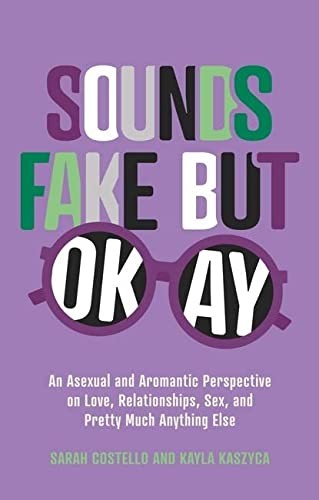
Elle started reading Sounds Fake but Okay by Sarah Costello
These two won't disappoint me T_T
These two won't disappoint me T_T

Mastodon: toot.lgbt/@ellesaurus
This link opens in a pop-up window



These two won't disappoint me T_T
These two won't disappoint me T_T
This was incredibly disappointing.
The very broad-strokes concept of the Power Threat Meaning Framework (PTMF) is that systems of power should be necessary components in how we treat mental illness, diagnoses can be an impediment to care, and to shift the focus from "what is wrong with you" to "what has happened to you."
The acknowledgement of systemic forces, personal circumstance, and how frequently how own mental struggles are the consequence of experience are useful generalities. But the authors seem to take that to extremes that lose the thread. The primary call to action appears to be eliminating the concept of psychiatric diagnosis. Its support for this extraordinary suggestion is extremely meek. The most prominent reason provided is that we haven't found precise biological causes after all this time, therefor they don't exist, therefor it can't be pathological.
I must admit I only read about 1/3 of the book. After a few …
The very broad-strokes concept of the Power Threat Meaning Framework (PTMF) is that systems of power should be necessary components in how we treat mental illness, diagnoses can be an impediment to care, and to shift the focus from "what is wrong with you" to "what has happened to you."
The acknowledgement of systemic forces, personal circumstance, and how frequently how own mental struggles are the consequence of experience are useful generalities. But the authors seem to take that to extremes that lose the thread. The primary call to action appears to be eliminating the concept of psychiatric diagnosis. Its support for this extraordinary suggestion is extremely meek. The most prominent reason provided is that we haven't found precise biological causes after all this time, therefor they don't exist, therefor it can't be pathological.
I must admit I only read about 1/3 of the book. After a few instances of odd references to schizophrenia, then quoting a woman with the seeming intent of suggesting bipolar disorder isn't a real disorder than can be helped with medication, I decided to background check the authors.
Mary Boyd I found had previously written Schizophrenia: A Scientific Delusion? (1990). These combined appear to delve into the kind of conspiracy theory that schizophrenia does not exist, and explains the slant of the book as being soundly in the anti-psychiatry genre.
Lucy Johnstone's record is more fraught. She has a series of articles posted only about neurodiversity. She blames the "rapid rise" of ADHD and ASD on "neoliberalism" and social media. She claims self-diagnosis isn't valid because it's "a misuse of language". It is a very odd angle to take on neurodiversity, given the PTMF's focus on systems to not acknowledge that self-diagnosis is a response to systemic failures for this group.
And if these types of arguments sound familiar, you may already anticipate what comes next. Lucy Johnstone was a speaker at the 2025 Society for Evidence-Based Gender Medicine (SEGM) Conference. SEGM is an anti-trans organization that pushes the "social contagion" hypothesis. I could not find the content of her talk, only that it was titled "Taking on a Diagnostic Label." and was otherwise able to confirm any expressly anti-trans statements. However, she should be more than aware of the active harm being caused by SEGM, and presenting there is tacit support.
As such, I opted to not finish this. The fundamental principles supposedly being espoused to appreciate the importance of people's experiences and the systems of power that cause harm in their lives, but proceeds to show both in the text and elsewhere that they are ineffective at applying those principles.
An illuminating exploration of the psychology of false belief that lies at the root of …
Boy did this one take a nosedive
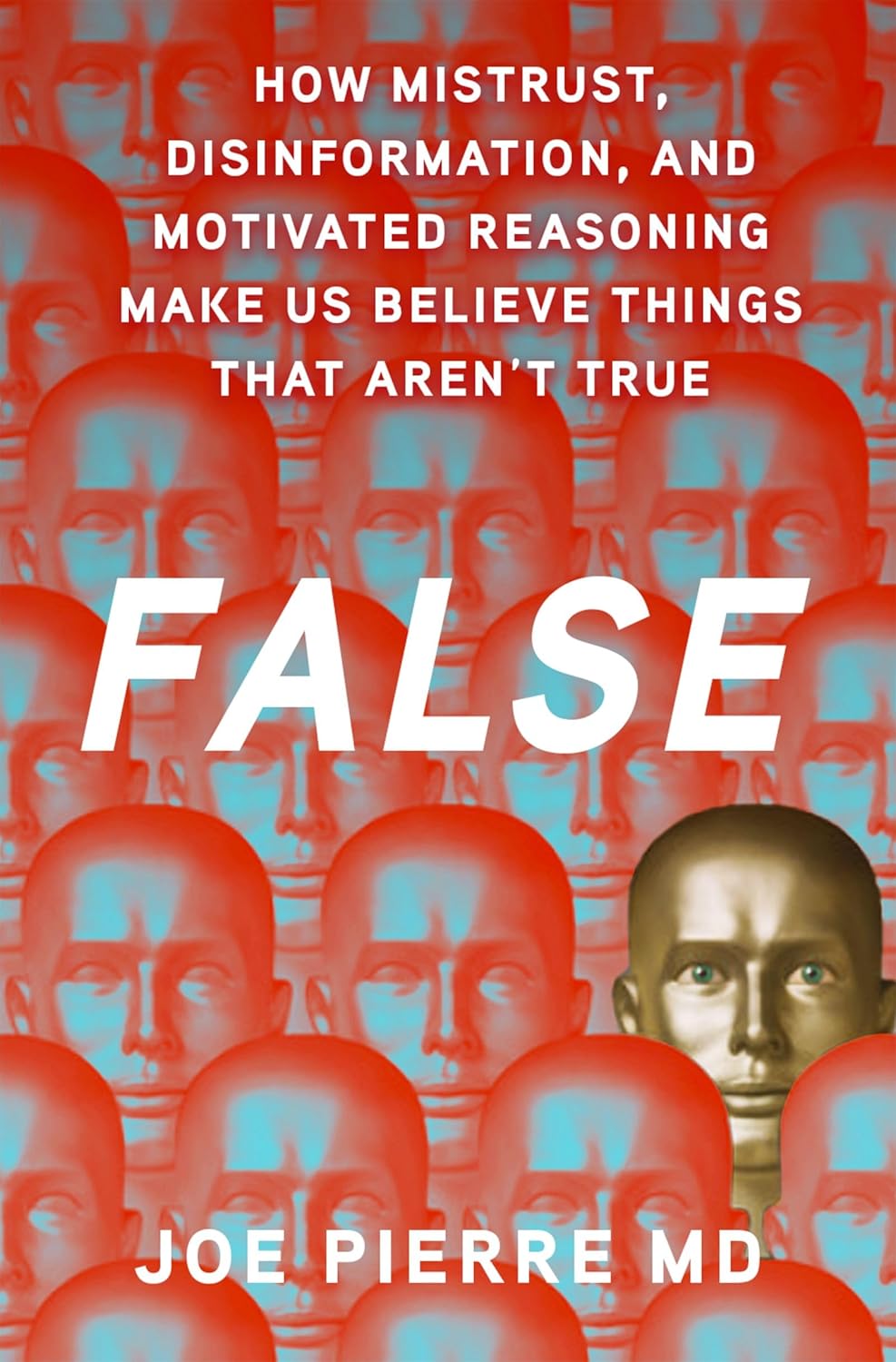
An illuminating exploration of the psychology of false belief that lies at the root of …
False is a difficult book to summarize. The world could use quite a bit more content like the majority of its contents. It does well to include many factors involved in how we are faulty thinkers and susceptible to poor reasoning leading to false beliefs. The author takes care to include all of us in the potential victims of our own biases, which a reminder we can never have enough of.
However, when Pierre chooses to shift from psychiatric topics to politics, racial and social justice, and philosophy, he finds himself quickly out of his depth. These chapters serve as something of a public forum for his seeming unaware internal conflict between his deep centrist leanings with his informed understanding of the existence of racial injustice and far-right extremism in the United States.
His apparent need to sit neatly in the middle and suggest that the most healthy …
False is a difficult book to summarize. The world could use quite a bit more content like the majority of its contents. It does well to include many factors involved in how we are faulty thinkers and susceptible to poor reasoning leading to false beliefs. The author takes care to include all of us in the potential victims of our own biases, which a reminder we can never have enough of.
However, when Pierre chooses to shift from psychiatric topics to politics, racial and social justice, and philosophy, he finds himself quickly out of his depth. These chapters serve as something of a public forum for his seeming unaware internal conflict between his deep centrist leanings with his informed understanding of the existence of racial injustice and far-right extremism in the United States.
His apparent need to sit neatly in the middle and suggest that the most healthy approach is one that includes "compromise" on issues such as "racial equality" and "abortion". Framing being "pro-choice" and "pro-life" as "contested ideologies". He exposes himself and his own biases in describing an archetype of a man who is "middle of the road", endorses "conservative economic stances" and "free-market capitalism", "believes in the right to bear arms" and "isn't particularly politically active" as someone who reaches this position as an example of a "mentally healthy way of believing".
Pierre also appears to not understand the concept of moral relativism while trying to use it as an example. At least, I hope he doesn't understand it. Because under the proper understanding of moral relativism -- that what is acceptable is contextual to facts involved when making the decision to act -- what is written excuses pedophilia and slavery.
Ultimately he appears to abandon the importance of being factually correct once it dips into politics, seemingly, though unspoken, by the belief that if people can get along more nicely, then we'd stop having extremists.
The last major flaw in the writings on politics is that it barely acknowledge the media ecosystem driving extremism on the right. Factors in faulty reasoning like confirmation bias and motivated reasoning don't really come into play when it someone is simply internalizing what they're told from authority figures because they are conditioned to do so.
Most of the book provides useful, interesting facts on how we think and come to conclusions. When Pierre tries to pull these points together into a sort of worldview of how politics should look like in America, it comes across naive, uninformed, and frankly, what you would expect from a well-off middle-aged White guy. And as such, I can't really recommend this book.
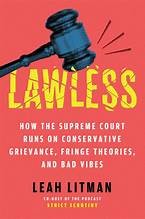
Lawless is very successful in compiling a substantial indictment of the Supreme Court comprised of many decisions over its history. The summation of the politically motivated decisions devoid of coherent judicial philosophy or reasoning is encapsulated by the author in the term "vibes". The court rules by vibes.
Despite the levity (and accuracy) of the description, the book doesn't stray far from dry facts. Even the narrative is more implied than directly stated throughout, drawing together relevant details to paint a picture over time.
I would highly recommend this book to anyone not especially familiar with the slanted nature of the court, but while Litman does walk through cases all the way back to the start of the court, there may not be a huge amount here for anyone who has been keeping tabs on John Roberts and company over the past decade.
Lawless is very successful in compiling a substantial indictment of the Supreme Court comprised of many decisions over its history. The summation of the politically motivated decisions devoid of coherent judicial philosophy or reasoning is encapsulated by the author in the term "vibes". The court rules by vibes.
Despite the levity (and accuracy) of the description, the book doesn't stray far from dry facts. Even the narrative is more implied than directly stated throughout, drawing together relevant details to paint a picture over time.
I would highly recommend this book to anyone not especially familiar with the slanted nature of the court, but while Litman does walk through cases all the way back to the start of the court, there may not be a huge amount here for anyone who has been keeping tabs on John Roberts and company over the past decade.
Still have to put together a review, but got through this one quickly (for me)!