💬 ⭐ "If someone threatens to burn your house down unless you follow their orders and they burn your house down anyway, you don't have to keep following their orders"
Surrendering to #Trump and capitulation is a failure...
But Tariffs are also a way to try force people to sell out (their country - e.g. saying tariffs will be put on Brazilian coffee if they don't accept US anti-circumvention laws - so those countries (all of them) …
💬 ⭐ "If someone threatens to burn your house down unless you follow their orders and they burn your house down anyway, you don't have to keep following their orders"
Surrendering to #Trump and capitulation is a failure...
But Tariffs are also a way to try force people to sell out (their country - e.g. saying tariffs will be put on Brazilian coffee if they don't accept US anti-circumvention laws - so those countries (all of them) give in and take on #US pressure.
Source: Cory Doctorow Podcast 507 The Post-American Internet -
@pluralistic with another banger. Guess who was in his second term in 2012? Barack Obama. In case any fellow Canucks think the Democrats are going to put everything ‘back to normal,’ this crap is normal for the Americans.
"Back in 2012, Canada passed Bill C-11, the Copyright Modernization Act. It’s a law that bans Canadian companies from modifying America’s digital tech exports. We passed it because the US threatened us with tariffs”
@pluralistic with another banger. Guess who was in his second term in 2012? Barack Obama. In case any fellow Canucks think the Democrats are going to put everything ‘back to normal,’ this crap is normal for the Americans.
"Back in 2012, Canada passed Bill C-11, the Copyright Modernization Act. It’s a law that bans Canadian companies from modifying America’s digital tech exports. We passed it because the US threatened us with tariffs”
How can a country without an anti-circumvention law handle its first trade-deal with USA?
Inspired by Cory Doctorow's Post-American Internet proposition [1], I'm thinking of the day when Iran's theocratic government falls, and the new political system starts normal economical relationship with the world.
Not only #Iran does not have any kind of anti-circumvention law, it is the biggest economy that is not a signatory to the Bern convention on copyright. Nevertheless, it has a relatively advanced and self-sufficient domestic IT world, with services for maps, video streaming, cloud services, finance, ride hailing, etc. At some point in 2021 ArvanCloud, an Iranian IT company, was the 8th highest-traffic CDN in the world.
So how would you build the almost-non-existent outward-facing economy of a big country, without falling into the usual trap of #enshittification?
Your ideas are very welcome. I would very much also …
How can a country without an anti-circumvention law handle its first trade-deal with USA?
Inspired by Cory Doctorow's Post-American Internet proposition [1], I'm thinking of the day when Iran's theocratic government falls, and the new political system starts normal economical relationship with the world.
Not only #Iran does not have any kind of anti-circumvention law, it is the biggest economy that is not a signatory to the Bern convention on copyright. Nevertheless, it has a relatively advanced and self-sufficient domestic IT world, with services for maps, video streaming, cloud services, finance, ride hailing, etc. At some point in 2021 ArvanCloud, an Iranian IT company, was the 8th highest-traffic CDN in the world.
So how would you build the almost-non-existent outward-facing economy of a big country, without falling into the usual trap of #enshittification?
Your ideas are very welcome. I would very much also like to know what Cory @pluralistic thinks about this :)
It's taken me some time to get my writing mojo back after the holidays, but I've finally managed the first #blog of the year. It's a #review of @pluralistic 's excellent The Internet Con.
I know I'm a book behind and #Enshittification is on my list, but The Internet Con remains an excellent manifesto, primer and polemic for anyone who wants to understand why the internet feels broken, and what we can do about it.
It's taken me some time to get my writing mojo back after the holidays, but I've finally managed the first #blog of the year. It's a #review of @pluralistic 's excellent The Internet Con.
I know I'm a book behind and #Enshittification is on my list, but The Internet Con remains an excellent manifesto, primer and polemic for anyone who wants to understand why the internet feels broken, and what we can do about it.
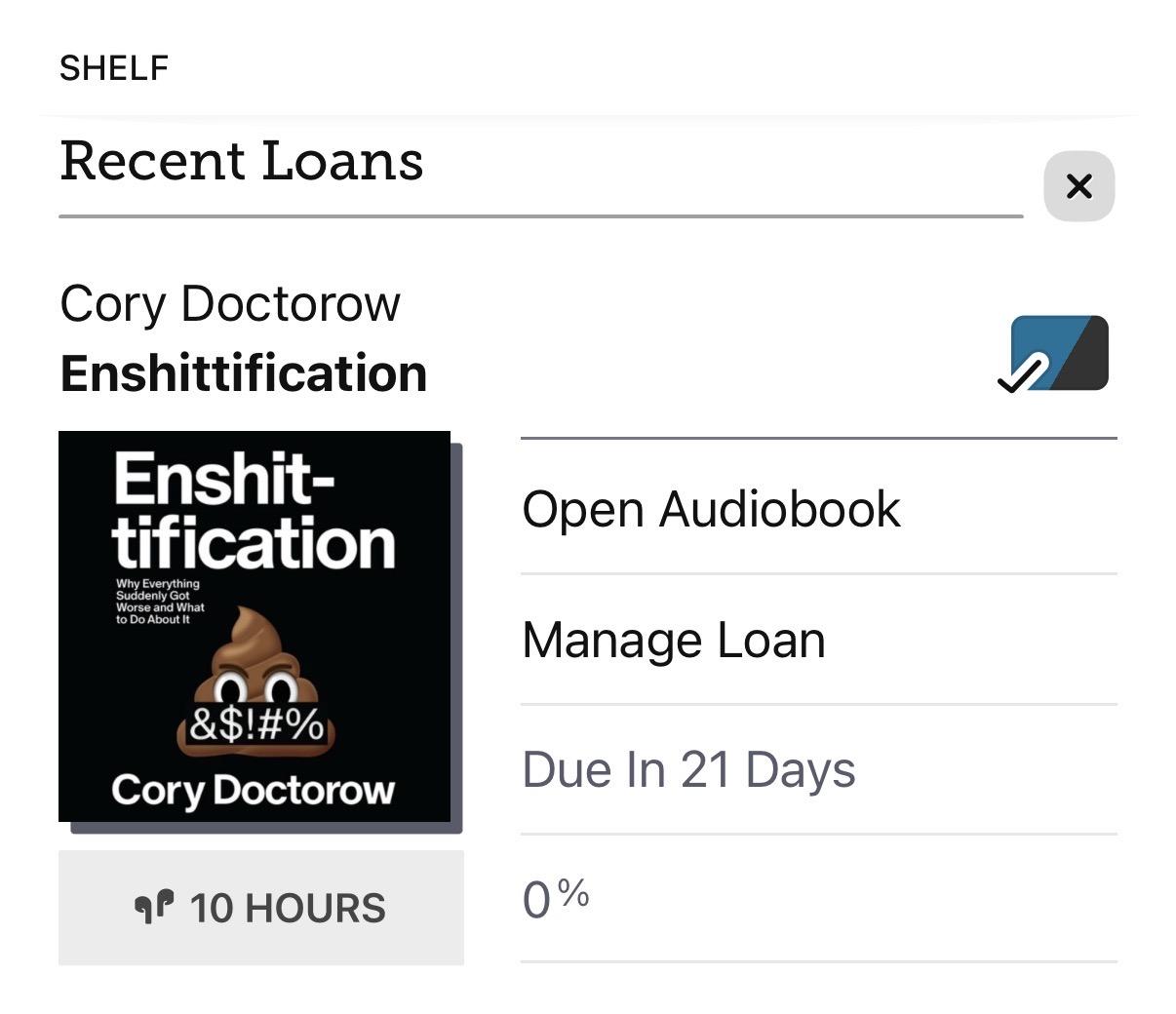
Gelesen: Enshittification (2025) von Cory Doctorow (@pluralistic). Sehr lesenswert! Er erklärt anhand von Beispielen wie X, Amazon, TikTok, Meta und Apple, wie das Leben online immer schlimmer wird und was man dagegen tun kann. #bookstagram#books#enshittification#enshittocene#bookstodon
"Because, after decades of throwing myself against a locked door, the door that leads to a new, good internet, one that delivers both the technological self-determination of the old, good internet, and the ease of use of Web 2.0 that let our normie friends join the party, that door has been unlocked.
Today, it is open a crack. It's open a crack!
And here's the weirdest part: Donald Trump is the guy who's unlocked that door."
"Because, after decades of throwing myself against a locked door, the door that leads to a new, good internet, one that delivers both the technological self-determination of the old, good internet, and the ease of use of Web 2.0 that let our normie friends join the party, that door has been unlocked.
Today, it is open a crack. It's open a crack!
And here's the weirdest part: Donald Trump is the guy who's unlocked that door."
Einer der Gründe für den Start der Mastodon-Instanz von «momou.social» war definitiv auch das aktuell eher zermürbende Erlebnis in den «grossen» sozialen Medien ...
Cory Doctorow (@pluralistic) brachte das in seinem ermutigenden und sehr empfehlenswerten Vortrag «A post-American, enshittification-resistant internet» am diesjährigen «Chaos Computer Congress» ziemlich gut auf den Punkt und fordert auf, ein «neues» Internet ohne #BigTech mitzugestalten.
I will never not boost the work of Cory Doctorow, even if most of the time I'm not big-brained enough to follow every thread that he lays down.
This book talks about interoperability, and how it's something that most people don't realise that they need more of in their life, and how it's been criminalised in the name of keeping citizens in the thrall of Big Tech. What's interoperability? If you've ever wondered why messages don't work properly across the iPhone/Android divide, or why you can't easily leave Facebook for another social media platform, or why you're not allowed to repair your own tractor, then you know something about why interoperability is important but restricted by tech gatekeepers. It's easy to make a device that can perform any sort of computation, but …
I will never not boost the work of Cory Doctorow, even if most of the time I'm not big-brained enough to follow every thread that he lays down.
This book talks about interoperability, and how it's something that most people don't realise that they need more of in their life, and how it's been criminalised in the name of keeping citizens in the thrall of Big Tech. What's interoperability? If you've ever wondered why messages don't work properly across the iPhone/Android divide, or why you can't easily leave Facebook for another social media platform, or why you're not allowed to repair your own tractor, then you know something about why interoperability is important but restricted by tech gatekeepers. It's easy to make a device that can perform any sort of computation, but they're always locked down – for whatever reason, usually profit – and this hobbling of the devices and platforms you own and engage with is an ongoing restriction on your personal data and belongings.
Doctorow shows the problem through a great series of examples – search engines, operating systems, VCRs, copyright infringement notices, deliberately-borked internet treaties, and so on – in his typical very-readable fashion. The first third of the book is a hit list of things you didn't realise made the world just a little bit more shitty... or enshittified.
The book pivots to discussing interoperability and federation, before throwing some problems up into the air that he opines can be solved with that one simple trick that the technofeudalists hate: better regulation.
I'll never not read a Cory Doctorow book, but I wish now and then that some of the solutions for which he advocates were implemented, rather than each new year bringing another set to examples for him to inevitably use in the opening chapters of his next book.
Most people in my bubble will probably have listened to this talk by now, but for those who missed it and want to go out of 2025 on a very hopeful talk, here's @pluralistic at #39c3 :)
Sometime around the 2020 era, we lost the right to be mediocre at things we love.
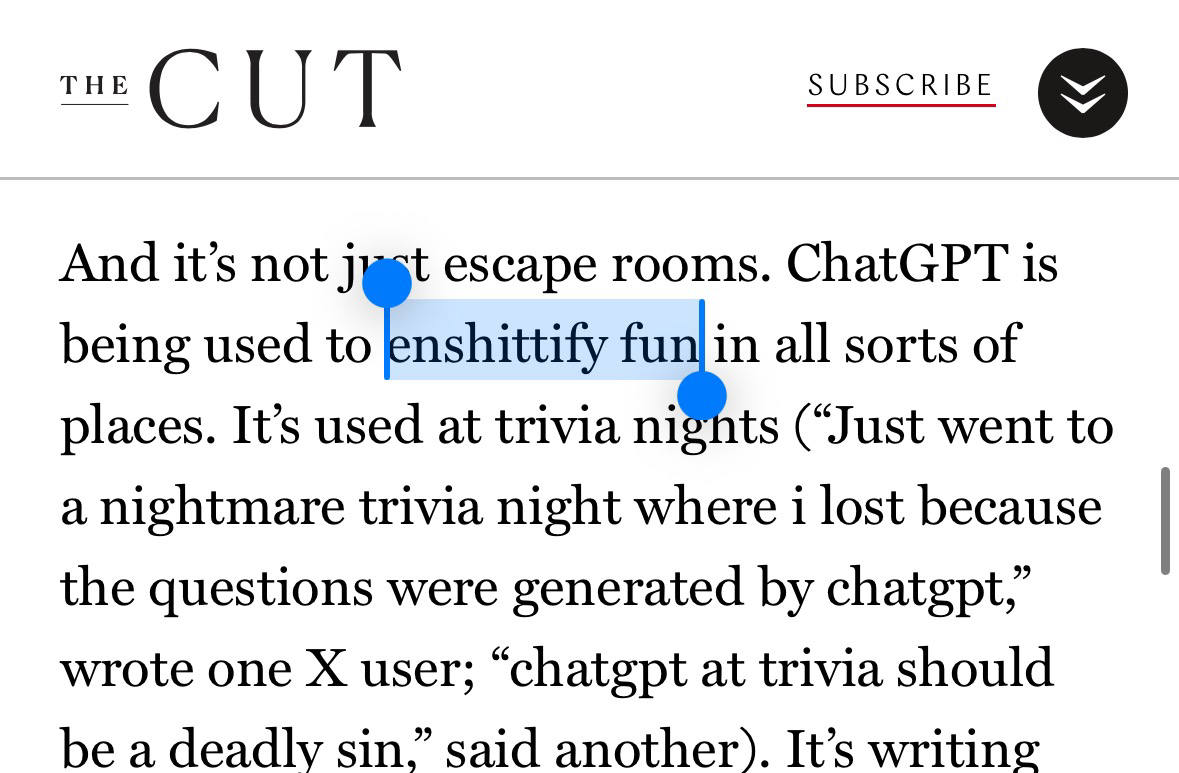
No longer can you just bake bread...you must start a sourdough side hustle lol. Wanna stay fit and go jogging or running? Nah, you gotta optimize your biometrics for a marathon. What my point is that every hobby has been enshittified and gentrified into a brand opportunity.
This strange infatuation with optimization culture is killing the human spirit.
So this new year, starting tomorrow, one of my resolutions is to do something bad but fun. Maybe I write a terrible poem. I like to draw and paint, so perhaps I will draw a horse that looks like a table or sing off-key in the showers or in front of my loved ones. The algorithm driving the mainstream social media wants me to be a polished product, but my humanity lives in …
Sometime around the 2020 era, we lost the right to be mediocre at things we love.
No longer can you just bake bread...you must start a sourdough side hustle lol. Wanna stay fit and go jogging or running? Nah, you gotta optimize your biometrics for a marathon. What my point is that every hobby has been enshittified and gentrified into a brand opportunity.
This strange infatuation with optimization culture is killing the human spirit.
So this new year, starting tomorrow, one of my resolutions is to do something bad but fun. Maybe I write a terrible poem. I like to draw and paint, so perhaps I will draw a horse that looks like a table or sing off-key in the showers or in front of my loved ones. The algorithm driving the mainstream social media wants me to be a polished product, but my humanity lives in these messy, unoptimized, cringe-inducing joyful failures.
I will try to reclaim the right to be an amateur. Will you join me?