Are you ready to dive into the incredible and innovative minds of octopuses?
These invertebrates are unlike anything in the animal kingdom, having survived ice ages and asteroids, outliving dinosaurs and spreading their arms to survive in every part of our oceans.
People ask me what I would advise them to do in preparation for their own funeral. I tend to say they can leave their loved ones to decide the service if they write a #will. And if you are #LGBTQ+ write a will & do it now. If you are #Queer or #trans write your will. If you are feeling you are too #young or not needing to think about it yet *write a will*. Look into the eyes of the people you love, write it for them. If we don’t write a will, #biology will win over #choice. Please #WriteAWill
We're just migrated from another instance, so here is our (re)introduction:
Neurofrontiers is a bilingual blog about interesting neuroscience topics that tries to be accessible to the broader public while still maintaining scientific accuracy. It's run by a team of three people: a computational neuroscientist, a psychologist, and a graphic designer. We think that being on social media allows us to stay up-to-date with the most recent discussions in science and hope to be able to connect with like-minded individuals.
We're just migrated from another instance, so here is our (re)introduction:
Neurofrontiers is a bilingual blog about interesting neuroscience topics that tries to be accessible to the broader public while still maintaining scientific accuracy. It's run by a team of three people: a computational neuroscientist, a psychologist, and a graphic designer. We think that being on social media allows us to stay up-to-date with the most recent discussions in science and hope to be able to connect with like-minded individuals.
TIL: The West African Crocodile (or Sacred Crocodile) Crocodylus suchus only was recognized as a separate species from the Nile Crocodile in 2003, despite being discovered as a seperate species in 1807 by a French naturalist who compared mummified crocodiles to common crocodiles.
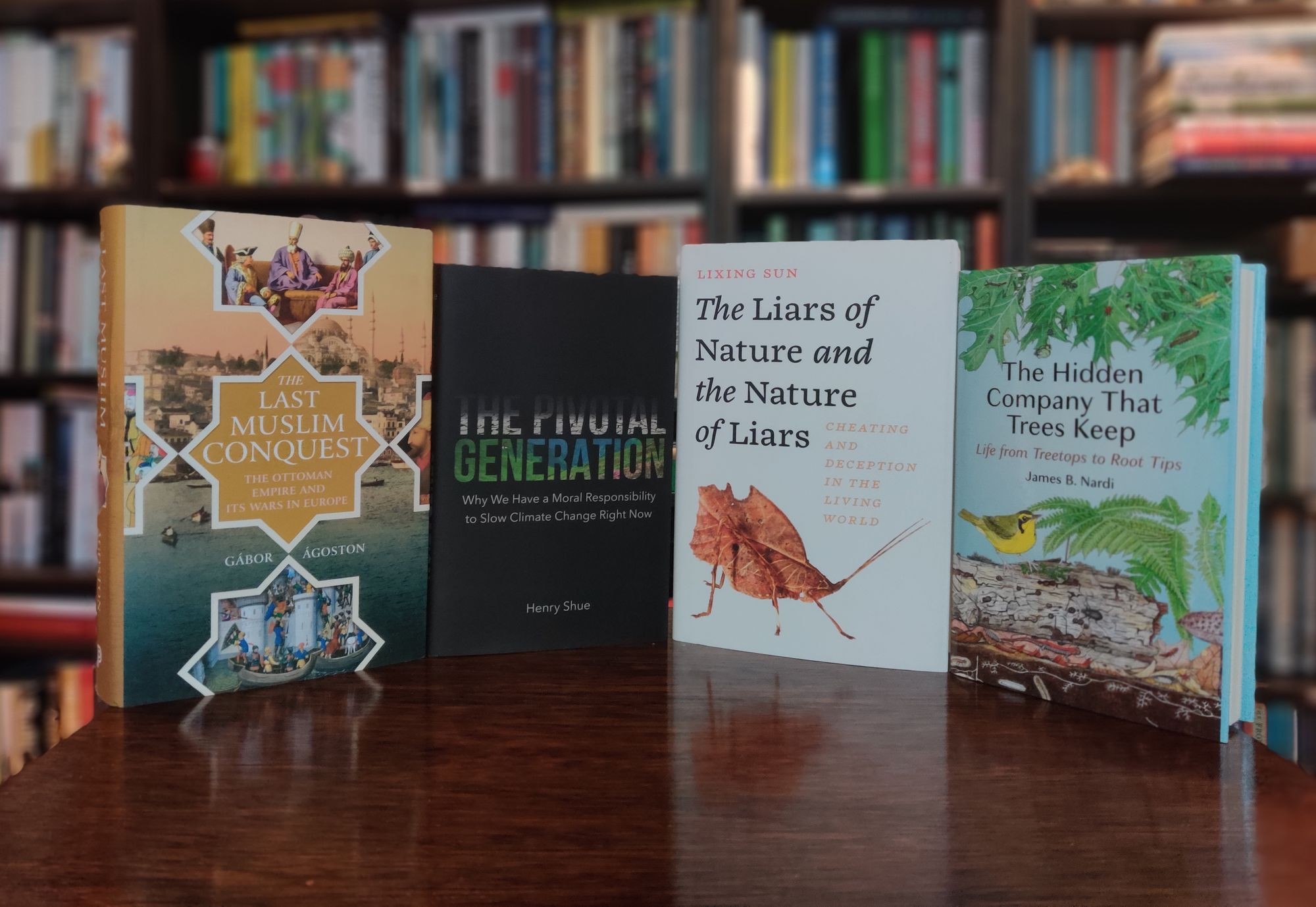
This week's #NewBooks at the library: Once a year @princetonupress has their autumn sale, knocking 70% off prices (it's still on!). Thus I bagged myself four very different books: The Last Muslim Conquest, The Pivotal Generation, The Liars of Nature and the Nature of Liars, and The Hidden Company That Trees Keep
“When you’re sure of what you’re looking at, look harder.” - Richard Powers, Generosity
Forty-four years ago I enrolled in a field biology class where we went out to survey wildlife using transects and quadrants for plants, binoculars for birds, and paint dabbed onto abdomens for ants. We wrote into our college notebooks what we observed of bird behavior. There were formulas to be used later for estimating plant species dominance and ant colony population size from data we collected. Today, inspired by those memories, by the delightful observations of humans by author @georgepenney, and the writings of novelist Richard Powers, I venture out far too late in the day when it is already hot in Texas.
I find a spot to sit on a limestone outcropping of an escarpment above the dry bed of Slaughter Creek in Austin. A Carolina wren calls from out of …
“When you’re sure of what you’re looking at, look harder.” - Richard Powers, Generosity
Forty-four years ago I enrolled in a field biology class where we went out to survey wildlife using transects and quadrants for plants, binoculars for birds, and paint dabbed onto abdomens for ants. We wrote into our college notebooks what we observed of bird behavior. There were formulas to be used later for estimating plant species dominance and ant colony population size from data we collected. Today, inspired by those memories, by the delightful observations of humans by author @georgepenney, and the writings of novelist Richard Powers, I venture out far too late in the day when it is already hot in Texas.
I find a spot to sit on a limestone outcropping of an escarpment above the dry bed of Slaughter Creek in Austin. A Carolina wren calls from out of sight in the distance. A slight breeze causes a few leaves and acorns to fall from nearby Texas live oak and Texas persimmon trees, making papery noises as they tumble through the remaining foliage. The sky is clear and light blue.
A turkey vulture soars high overhead, silently on the thermals with no need for any exertion by the flapping of wings. The sometimes fallible Merlin app tells me it hears a great horned owl. It sounds more like a blue jay to me. I restart the app and Merlin vacillates between the owl and a blue jay. An unidentified bird with pointy wingtips flies low over my head, flapping noisily in the air, perhaps chased away by the blue jay.
A yellow-jacket wasp flies through Texas kidneywood with tiny drought resistant leaflets on its compound leaves and dark peeling bark that reveals a whitish cambium. Extract from its bark was used medicinally by indigenous people. The wasp briefly alights three times before continuing on its way. Yellow butterflies and white butterflies pass by, not stopping to show me their identification.
A passenger jet flies overhead. I hear a train horn a few miles away. I can’t spot a single insect on the ground at noon and don’t wish to disturb siestas by overturning stones. It is far too hot outside for this senior citizen, so I follow the insects’ example and walk home to my air-conditioned shelter. On the way, I see more of the butterflies, the yellow one a southern dogface, the white one with an orange border a common mestra. Like the wasp, they visit a Texas ironwood which may provide some kind of respite from the heat, perhaps offering tiny droplets of water or sap along its stems.