Morals and Metaphor
3 stars
Until a few weeks ago, I only knew Iris Murdoch as a novelist, and one whose writing I have always enjoyed. I only recently learned that she also wrote books on moral philosophy. This school of philosophy is one I've always found a little hard to access, particularly in western writing where it is often tied up in Judaeo-Christian moralism; having been raised in this tradition, I often find it hard to identify bias, or to use a metaphor: to see the wood for the trees.
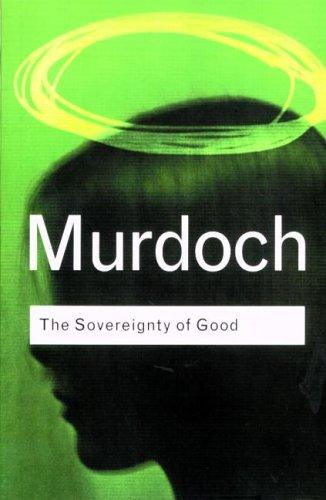
I chose metaphor above as a nod to Murdoch. Metaphor is central to this book, which is split into three sections. The first considers perfection, using a story about a mother-in-law and a daughter as a way to understand individual motivations. The second section deals specifically with God, with some interesting observations on how art can interpret 'good' by using metaphor. The third …
Until a few weeks ago, I only knew Iris Murdoch as a novelist, and one whose writing I have always enjoyed. I only recently learned that she also wrote books on moral philosophy. This school of philosophy is one I've always found a little hard to access, particularly in western writing where it is often tied up in Judaeo-Christian moralism; having been raised in this tradition, I often find it hard to identify bias, or to use a metaphor: to see the wood for the trees.
I chose metaphor above as a nod to Murdoch. Metaphor is central to this book, which is split into three sections. The first considers perfection, using a story about a mother-in-law and a daughter as a way to understand individual motivations. The second section deals specifically with God, with some interesting observations on how art can interpret 'good' by using metaphor. The third section deals with how we perceive goodness, drawing from Plato through two millennia of moral philosophy.
I enjoyed the method of discussion in the first two sections, even if I didn't always understand the line of argument. Murdoch gives food for thought for how moral behaviours can be enacted inwardly and socially. The third section didn't align much to my understanding of the world because it begins from the assumption that all people are inherently selfish. She attributes this to Kant, although I would argue it comes as much from Hobbes and the British tradition of moral philosophy, and I'd also argue that any argument after that assumption will fail to hold up, based on many things we know about symbiosis. This assumption fits the bias of western philosophy, and Murdoch seems to be a strong believer in it.
In the end, I enjoyed how Murdoch gave breadth to other philosophers, particularly expanding some of Simone Weil's ideas, bringing them into focus through art. When writing about art I felt that the writing was strongest and flowed most freely. That might be my own bias, revealing where my own sovereignty of good might be found.