“Is Google making us stupid?” When Nicholas Carr posed that question, in a celebrated Atlantic Monthly cover story, he tapped into a well of anxiety about how the Internet is changing us. He also crystallized one of the most important debates of our time: As we enjoy the Net’s bounties, are we sacrificing our ability to read and think deeply?
Now, Carr expands his argument into the most compelling exploration of the Internet’s intellectual and cultural consequences yet published. As he describes how human thought has been shaped through the centuries by “tools of the mind”—from the alphabet to maps, to the printing press, the clock, and the computer—Carr interweaves a fascinating account of recent discoveries in neuroscience by such pioneers as Michael Merzenich and Eric Kandel. Our brains, the historical and scientific evidence reveals, change in response to our experiences. The technologies we use to find, store, and …
“Is Google making us stupid?” When Nicholas Carr posed that question, in a celebrated Atlantic Monthly cover story, he tapped into a well of anxiety about how the Internet is changing us. He also crystallized one of the most important debates of our time: As we enjoy the Net’s bounties, are we sacrificing our ability to read and think deeply?
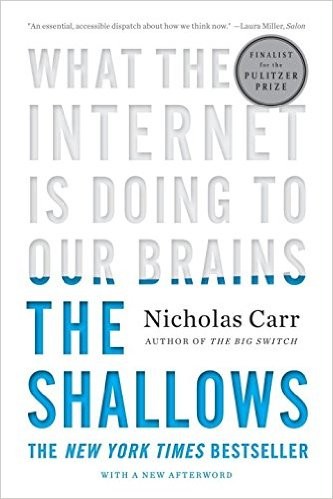
Now, Carr expands his argument into the most compelling exploration of the Internet’s intellectual and cultural consequences yet published. As he describes how human thought has been shaped through the centuries by “tools of the mind”—from the alphabet to maps, to the printing press, the clock, and the computer—Carr interweaves a fascinating account of recent discoveries in neuroscience by such pioneers as Michael Merzenich and Eric Kandel. Our brains, the historical and scientific evidence reveals, change in response to our experiences. The technologies we use to find, store, and share information can literally reroute our neural pathways.
Building on the insights of thinkers from Plato to McLuhan, Carr makes a convincing case that every information technology carries an intellectual ethic—a set of assumptions about the nature of knowledge and intelligence. He explains how the printed book served to focus our attention, promoting deep and creative thought. In stark contrast, the Internet encourages the rapid, distracted sampling of small bits of information from many sources. Its ethic is that of the industrialist, an ethic of speed and efficiency, of optimized production and consumption—and now the Net is remaking us in its own image. We are becoming ever more adept at scanning and skimming, but what we are losing is our capacity for concentration, contemplation, and reflection.
Part intellectual history, part popular science, and part cultural criticism, The Shallows sparkles with memorable vignettes—Friedrich Nietzsche wrestling with a typewriter, Sigmund Freud dissecting the brains of sea creatures, Nathaniel Hawthorne contemplating the thunderous approach of a steam locomotive—even as it plumbs profound questions about the state of our modern psyche. This is a book that will forever alter the way we think about media and our minds.
Extremely interesting, very well readable book on how the digital media and tools we consume and use, affect our brains. I was shocked to find out how radically memory, attention span and even empathy are influenced by these tools. I already was sceptical of these technologies and the prominent role they have in our everyday lives, but this book truly convinced me of the importance of de-digitalizing some parts of life. Highly recommend!
Overall, it's okay and I find it making some compelling arguments for the shift in thinking that's been enforced by more technology but it spends more time centering on the medium rather than the way that it's been used. If the issue is truly overstimulation, we can find ways to reel back the stimulation while still maintaining the benefits of tech. Along with missing that significant distinction, it feels a bit out of date. That's solely the result of tech being a moving target that's easy to miss and the book being over a decade old at this point. Perhaps it's a testament to its presience but I'd probably say you should spend more time reading "Irresistible" by Adam Alter. If you find yourself still wanting more on the ethics and impact of tech, this is certainly worth the while but not something I'd recommend as a top-level view.
Overall, it's okay and I find it making some compelling arguments for the shift in thinking that's been enforced by more technology but it spends more time centering on the medium rather than the way that it's been used. If the issue is truly overstimulation, we can find ways to reel back the stimulation while still maintaining the benefits of tech. Along with missing that significant distinction, it feels a bit out of date. That's solely the result of tech being a moving target that's easy to miss and the book being over a decade old at this point. Perhaps it's a testament to its presience but I'd probably say you should spend more time reading "Irresistible" by Adam Alter. If you find yourself still wanting more on the ethics and impact of tech, this is certainly worth the while but not something I'd recommend as a top-level view.
I used to read a lot more books, and made a conscious decision to read more books this year. I've found I'm not as good at reading them -- I'm easily distracted, and haven't as much capacity to stay focused on one text. When my 19yo announced she was ditching her smartphone for her mental health, I decided I should read this book. I'm glad I did.
Chilling. Carr shows how the medium changes the mind. We do not think as much, our brain loses capabilities, we are more gullible and less empathetic. We see this all around us, but we're probably blinded by thinking, "Not me!" Carr makes it clear that all of us are affected.
I've spent a career developing software. It's not all bad, and Carr doesn't make that accusation. I've made some tasks significantly simpler and more efficient, like shipping goods via rail or getting …
I used to read a lot more books, and made a conscious decision to read more books this year. I've found I'm not as good at reading them -- I'm easily distracted, and haven't as much capacity to stay focused on one text. When my 19yo announced she was ditching her smartphone for her mental health, I decided I should read this book. I'm glad I did.
Chilling. Carr shows how the medium changes the mind. We do not think as much, our brain loses capabilities, we are more gullible and less empathetic. We see this all around us, but we're probably blinded by thinking, "Not me!" Carr makes it clear that all of us are affected.
I've spent a career developing software. It's not all bad, and Carr doesn't make that accusation. I've made some tasks significantly simpler and more efficient, like shipping goods via rail or getting a referral to a specialist. This book isn't a screed against technology. It's an honest and brave treatise about how the development of new technologies inevitably change not only the way we think, but the development and state of our brains. Sometimes for good, sometimes for bad . . . but as he says, "the technology we assumed would enlarge us has made us smaller." Gut check for us all.
Many books I've ready about the Internet and society seem outdated and naive very shortly after they're published. A large part of this book is not about the Internet at all, but rather takes a historical perspective of advancements that have come before it - writing, mass literacy, the printing press and typewriters - and the hopes and fears that people had for them when they emerged. Creating and consuming information in ways which have deep effects on the ways our minds work is nothing new, but the level of distraction that the Internet now presents us with is perhaps unprecedented. Don't be put off by the fact that this book was published in 2011 when smart phones were in their infancy and before presidents governed via Twitter, if you have a mobile, read a news website or use social media, read this.
Many books I've ready about the Internet and society seem outdated and naive very shortly after they're published. A large part of this book is not about the Internet at all, but rather takes a historical perspective of advancements that have come before it - writing, mass literacy, the printing press and typewriters - and the hopes and fears that people had for them when they emerged. Creating and consuming information in ways which have deep effects on the ways our minds work is nothing new, but the level of distraction that the Internet now presents us with is perhaps unprecedented. Don't be put off by the fact that this book was published in 2011 when smart phones were in their infancy and before presidents governed via Twitter, if you have a mobile, read a news website or use social media, read this.