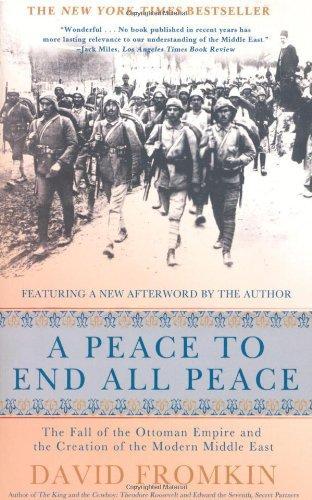

Bill Day reviewed A Peace to End All Peace by David Fromkin
Review of 'A Peace to End All Peace' on 'Goodreads'
5 stars
David Fromkin's a Peace to End All Peace repays reading at least a second time. It is perhaps somewhat old fashioned in its sweeping historical narrative, but it offers a keen analysis of the final collapse of the Ottoman Empire during World War I and the subsequent disastrous settlement of 1922, seen from a British perspective and centered around the career of Winston Churchill. Largely absent is the perspective of the Arabs caught between the anvil of Ottoman Rule and the hammer of the British invasion. For all that, it provides a fascinating and insightful perspective into the motivations that drove the Allies in their campaign to destroy the the Ottoman Empire and assume control of its Arab provinces.
The exhausted postwar allies, primarily Britain and France, bickered amongst themselves as they carved up the Arab Middle East into arbitrary territories governed by weak puppets. Ironically, it was the champion …
David Fromkin's a Peace to End All Peace repays reading at least a second time. It is perhaps somewhat old fashioned in its sweeping historical narrative, but it offers a keen analysis of the final collapse of the Ottoman Empire during World War I and the subsequent disastrous settlement of 1922, seen from a British perspective and centered around the career of Winston Churchill. Largely absent is the perspective of the Arabs caught between the anvil of Ottoman Rule and the hammer of the British invasion. For all that, it provides a fascinating and insightful perspective into the motivations that drove the Allies in their campaign to destroy the the Ottoman Empire and assume control of its Arab provinces.
The exhausted postwar allies, primarily Britain and France, bickered amongst themselves as they carved up the Arab Middle East into arbitrary territories governed by weak puppets. Ironically, it was the champion of the British Empire, Winston Churchill, who argued that the British Empire was badly overextended in the Middle East, even as he laid plans to maintain order with a series of air bases in the absence of the British Army which he was demobilizing.
In the midst of the horrific carnage of the first World War, one hardly knows what to make of the "sideshow to a sideshow," as T.E. Lawrence put it, a tragedy and a farce that has caused so much grief in the modern world, most of all to the Arab people whom Britain was supposedly "liberating" from the domination of the Turks. The biggest blindspots of the British, according to Fromkin, were the British assumptions that Turkey and Russia were dominated by a worldwide Jewish conspiracy — to which the creation of a Jewish homeland was in part a sop — that the Middle East would rally around a "caliph" handpicked by Britain, which chose the marginal Hussein of Mecca to fulfill the role, and that the Arabs had an interest in trading rule by Muslim Turks for Christian Englishman.
In their rush to create a new imperial order in the Middle East, both to maintain a buffer between Russia and India and to control a region than increasingly appeared to contain petroleum reserves essential to the British Navy, the British promised everything to everyone. They assumed that everything could be sorted out after they won they won the war, but the result was a series of messy compromises and subterfuges with the coming of the various armistices with the Central Powers. Having spilled so much blood in the war in the East, particularly in the ill-fated Gallipoli campaign, by the war's end Britain was not only the only power left standing, but also felt an enormous sense of entitlement to its territorial gains. As a result, it went back on its promises to divide the region with the French and set up a series of weak Hashemite rulers in the hope of maintaining indirect control. Meanwhile, even in Egypt, which they had promised independence during the war, the British were confronted with a restive populace, and throughout the region were continually contending with unanticipated insurgencies. In addition, they were faced with a hostile Bolshevik Russia and a resurgent Turkey under the leadership of Mustapha Kemal (later Ataturk).
In the end, Fromkin presents us with a farrago of cynical manipulation, imperial greed, bumbling ignorance and incompetence, and naive good intentions which would be comic were the consequences not so tragic. In one sense, the modern Middle East is simply one more casualty of a war which as of that time constituted the most catastrophic event in human history; its tragedy is that the wounds have not healed to this day.