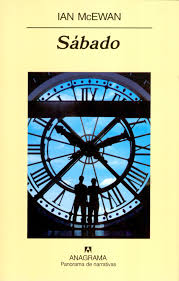

Acton reviewed Saturday by Ian McEwan
Review of 'Saturday' on 'Goodreads'
4 stars
Some hours before dawn Henry Perowne, a neurosurgeon, wakes to find himself already in motion, pushing back the covers from a sitting position, and then rising to his feet. It’s not clear to him when exactly he became conscious, nor does it seem relevant. He’s never done such a thing before, but he isn’t alarmed or even faintly surprised...
So starts Ian McEwan’s Saturday , a novel about an extraordinary day in the life of the London doctor Henry Perowne. This particular day happens to be February 15, 2003, and Henry is waking up to his affluent life in London, beside his beloved wife, and has much to look forward to: his talented son’s blues band rehearsal, in which they will perform a new song for him, the arrival of his daughter from Italy, and the dinner he is to prepare and share with the entire family, to top it …
Some hours before dawn Henry Perowne, a neurosurgeon, wakes to find himself already in motion, pushing back the covers from a sitting position, and then rising to his feet. It’s not clear to him when exactly he became conscious, nor does it seem relevant. He’s never done such a thing before, but he isn’t alarmed or even faintly surprised...
So starts Ian McEwan’s Saturday , a novel about an extraordinary day in the life of the London doctor Henry Perowne. This particular day happens to be February 15, 2003, and Henry is waking up to his affluent life in London, beside his beloved wife, and has much to look forward to: his talented son’s blues band rehearsal, in which they will perform a new song for him, the arrival of his daughter from Italy, and the dinner he is to prepare and share with the entire family, to top it all off. Henry Perowne has a wonderful and affluent life.
However, a few unlikely events happen on the way to these happier plans that cause Henry to ponder the troubling world events that surround his insulated life, such as his country’s security fears since 9/11. First, he witnesses something while looking out at the sky during his early morning reverie that unsettles him and turns his mind toward the state of his own family’s security. Then, on his way to meet a colleague for a squash game, he must dodge a huge crowd of war-protestors, an event that is very important that day in London. This protest march is not only the constant reminder of his unsettled feelings, but also an indirect cause of the minor car accident he has on his way to his game. Unfortunately, Henry’s accident brings him in contact with a dangerous young man named Baxter, and the confrontation the two men have proves to be potentially disastrous for Henry’s family.
McEwan’s book is marvelously paced; even though most of what is written takes place in Henry Perowne’s head (he’s a neurosurgeon, after all), there is enough action in this story to balance the weight of Henry’s thoughts and memories. Also, I think that the way time passes in the book is fascinating--at certain points, the day seems too crowded with various events, and I felt sorry for Henry, to have all this to do, on a day off! Then, at other spots, time seems to pass at an excruciatingly slow pace. This is one of the aspects that makes this novel seem so real to me. One other point I appreciated was that, while Henry was feeling uneasy about war and terrorism, the real danger came from someone he might have met any day of his life, on the streets of London: The biggest danger to his family was close to home.
Ian McEwan’s novel is a thought-provoking look at how lives can be drastically affected by certain events, many of which cannot be predicted. It is also a relevant statement about how we perceive the potential dangers in our lives, and the importance of enjoying what we have, to live in the here and now.
I really was pleasantly surprised to find myself enjoying this one, since I'd read McEwan's earlier novel Amsterdam and didn't like it--in fact, the only reason I finished it was because I was stranded with it.