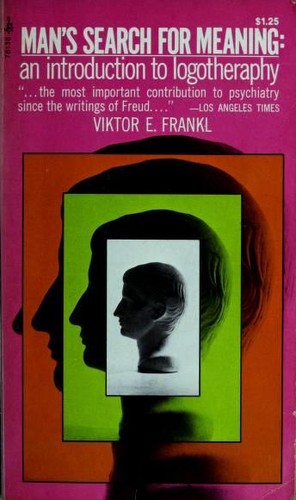
Dr. Viktor E. Frankl is professor of psychiatry and neurology at the University of Vienna, head of the Department of Neurology at the Poliklinik Hospital in Vienna, and president of the Austrian Medical Society for Psychotherapy. He is the leader and originator of the school of logotherapy or existential analysis.
After three grim y ears at Auschwitz and other Nazi prisons, Dr. Frankl gained freedom only to learn that almost his entire family had been wiped out. But during, and indeed partly because of, the incredible suffering and degradation of those harrowing years, he developed his theory of logotherapy.
In his own words, "logotherapy...makes the concept of man into a whole...and focuses its attention upon mankind's groping for a higher meaning in life." (back cover)
Dr. Viktor E. Frankl is professor of psychiatry and neurology at the University of Vienna, head of the Department of Neurology at the Poliklinik Hospital in Vienna, and president of the Austrian Medical Society for Psychotherapy. He is the leader and originator of the school of logotherapy or existential analysis.
After three grim y ears at Auschwitz and other Nazi prisons, Dr. Frankl gained freedom only to learn that almost his entire family had been wiped out. But during, and indeed partly because of, the incredible suffering and degradation of those harrowing years, he developed his theory of logotherapy.
In his own words, "logotherapy...makes the concept of man into a whole...and focuses its attention upon mankind's groping for a higher meaning in life."
(back cover)
Review of "Man's Search for Meaning" on 'Goodreads'
4 stars
Combinando vivencias con análisis médico, este libro deja huella en todo aquel que lo lea. Lecciones, una tras otra, que te maravillan y asustan al mismo tiempo, y que espero que causen las mejores reflexiones en las mentes de toda persona digna.
Viktor Frankl nos trae sus experiencias en un campo de concentración y cómo logra superar ése calvario.
Cuando uno pasa por una crisis y se enfrenta a la pérdida del sentido de vida, uno debería aferrarse a algo, ¿Qué le da sentido a tu vida? Si encuentras ése ancla a la realidad logras superar, no sin esfuerzo la adversidad. Lectura obligada para cuando estás bien y sobre todo para cuando estás mal.
La logoterapia nace de aquí y el enfrentarse a las cosas es para muchos, la vía a la recuperación.
Review of "Man's Search for Meaning" on 'Goodreads'
5 stars
ViktorFrankl survived the holocaust to write #MansSearchforMeaning. I don't say this lightly; Frankl cites one of the reasons he claimed not to succumb to suicide was bringing the insights he gleaned from the holocaust ,and its psychological effects, to the world outside of the Third Reich. He asks us to dispense with Freud's pleasure principle and Adam Smith's invisible hand and see the search for meaning in one's life as the motivating force of all people.
Facing the rise of authoritarianism, the endless, preventable plague, and the future throes of climate change, Frankl's insights are worth your time.
Man's Search for Meaning was one of my uncle's favorite books. I know he took inspiration from these words in his final hours:
"I once read a letter written by a young invalid, in which he told a friend that he had just found out he would not live for long, that …
ViktorFrankl survived the holocaust to write #MansSearchforMeaning. I don't say this lightly; Frankl cites one of the reasons he claimed not to succumb to suicide was bringing the insights he gleaned from the holocaust ,and its psychological effects, to the world outside of the Third Reich. He asks us to dispense with Freud's pleasure principle and Adam Smith's invisible hand and see the search for meaning in one's life as the motivating force of all people.
Facing the rise of authoritarianism, the endless, preventable plague, and the future throes of climate change, Frankl's insights are worth your time.
Man's Search for Meaning was one of my uncle's favorite books. I know he took inspiration from these words in his final hours:
"I once read a letter written by a young invalid, in which he told a friend that he had just found out he would not live for long, that even an operation would be of no help. He wrote further that he remembered a film he had seen in which a man was portrayed who waited for death in a courageous and dignified way. The boy had thought it a great accomplishment to meet death so well. Now—he wrote—fate was offering him a similar chance."