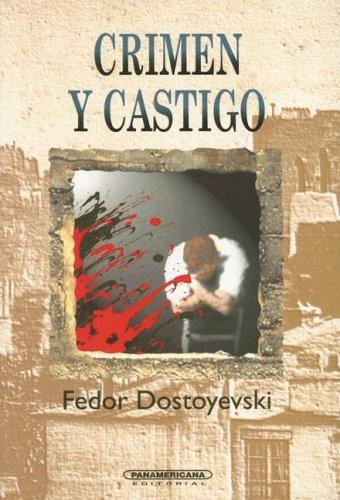
Crimen y Castigo fue publicada por Fiódor Dostoyevski en 1866 a través del diario El mensajero ruso, en doce partes que luego conformarían la novela, universalmente reconocida como una de las más influyentes de la literatura rusa. La novela tiene un corte psicológico que lleva al lector a explorar de forma constante los pensamientos del protagonista, el estudiante Raskolnikov, quién a través de sus diálogos con los demás personajes, analiza cada uno de los actos que lo llevarán luego a cumplir una condena en Siberia; crímenes que no son buenos ni malos hasta que se los mira desde la óptica de la sociedad y de los diferentes individuos involucrados. Motivado por el deseo de hacer el bien a su hermana Dunia sus acciones terminan siendo, sin embargo, sangrientas, y solo una muchacha humilde que se convierte en su confidente podrá comprender del todo sus razones.
Foi muito bom!!! Teve momentos que foram meio mornos, mas normal quando é um livro tão grande. Fiquei pensativo lendo. Os últimos capítulos foram ótimos, e a tensão no começo do livro também. As reviravoltas foram todas muito divertidas. Recomendo, um Strong 9
Review of 'Dostoevsky Crime & Punishment' on 'Goodreads'
4 stars
Growing up in former Yugoslavia, I was exposed to Russian literature from the very early age. There's still some of the old awe remaining in me when I read the old Russian masters, like Dostoevsky. I don't think I'm qualified or brazen enough to review the "Crime and Punishment," but I can offer some impressions the book made on me.
Let me begin by mentioning the language. My first language is Serbo-Croatian: a language which is nowadays split at the hyphen into two separate languages. I never realized that hyphen stood for the ethnic line between the two groups of people, though I was forced to learn it when the line broke in the bloody conflict of the Balkans, and the language split, just as the country did, into two separate entities. But, I digress. The point is that both, Croatian and Serbian language, are of the Slavic origin, as …
Growing up in former Yugoslavia, I was exposed to Russian literature from the very early age. There's still some of the old awe remaining in me when I read the old Russian masters, like Dostoevsky. I don't think I'm qualified or brazen enough to review the "Crime and Punishment," but I can offer some impressions the book made on me.
Let me begin by mentioning the language. My first language is Serbo-Croatian: a language which is nowadays split at the hyphen into two separate languages. I never realized that hyphen stood for the ethnic line between the two groups of people, though I was forced to learn it when the line broke in the bloody conflict of the Balkans, and the language split, just as the country did, into two separate entities. But, I digress. The point is that both, Croatian and Serbian language, are of the Slavic origin, as is Russian. Therefore, the translations from Russian into Croatian are seamless and the flow is natural, unlike the awkward and rigid form English translation gave to the "Crime and Punishment." I recently read another Russian classic translated in English, Tolstoy's "Ana Karenina", which had the same inflexible awkwardness.
Once you get over the language, you're teleported into Russian Empire at it's eleventh hour, with it's social and ideological problems, you catch a glimpse of the seed of ideas which will evolve--or devolve--into Communism; you feel the heat of rainless St. Petersburg, the stench of poverty, the corruption of the higher middle class. You feel for the criminal, and although you can't justify his crime, you feel and cheer for him. And, at the end, you are rewarded with the gift of hope.